Teaching design for mobile social play

Last week, the group project I am coaching at the Utrecht School of the Arts kicked off. The project is part of the school’s master of arts program. The group consists of ten students with very different backgrounds, ranging from game design & development to audio design, as well as arts management, media studies, and more. Their assignment is to come up with a number of concepts for games that incorporate mobile phones, social interactions, audio and the web. Nokia Research Center has commissioned the project, and Jussi Holopainen, game design researcher and co-author of Patterns in Game Design, is the client. In the project brief there is a strong emphasis on sketching and prototyping, and disciplined documentation of the design process. The students are working full time on the project and it will run for around 4 months.

I am very happy with the opportunity to coach this group. It’s a new challenge for me as a teacher – moving away from teaching theory and into the area of facilitation. I am also looking forward to seeing what the students will come up with, of course, as the domain they are working in overlaps hugely with my interests. So far, working with Jussi has proven to be very inspirational, so I am getting something out of it as a designer too.

Reboot 10 slides and video

I am breaking radio-silence for a bit to let you know the slides and video for my Reboot 10 presentation are now available online, in case you’re interested. I presented this talk before at The Web and Beyond, but this time I had a lot more time, and I presented in English. I therefore think this might still be of interest to some people.1 As always, I am very interested in receiving constructive criticism Just drop me a line in the comments.

Update: It occurred to me that it might be a good idea to briefly summarize what this is about. This is a presentation in two parts. In the first, I theorize about the emergence of games that have as their goal the conveying of an argument. These games would use the real-time city as their platform. It is these games that I call urban procedural rhetorics. In the second part I give a few examples of what such games might look like, using a series of sketches.

The slides, posted to SlideShare, as usual:

The video, hosted on the Reboot website:

  1. I did post a transcript in English before, in case you prefer reading to listening. []

Playing with emergence is like gardening

It’s been a while since I finished reading Steven Berlin Johnson’s Emergence. I picked up the book because ever since I started thinking about what IxDs can learn from game design, the concept of emergence kept popping up.

Johnson’s book is a pleasant read, an easy-going introduction to the subject. I started and finished it over the course of a weekend. There were a few passages I marked as I went a long, and I’d like to quote them here and comment on them. In order, they are about:

  1. Principles that are required for emergence to happen
  2. How learning can be unconscious
  3. Unique skills of game players
  4. Gardening as a metaphor for using (and making) emergent systems

A cheat sheet

Let’s start with the principles.1

“If you’re building a system designed to learn from the ground level, a system where macrointelligence and adaptability derive from local knowledge, there are five fundamental principles you need to follow.”

These principles together form a useful crib sheet for designers working on social software, MMOGs, etc. I’ll summarise each of Johnson’s principles here.

“More is different.”

You need to have a sizeable amount of low-level elements interacting to get patterns emerging. Also, there is a difference between the behaviour you will observe on the microlevel, and on the macrolevel. You need to be aware of both.

“Ignorance is useful.”

The simple elements don’t have to be aware of the higher-level order. In fact, it’s best if they aren’t. Otherwise nasty feedback-loops might come into being.

“Encourage random encounters.”

You need chance happenings for the system to be able to learn and adapt.2

“Look for patterns in the signs.”

Simply put, the basic elements can have a simple vocabulary, but should be able to recognise patterns. So although you might be working with only one signal, things such as frequency and intensity should be used to make a range of meanings.

“Pay attention to your neighbours.”

There must be as much interaction between the components as possible. They should be made constantly aware of each other.

Now with these principles in mind look at systems that successfully leverage collective intelligence. Look at Flickr for instance. They are all present.

Chicken pox

I liked the following passage because it seems to offer a nice metaphor for what I think is the unique kind of learning that happens while playing. In a way, games and toys are like chicken pox.3

“[…] learning is not always contingent on consciousness. […] Most of us have developed immunity to the varicella-zoster virus—also known as chicken pox—based on our exposure to it early in childhood. The immunity is a learning process: the antibodies of our immune system learn to neutralize the antigens of the virus, and they remember those neutralization strategies for the rest of our lives. […] Those antibodies function as a “recognition system,” in Gerald Edelman’s phrase, successfully attacking the virus and storing the information about it, then recalling that information the next time the virus comes across the radar. […] the recognition unfolds purely on a cellular level: we are not aware of the varicella-zoster virus in any sense of the word, […] The body learns without consciousness, and so do cities, because learning is not just about being aware of information; it’s also about storing information and knowing where to find it. […] It’s about altering a system’s behaviour in response to those patterns in ways that make the system more successful at whatever goal it’s pursuing. The system need not be conscious to be capable of that kind of learning.

Emphasis on the last sentence mine, by the way.

Patience

Johnson writes about his impression of children playing video games:4

“[…] they are more tolerant of being out of control, more tolerant of that exploratory phase where the rules don’t all make sense, and where few goals have been clearly defined.”

This attitude is very valuable in today’s increasingly complex world. It should be fostered and leveraged in areas besides gaming too, IMHO. This point was at the core of my Playing With Complexity talk.

Gardening

“Interacting with emergent software is already more like growing a garden than driving a car or reading a book.”5

Yet, we still tend to approach the design of systems like this from a tradition of making tools (cars) or media (books). I not only believe that the use of systems like this is like gardening, but also their creation. Perhaps they lie in each other’s extension, are part of one never-ending cycle? In any case, when designing complex systems, you need to work with it “live”. Plant some seeds, observe, prune, weed, plant some more, etc.

I am going to keep a garden (on my balcony). I’m pretty sure that will teach me more about interaction design than building cars or writing books.

  1. The following quotes are taken from pages 77-79. []
  2. This reminds me of Nassim Nicholas Taleb’s The Black Swan, wherein he writes about maximising your chance of having serendipitous encounters. []
  3. Taken from pages 103-104. []
  4. Page 177. []
  5. Page 207. []

Playing With Complexity — slides and notes for my NLGD Festival of Games talk

When the NLGD Foundation invited me to speak at their anual Festival of Games I asked them what they would like me to discuss. “Anything you like,” was what they said, essentially. I decided to submit an abstract dealing with data visualization. I had been paying more and more attention to this field, but was unsuccessful in relating it the other themes running through my work, most notably play. So I thought I’d force myself to tackle this issue by promising to speak about it. Often a good strategy, I’ve found. If it worked out this time I leave for you to judge.

In brief, in the presentation I argue two things: one — that the more sophisticated applications of interactive data visualization resemble games and toys in many ways, and two — that game design can contribute to the solutions to several design issues I have detected in the field of data visualization.

Below are the notes for the talk, slightly edited, and with references included. The full deck of slides, which includes credits for all the images used, is up on SlideShare.

Hello everyone, my name is Kars Alfrink. I am a Dutch interaction designer and I work freelance. At the moment I work in Copenhagen, but pretty soon I will be back here in Utrecht, my lovely hometown.

In my work I focus on three areas: mobility, social interactions, and play. Here is an example of my work: These are storyboards that explore possible applications of multitouch technology in a gated community. Using these technologies I tried to compensate for the negative effects a gated community has on the build-up of social capital. I also tried to balance ‘being-in-the-screen’ with ‘being-in-the-world’ — multitouch technologies tend to be very attention-absorbing, but in built environments this is often not desirable.1

I am not going to talk about multitouch though. Today’s topic is data visualization and what opportunities there are for game designers in that field. My talk is roughly divided in three parts. First, I will briefly describe what I think data visualization is. Next, I will look at some applications beyond the very obvious. Third and last, I will discuss some design issues involved with data visualization. For each of these issues, I will show how game design can contribute.

Right, let’s get started.

Continue reading Playing With Complexity — slides and notes for my NLGD Festival of Games talk

  1. For more background on this project please see this older blog post. More examples of my recent work can be found in my portfolio. []

Slides and summary for ‘More Than Useful’

Update: The video and slides are now available on the conference site.

The conference From Business to Buttons 2008 aimed to bring together the worlds of business and interaction design. I was there to share my thoughts on the applicability of game design concepts to interaction design. You’ll find my slides and a summary of my argument below.

I really enjoyed attending this conference. I met a bunch of new and interesting people and got to hang out with some ‘old’ friends. Many thanks to InUse for inviting me.

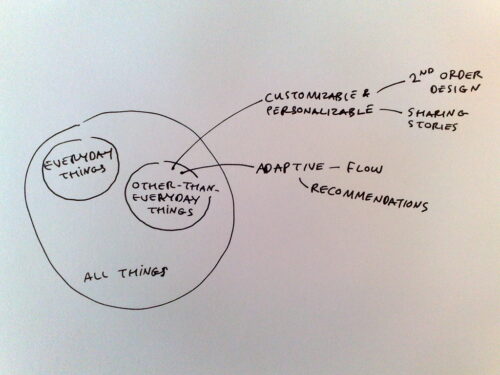
Diagram summarizing my FBTB 2008 talk

The topic is pretty broad so I decided to narrow things down to a class of product that is other-than-everyday — meaning both wide and deep in scope. Using Norman’s The Design of Everyday Things as a starting point, I wanted to show that these products require a high level of explorability that is remarkably similar to play. After briefly examining the phenomenon of play itself I moved on to show applications of this understanding to two types of product: customizable & personalizable ones, and adaptive ones.

For the former, I discussed how game design frameworks such as MDA can help with sculpting the parameter space, using ‘experience’ as the starting point. I also looked at how games support players in sharing stories and speculated about ways this can be translated to both digital and physical products.

For the latter — adaptive products — I focussed on the ways in which they induce flow and how they can recommend stuff to people. With adaptation, designers need to formulate rules. This can be done using techniques from game design, such as Daniel Cook’s skill chains. Successful rules-based design can only happen in an iterative environment using lots of sketching.

The presentation was framed by a slightly philosophical look at how certain games subliminally activate cognitive processes and could thus be used to allow for new insights. I used Breakout and Portal as examples of this. I am convinced there is an emerging field of playful products that interaction designers should get involved with.

Sources referenced in this presentation:1

As usual, many thanks to all the Flickr photographers who’ve shared their images under a CC license. I’ve linked to the originals from the slides. Any image not linked to is probably mine.

  1. Most of these are offline books or papers, those that aren’t have been hyperlinked to their source. []

Urban procedural rhetorics — transcript of my TWAB 2008 talk

This is a transcript of my presentation at The Web and Beyond 2008: Mobility in Amsterdam on 22 May. Since the majority of paying attendees were local I presented in Dutch. However, English appears to be the lingua franca of the internet, so here I offer a translation. I have uploaded the slides to SlideShare and hope to be able to share a video recording of the whole thing soon.

Update: I have uploaded a video of the presentation to Vimeo. Many thanks to Almar van der Krogt for recording this.

In 1966 a number of members of Provo took to the streets of Amsterdam carrying blank banners. Provo was a nonviolent anarchist movement. They primarily occupied themselves with provoking the authorities in a “ludic” manner. Nothing was written on their banners because the mayor of Amsterdam had banned the slogans “freedom of speech”, “democracy” and “right to demonstrate”. Regardless, the members were arrested by police, showing that the authorities did not respect their right to demonstrate.1

Good afternoon everyone, my name is Kars Alfrink, I’m a freelance interaction designer. Today I’d like to talk about play in public space. I believe that with the arrival of ubiquitous computing in the city new forms of play will be made possible. The technologies we shape will be used for play wether we want to or not. As William Gibson writes in Burning Chrome:

“…the street finds its own uses for things”

For example: Skateboarding as we now know it — with its emphasis on aerial acrobatics — started in empty pools like this one. That was done without permission, of course…

Only later half-pipes, ramps, verts (which by the way is derived from ‘vertical’) and skateparks arrived — areas where skateboarding is tolerated. Skateboarding would not be what it is today without those first few empty pools.2

Continue reading Urban procedural rhetorics — transcript of my TWAB 2008 talk

  1. The website of Gramschap contains a chronology of the Provo movement in Dutch. []
  2. For a vivid account of the emergence of the vertical style of skateboarding see the documentary film Dogtown and Z-Boys. []

Sketching the experience of toys

A frame from the Sketch-A-Move video

“Play is the highest form of research.”

—Albert Einstein1

That’s what I always say when I’m playing games, too.

I really liked Bill Buxton‘s book Sketching User Experiences. I like it because Buxton defends design as a legitimate profession separate from other disciplines—such as engineering—while at the same time showing that designers (no matter how brilliant) can only succeed in the right ecosystem. I also like the fact that he identifies sketching (in its many forms) as a defining activity of the design profession. The many examples he shows are very inspiring.

One in particular stood out for me, which is the project Sketch-A-Move by Anab Jain and Louise Klinker done in 2004 at the RCA in London. The image above is taken from the video they created to illustrate their concept. It’s about cars auto-magically driving along trajectories that you draw on their roof. You can watch the video over at the book’s companion website. It’s a very good example of visualizing an interactive product in a very compelling way without actually building it. This was all faked, if you want to find out how, buy the book.2

The great thing about the video is not only does it illustrate how the concept works, it also gives you a sense of what the experience of using it would be like. As Buxton writes:3

“You see, toys are not about toys. Toys are about play and the experience of fun that they help foster. And that is what this video really shows. That, and the power of video to go beyond simply documenting a concept to communicating something about experience in a very visceral way.”

Not only does it communicate the fun you would have playing with it, I think this way of sketching actually helped the designers get a sense themselves of wether what they had come up with was fun. You can tell they are actually playing, being surprised by unexpected outcomes, etc.

The role of play in design is discussed by Buxton as well, although he admits he needed to be prompted by a friend of his: Alex Manu, a teacher at OCAD in Toronto writes in an email to Buxton:4

“Without play imagination dies.”

“Challenges to imagination are the keys to creativity. The skill of retrieving imagination resides in the mastery of play. The ecology of play is the ecology of the possible. Possibility incubates creativity.”

Which Buxton rephrases in one of his own personal mantras:5

“These things are far too important to take seriously.”

All of which has made me realize that if I’m not having some sort of fun while designing, I’m doing something wrong. It might be worth considering switching from one sketching technique to another. It might help me get a different perspective on the problem, and yield new possible solutions. Buxton’s book is a treasure trove of sketching techniques. There is no excuse for being bored while designing anymore.

  1. Sketching User Experiences p.349 []
  2. No, I’m not getting a commission to say that. []
  3. Ibid. 1, at 325 []
  4. Ibid., at 263 []
  5. Ibid. []

Zona Incerta and using ARGs for activism

(Following some recent overly long posts, here’s an attempt to stay under 500 words.)

For a while now, I have been lurking on the mailing list of the Alternate Reality Games IGDA SIG. ARGs are games that use the real world as their platform. They usually revolve around a mystery to be unraveled. I find ARGs interesting for the way they clash with the game design notion of the magic circle. The magic circle can be defined as the time and space within which a game is played. With traditional games, players are aware of the magic circle and enter it willingly. Not so with ARGs, as the following example I found on the list shows:1

The producers of Zona Incerta, a Brazilian ARG, published a video on YouTube. In it the ‘senior marketing director’ of Arkhos Biotechnology asks viewers to help them buy the Amazon rainforest and reminds them “the Amazon belongs to no country, it belongs to the world”:

The video was mistaken by many as real–including two senators and one governor. On the list, André Sirangelo, the game’s writer, says:

“It wasn’t long until some journalists connected the dots and found out the company didn’t exist. That’s when it really exploded – after all, there are lots of companies that actually do want to buy the rainforest, but it’s not every day a powerful senator makes a speech about one that doesn’t really exist.”

Because the game was sponsored, they had to come out and offer a public apology. Some people took it in a good way, others were less amused:

“They wanted to sue and maybe even arrest us for making a video that was against the nation’s sovereignty and all that. It was all BS though, because there wasn’t really a crime. We never published fake news, we just put the video on YouTube and some people tought it was real. Not our fault! :)”

Clearly, the ambiguous nature of ARGs is key to what makes them fun. Knowing that people might mistake things for real is thrilling to ARG developers. Players are challenged to recognize the content that is part of an ARG—rewarding them with the feeling that they are part of a secret society.

So far, the genre remains a niche.2 But what if ARGs take off in a big way? What if the mediascape is flooded by ARG content?

Will we, similar to what is now being proposed for ubicomp, need recognizable iconography that tells people: “warning, alternate reality content”?

Proposed icon for objects that have invisible qualities by the Touch research project

I wonder what would make a good image. Perhaps the March Hare?

Illustration of the March Hare by John Tenniel

Zona Incerta‘s aim was to entertain. Despite this, they raised awareness for the Amazon’s plight. Would the format of ARGs be useful to people with another agenda? What if activists start using them to make the future they want to avert—or desire to bring about—tangible to the public?

Image credits: Icon by Touch research project, March Hare by John Tenniel taken from WikiFur.

Updated with a YouTube embed that validates.

  1. For more about ARGs and the magic circle also see my Reboot 9.0 presentation Mobile Social Play. []
  2. Here are statistics of some prominent past ARGs. []

Where social software should go next — Habitat’s lessons

MMOGs have not progressed since 1990. Neither has social software.

Well maybe a little, but not much. At least that’s what I’m lead to believe after reading another wonderful essay in The Game Design Reader—a book I like to dip into once in a while to read whatever catches my fancy.

In The Lessons of Lucasfilm’s Habitat1 Messrs Farmer and Morningstar share their experiences building possibly one of the first graphical MMOGs ever. The game’s front-end ran on a Commodore 64 and looked something like this:

Screenshot of Lucasfilm's Habitat

It’s striking how many of the lessons summed up by the authors have not been (fully) taken to heart by MMOG designers. Bitching aside, their article offers as much useful advice to game designers as to designers of any piece of social software. Since this post has grown unexpectedly long (again). I’ll sum them up here:

  • “The implementation platform is relatively unimportant.” — on loosely coupling a world’s conceptual model and its representation
  • “Detailed central planning is impossible; don’t even try.” — on relinquishing control as designers, co-design and evolutionary systems
  • “Work within the system.” — on facilitating world creation by players and moderation from within the world

Let’s look at each in more detail:

Loosely coupled

“The implementation platform is relatively unimportant.”

Meaning that how you describe the world and how you present it can or should be loosely coupled. The advantage of this is that with one world model you can serve clients with a wide range of (graphical) capabilities and scale into the future without having to change model. Their example is of a tree, which can be rendered to one user as a string of text: “There is a tree here.” And to another user as a rich high resolution 3D animated image accompanied by sound.

“And these two users might be looking at the same tree in the same place in the same world and talking to each other as they do so.”

When I read this I instantly thought of Raph Koster‘s Metaplace and wondered if the essay I was reading served as some sort of design guideline for it. What I understood from Raph’s GDC 2008 presentation2 was that they are trying to achieve exactly this, by applying the architectural model of the internet to the design of MMOGs.

Looking at social software in general, how many examples can you give of the current wave of social web apps that apply this principle? I’m reminded of Tom Coates’s Native to a Web of Data presentation—in which he argues that a service’s data should ideally be accessible through any number of channels.3

Similarly, web 2.0 poster child Dopplr is designed to be “a beautiful part of the web”, “a feature of a larger service, called the internet”.4 And they want to be everywhere, adding a little bit of value where it is most needed. Perhaps not exactly the same thing as what Farmer and Morningstar are alluding to, but based on similar principles.

As an aside, in MMOG land, there is one other major concern with this:

“Making the system fully distributed […] requires solving a number of difficult problems. The most significant of these is the prevention of cheating.”

Cheating might be of less concern to social software than to games (although there are exceptions, take Digg for example). For those interested in more about this, Raph Koster recently posted an elaborate examination of hacking and cheating in MMOGs.

Control, co-design, evolution

Cheating aside, there is more useful (albeit familiar) advice for social software designers in the piece. For instance on the need to hand over (part of) the control over the system’s design to its users:

“Again and again we found that activities based on often unconscious assumptions about player behaviour had completely unexpected outcomes (when they were not simply outright failures). “

They go on to say that they found it was more productive to work with the community:

“We could influence things, we could set up interesting situations, we could provide opportunities for things to happen, but we could not dictate the outcome. Social engineering is, at best, an inexact science […] we shifted into a style of operations in which we let the players themselves drive the direction of the design.”

Again, familiar advice perhaps, but they describe in some detail how they actually went about this, which makes for enlightening reading. That this practice of co-design goes against ‘common’ software development practices is not left unaddressed either:

“[…] the challenge posed by large systems are prompting some researchers to question the centralized, planning dominated attitude that we have criticized here, and to propose alternative approaches based on evolutionary and market principles. These principles appear applicable to complex systems of all types […]”

(Emphasis mine.) I am intrigued by this evolutionary model of web development. In the abstract for Movement, Matt Webb writes:

“the Web in 2008 has some entirely new qualities: more than ever it’s an ecology of separate but highly interconnected services. Its fiercely competitive, rapid development means differentiating innovations are quickly copied and spread. Attention from users is scarce. The fittest websites survive.

(Again, emphasis mine.) I think the challenge that now lies before us is to not only as designers practice co-design with our users, but to go one step further, and encode rules for autonomous evolution into our systems. These are the adaptive systems I’ve been blogging about recently. An important note is that systems can adapt to individual users, but also—in the case of social software—to aggregate behaviour of user groups.5

This can be extended to a world’s governance. Here is one of the ideas I find most exciting in the context of social software, one I have seen very few examples of so far.

“[…] our view is that a virtual world need not be set up with a “default” government, but can instead evolve as needed.”

I cannot think of one MMOG that is designed to allow for a model of governance to emerge from player interactions. The best example I can think of from the world of social software is this article by Tom Coates at the Barbelith wiki. Barbelith is a somewhat ‘old school’ online community comprised of message boards (remember those?). In the piece (titled TriPolitica) he writes:

“Imagine a message board with three clear identities, colour-schemes and names. Each has a generic set of basic initial forums on a clearly defined range of subjects (say – Politics / Science / Entertainment). Each forum starts with a certain structure – one Monarchic, one Parliamentary Democracy and one Distributed Anarchy. All the rules that it takes to run each community have been sufficiently abstracted so that they can be turned on or off at will BY the community concerned. Moreover, the rules are self-reflexive – ie. the community can also create structures to govern how those rules are changed. This would operate by a bill-like structure where an individual can propose a new rule or a change to an existing rule that then may or may not require one or more forms of ratification. There would be the ability to create a rule governing who could propose a new bill, how often and what areas it might be able to change or influence.”

He goes on to give examples of how this would work—what user types you’d need and what actions would need to be available to those users. I’m pretty sure this was never implemented at Barbelith (which, by the way, is a fun community to browse through if you’re into counter cultural geekery). Actually, I’m pretty sure I know of no online space that has a system like this in place. Any interaction designers out there who are willing to take up the gauntlet?

Creativity, moderation

“Work within the system.”

This is the final lesson offered in the essay I’d like to look at, one that is multifaceted. On the one hand, Messrs Farmer and Morningstar propose that world building should be part of the system itself (and therefore accessible to regular players):

“One of the goals of a next generation Habitat-like system ought to be to permit far greater creative involvement by the participants without requiring them to ascend to full-fledged guru-hood to do so.”

And, further on:

“This requires finding ways to represent design and creation of regions and objects as part of the underlying fantasy.”

I do not think a MMOG has achieved this in any meaningful sense so far. Second Life may offer world creation tools to users, but they are far from accessible, and certainly not part of the “underlying fantasy”. In web based social software, suspension of disbelief is of less concern. It can be argued that Flickr for instance successfully offers world creation at an accessible level. Each Flickr user contributes to the photographic tapestry that is the Flickr ‘photoverse’. Wikipedia, too offers relatively simple tools for contribution, albeit text based. In the gaming sphere, there are examples such as SFZero, a Collaborative Production Game, in which players add tasks for others to complete, essentially collaboratively creating the game with the designers.

Like I said, the lesson “work within the system” applies to more than one aspect. The other being moderation. The authors share an amusing anecdote about players exploiting a loop hole introduced by new characters and objects (the players gained access to an unusually powerful weapon). The anecdote shows that it is always better to moderate disputes within the shared fantasy of the world, in stead of making use of external measures that break the player’s suspension of disbelief. Players will consider the latter cheating on the part of administrators:

“Operating within the participants’ world model produced a very satisfactory result. On the other hand, what seemed like the expedient course, which involved violating this model, provoked upset and dismay.”

Designers should play with users, not against them. This applies to social software on the web equally. It is this attitude that sets Flickr apart from many other online communities. Flickr‘s designers understand the principle of “operating within the participants’ world model”. For example, look at how they handled confusion and irritation around the last Talk Like A Pirate Day gag.6

Summary

In summary, dear reader, if you got this far, I would love to see examples of social software that:

  • Are accessible in a number of ‘representations’
  • Are co-designed with users, or better yet, apply evolutionary principles to its design
  • Allow users to develop their own model of governance
  • Allow users to easily add to the system, in an integrated way
  • Are moderated from within the system

If you—like me—can’t think of any, perhaps it’s time to build some?

Image credits: © 1986 LucasArts Entertainment Company.

  1. The essay can be read online over here. []
  2. More about my GDC 2008 experiences. []
  3. This principle is now being applied to the extreme in Yahoo!’s Fire Eagle. []
  4. The former quote I first encountered in Matt Jones’s presentation RuleSpace, the latter is from this BBC article on Reboot 9.0. []
  5. For more on aggregating user behaviour in social software also see Greater than the sum of its parts by Tom Coates (yes him again). []
  6. Tom Armitage has some good thoughts on the Talk Like A Pirate Day debacle. []

Tools for having fun

ZoneTag Photo Friday 11:40 am 4/18/08 Copenhagen, Hovedstaden

One of the nicer things about GDC was the huge stack of free magazines I took home with me. Among those was an issue of Edge, the glossy games magazine designed to look good on a coffee table next to the likes of Vogue (or whatever). I was briefly subscribed to Edge, but ended up not renewing because I could read reviews online and the articles weren’t all that good.

The january 2008 issue I brought home did have some nice bits in it—in particular an interview with Yoshinori Ono, the producer of Street Fighter IV. This latest incarnation of the game aims to go back to what made Street Fighter II great. What I liked about the interview was Ono’s clear dedication to players, not force feeding them what the designers think would be cool. Something often lacking in game design.

“”First of all, the most important thing about SFIV is ‘fair rules’, and by that I mean fair and clear rules that can be understood by everyone very easily.” A lesson learned from the birth of modern videogaming: ‘Avoid missing ball for high score’.”

This of course is a reference to PONG. Allan Alcorn (the designer of the arcade coin operated version of PONG) famously refused to include instructions with the game because he believed if a game needed written instructions, it was crap.

Later on in the same article, Ono says:

“[…] what the game is — a tool for having fun. A tool to give the players a virtual fighting stage — an imaginary arena, if you like.”

(Emphasis mine.) I like the fact that he sees the game as something to be used, as opposed to something to be consumed. Admittedly, it is easier to think of a fighting game this way than for instance an adventure game—which has much more embedded narrative—but in any case I think it is a more productive view.

While we’re on the topic of magazines. A while back I read an enjoyable little piece in my favorite free magazine Vice about the alleged clash between ‘hardcore’ and ‘casual’ gamers:

“Casual games are taking off like never before, with half of today’s games being little fun quizzes or about playing tennis or golf by waving your arms around. The Hardcore crowd are shitting themselves that there might not be a Halo 4 if girls and old people carry on buying simple games where everyone’s a winner and all you have to do is wave a magic wand around and press a button every few times.”

Only half serious, to be sure, but could it be at least partly true? I wouldn’t mind it to be so. I appreciate the rise of the casual game mainly for the way it brings focus back to player centred game design. Similar to Yoshinori Ono’s attitude in redesigning Street Fighter.