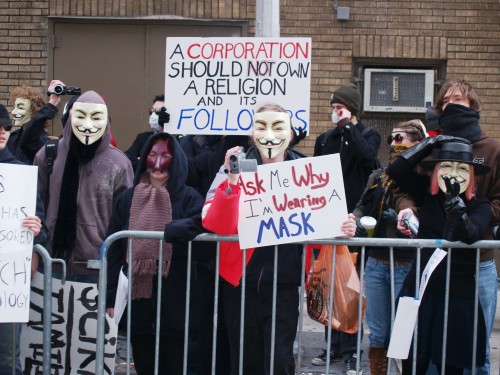
"Anonymous Scientology 1 by David Shankbone" by David Shankbone - David Shankbone. Licensed under CC BY-SA 3.0 via Wikimedia Commons - https://commons.wikimedia.org/wiki/File:Anonymous_Scientology_1_by_David_Shankbone.JPG#mediaviewer/File:Anonymous_Scientology_1_by_David_Shankbone.JPG

Political play is a mode of thinking critically about politics, and of developing an agonistic approach to those politics. This agonism is framed through carnivalesque chaos and humour, through the appropriation of the world for playing. By playing, by carefully negotiating the purpose of playing between pleasure and the political, we engage in a transformative act.

Quote taken from PARTICIPATORY REPUBLICS: PLAY AND THE POLITICAL by Miguel Sicart on the Play Matters book blog.

I love where Miguel is going with his thinking on the relationship between play, politics, appropriation and resistance.

I am interested in this because at Hubbub we have been exploring similar themes through the making of games and things-you-can-play-with.

The big challenges with this remain in the area of instrumentalisation – if you set out to design a thing that encourages this kind of play you often end up with something that is far from playful.

But the opportunities are huge because so much of today’s struggles of individuals against the state relate to legibility and control in some way, and play is the perfect antidote.

For example shortly after reading Miguel’s piece I came across this McKenzie Wark piece on extrastatecraft via Honor Harger. Extrastatecraft shifts the focus from architecture and politics to infrastructure.

Infrastructure is how power deploys itself, and it does so much faster than law or democracy.

You should read the whole thing. What’s fascinating is that Wark briefly discusses strategies and tactics for resisting such statecraft.

So the world might be run not by statecraft but at least in part by extrastatecraft. Easterling: “Avoiding binary dispositions, this field of activity calls for experiments with ongoing forms of leverage, reciprocity, and vigilance to counter the violence immanent in the space of extrastatecraft.” (149) She has some interesting observations on the tactics for this. Some exploit the informational character of third nature, such as gossip, rumor and hoax. She also discusses the possibilities of the gift or of exaggerated compliance (related perhaps to Zizek’s over-identification), and of mimicry and comedy.

“Gossip, rumor and hoax” sound a lot like the carnivalesque reflective-in-action political play Miguel is talking about.

To finish off, here’s a video of the great James C. Scott on the art of not being governed. He talks at length about how peoples have historically fled from statecraft into geographical zones unreachable by power’s infrastructure. And how they deploy their own, state-resistant infrastructure (such as particular kinds of crops) to remain illegible and uncapturable.
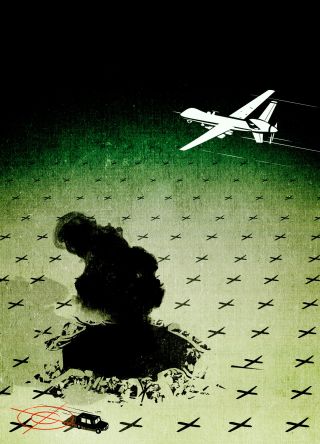

“I think the greatest problem is the mentality that accompanies drone strikes,” Philip Alston, an N.Y.U. law professor who investigated drone attacks for the U.N. between 2004 and 2010, told me. “The identification of a list of targets, and if we can succeed in eliminating that list we will have achieved good things—that mentality is what drives it all: if only we can get enough of these bastards, we’ll win the war.” (via Obama’s Drone War)

A great and disturbing piece on the CIA’s drone war in Pakistan. Timely, also, because Hubbub is making a game about drone warfare at the moment, called Bycatch. The quote above describes the mentality we are exploring in the game quite well.

I think hard times are coming when we will be wanting the voices of writers who can see alternatives to how we live now and can see through our fear-stricken society and its obsessive technologies to other ways of being, and even imagine some real grounds for hope. We will need writers who can remember freedom. Poets, visionaries—the realists of a larger reality.

I haven’t read much of Le Guin’s work, but what I have impressed me by its great humanism. “Realists of a larger reality” is a great way to describe what attracts me in speculative fiction.

(via “We will need writers who can remember freedom”: Ursula K Le Guin at the National Book Awards – parker higgins dot net)

If you provide novice problem-solvers with a problem, they’ll attempt to solve it using superficial strategies, comparing it to routine problems that they already understand. This much I have covered already. But if you provide novice problem-solvers with — instead of a problem — a set of constraints, and then ask them to form and solve their own complex problems, something amazing happens — they solve these problems with expert-level strategies.

It’s the difference between teaching someone to fish, and having them invent things to do around a pond with a hook line and stick.

The strategy Gage described here for helping players learn games is as genius as it seems obvious in hind sight.

The big thing for me is that if you want to add this to your game it needs to be sufficiently complex to begin with for sandbox to be interesting. Which is a great litmus test for if your game is good in the first place.

(via Designing For Problem Solvers – Zach Gage, Nov 2014)

Asked if it was a playful moment of invention, Rubin responds sternly, almost Cosellianly, “It wasn’t playful. I hate play. It was just a process. You have scores and scores of those moments when you try these things out. I remember in ’96, the first time I tasted it, I thought”—his voice goes high and giddy—“Yeeaahh! And the next day we made a bunch more, and I remember everybody saying, ‘Wow, that’s really good.’ And I said ‘O.K., fine, try it out.’ ”

How is that not play?

(via Panic in the Pastry Shop)