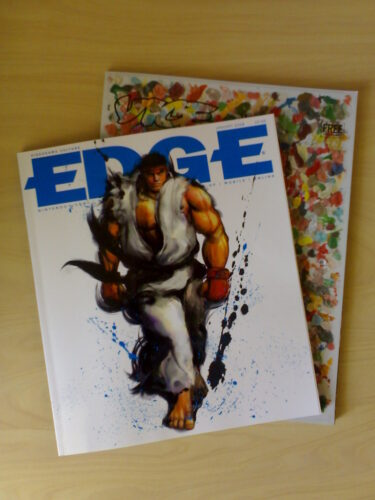
In a recent post on the Edge blog – which, if you consider yourself a games designer, you absolutely must read – Matt Jones asks:
“Why should pocket calculators be put on a pedestal, and not Peggle?”
He writes about the need for games to be appreciated and critiqued as design objects. He points out that the creation of any successful game is “at least as complex and coordinated as that of a Jonathan Ive laptop”. He also speculates that reasons for games to be ignored is that they might be seen primarily as media, and that mainstream design critics lack literacy in games, which makes them blind to their design qualities.
Reading this, I recalled a discussion I had with Dave Malouf on Twitter a while back. It was sparked by a tweet from Matt, which reads:
“it’s the 3rd year in a row they’ve ignored my submission of a game… hmmph (L4D, fwiw) – should games be seen as design objects? or media?”
I promptly replied:
“@moleitau design objects, for sure. I’m with mr Lantz on the games aren’t media thing.”
For an idea of what I mean by “being with Mr. Lantz”, you could do worse that to read this interview with him at the Tale of Tales blog.
At this point, Dave Malouf joined the fray, posting:
“@kaeru can a game be used to convey a message? We know the answer is yes, so doesn’t that make it a form of media? @moleitau”
I could not resist answering that one, so I posted a series of four tweets:
“@daveixd let me clarify: 1. some games are bits of content that I consume, but not all are
“@daveixd 2. ultimately it is the player who creates meaning, game designers create contexts within which meaning emerges.
“@daveixd 3. thinking of games as media creates a blind spot for all forms of pre-videogames era play”
“@daveixd that’s about it really, 3 reasons why I think of games more as tools than media. Some more thoughts: http://is.gd/5m5xa @moleitau”
“@kaeru re: #2 all meaning regardless of medium or media are derived at the human level.”
“@kaeru maybe this is semantics, but any channel that has an element of communicating a message, IMHO is media. Tag & tic-tac-toe also.”
“@kaeru wait, are you equating games to play to fun? But I’m limiting myself to games. I.e. role playing is play, but not always a game.”
At this point, I got frustrated by Twitter’s lack of support for a discussion of this kind. So I wrote:
“@daveixd Twitter is not the best place for this kind of discussion. I’ll try to get back to your points via my blog as soon as I can.”
And here we are. I’ll wrap up by addressing each of Dave’s points.
- Although I guess Dave’s right about all meaning being derived at the human level, what I think makes games different from, say, a book or a film is that the thing itself is a context within which this meaning making takes place. It is, in a sense, a tool for making meaning.
- Games can carry a message, and sometimes are consciously employed to do so. One interesting thing about this is on what level the message is carried – is it told through bits of linear media embedded in the game, or does it emerge from a player’s interaction with the game’s rules? However, I don’t think all games are made to convey a message, nor are they all played to receive one. Tic-Tac-Toe may be a very rough simulation of territorial warfare, and you could argue that it tells us something about the futility of such pursuits, but I don’t think it was created for this reason, nor is it commonly played to explore these themes.
- I wasn’t equating games to play (those two concepts have a tricky relationship, one can contain the other, and vice-versa) but I do feel that thinking of games as media is a product of the recent video game era. By thinking of games as media, we risk forgetting about what came before video games, and what we can learn from these toys and games, which are sometimes nothing more than a set of socially negotiated rules and improvised attributes (Kick the can, anyone?)
I think I’ll leave it at that.