Designing Learning Experiences in a Post-ChatGPT World

Transcript of a talk delivered at LXDCON’25 on June 12, 2025.
My name is Kars. I am a postdoc at TU Delft. I research contestable AI—how to use design to ensure AI systems remain subject to societal control. I teach the responsible design of AI systems. In a previous life, I was a practicing designer of digital products and services. I will talk about designing learning experiences in a post-ChatGPT world.

Let’s start at this date.

This is when OpenAI released an early demo of ChatGPT. The chatbot quickly went viral on social media. Users shared examples of what it could do. Stories and samples included everything from travel planning to writing fables to coding computer programs. Within five days, the chatbot had attracted over one million users.
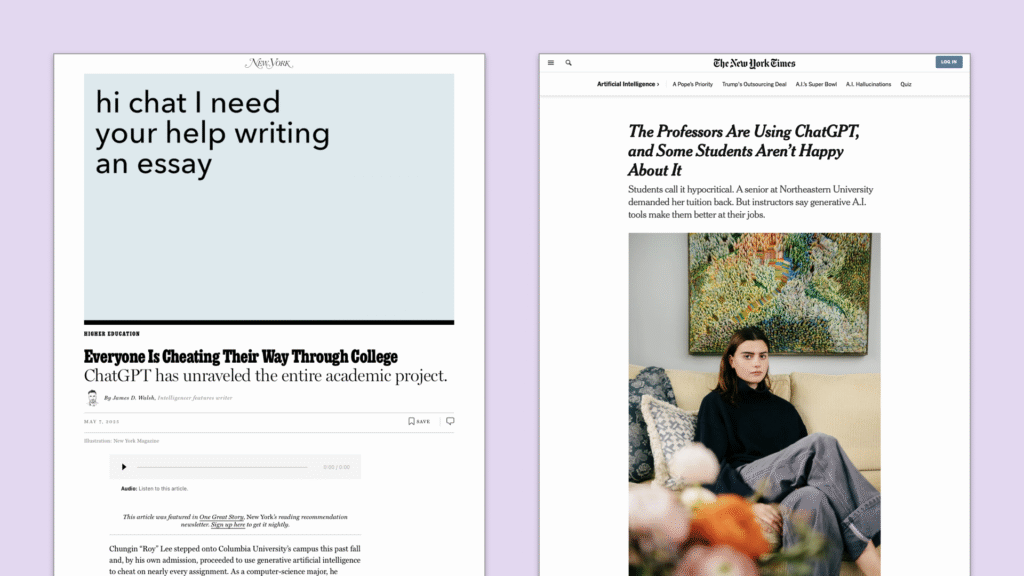
Fast forward to today, 2 years, 6 months, and 14 days later, we’ve seen a massive impact across domains, including on education.

For example, the article on the left talks about how AI cheating has become pervasive in higher education. It is fundamentally undermining the educational process itself. Students are using ChatGPT for nearly every assignment while educators struggle with ineffective detection methods and question whether traditional academic work has lost all meaning.

The one on the right talks about how students are accusing professors of being hypocritical. Teachers are using AI tools for things like course materials and grading while telling students they cannot use them.
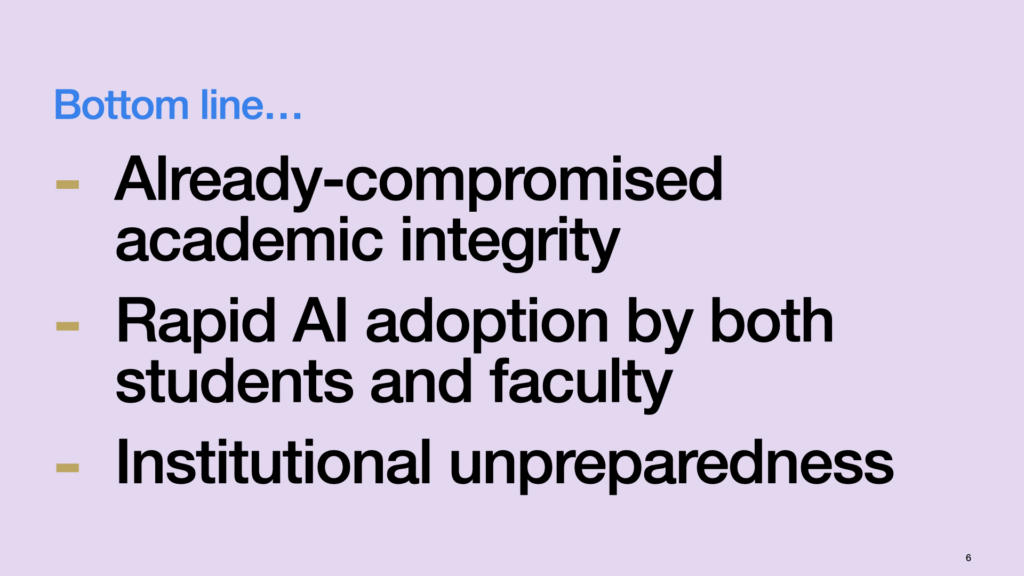
What we’re looking at is a situation where academic integrity was already in question, on top of that, both students and faculty are quickly adopting AI, and institutions aren’t really ready for it.

These transformations in higher education give me pause. What should we change about how we design learning experiences given this new reality?
So, just to clarify, when I mention “AI” in this talk, I’m specifically referring to generative AI, or GenAI, and even more specifically, to chatbots that are powered by large language models, like ChatGPT.
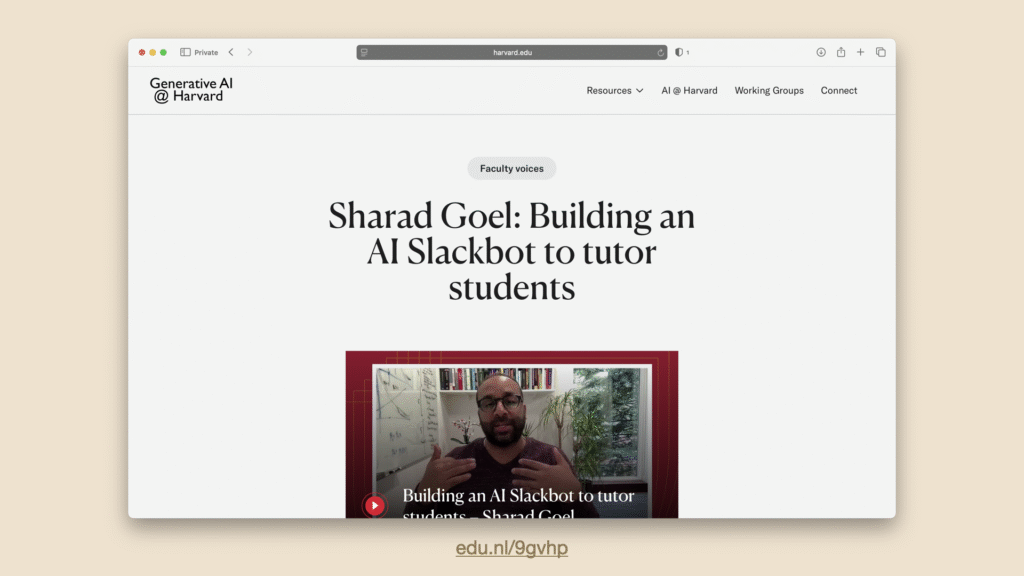
Throughout this talk I will use this example of a learning experience that makes use of GenAI. Sharad Goel, Professor at Harvard Kennedy School, developed an AI Slackbot named “StatGPT” that aims to enhance student learning through interactive engagement.
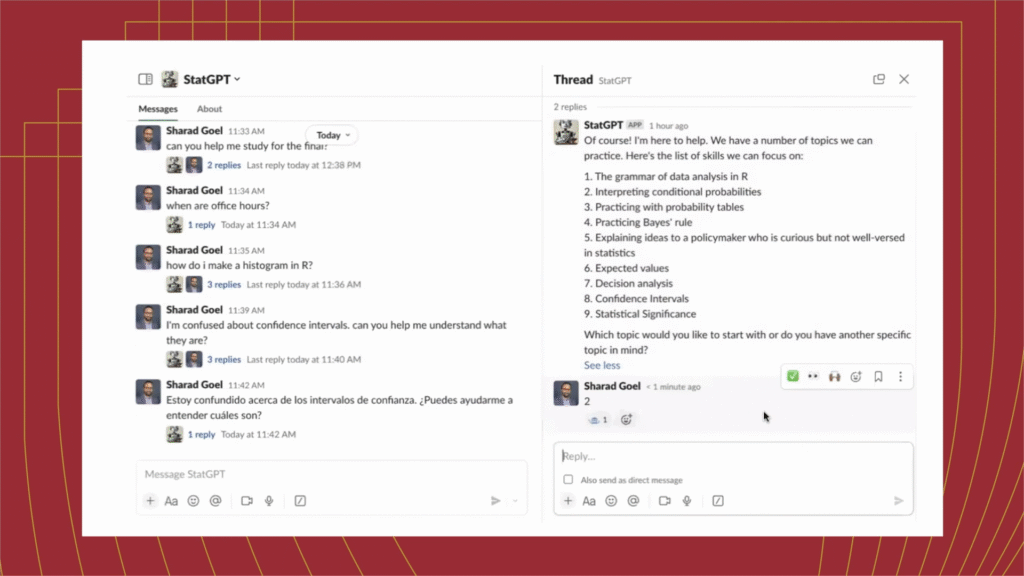
It was tested in a statistics course with positive feedback from students. They described it as supportive and easily accessible, available anytime for student use. There are plans to implement StatGPT in various other courses. They say it assists in active problem-solving and consider it an example of how AI can facilitate learning, rather than replace it.
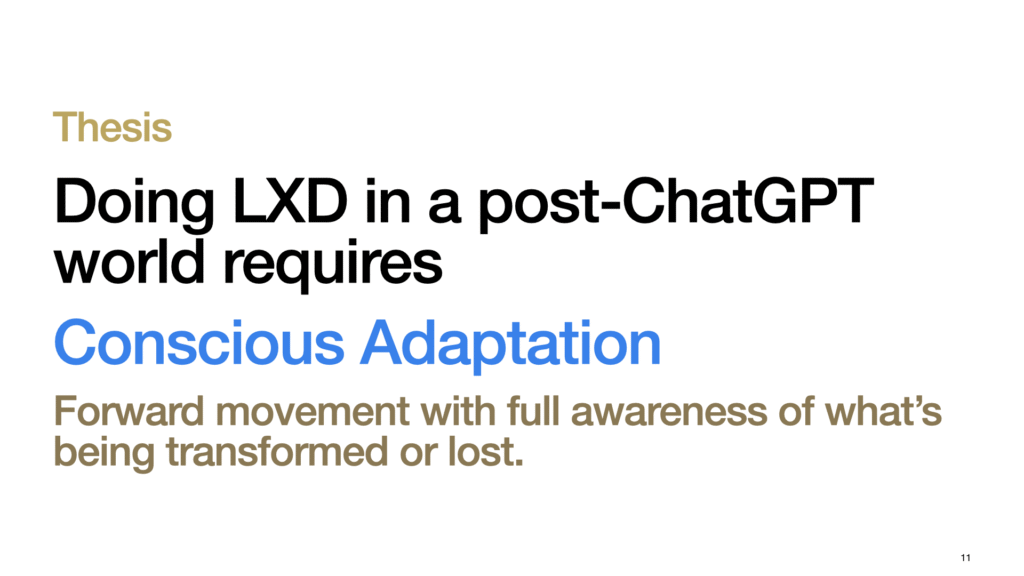
The debate around GenAI and learning has become polarized. I see the challenge as trying to find a balance. On one side, there’s complete skepticism about AI, and on the other, there’s this blind acceptance of it. What I propose is that we need an approach I call Conscious Adaptation: moving forward with full awareness of what’s being transformed.
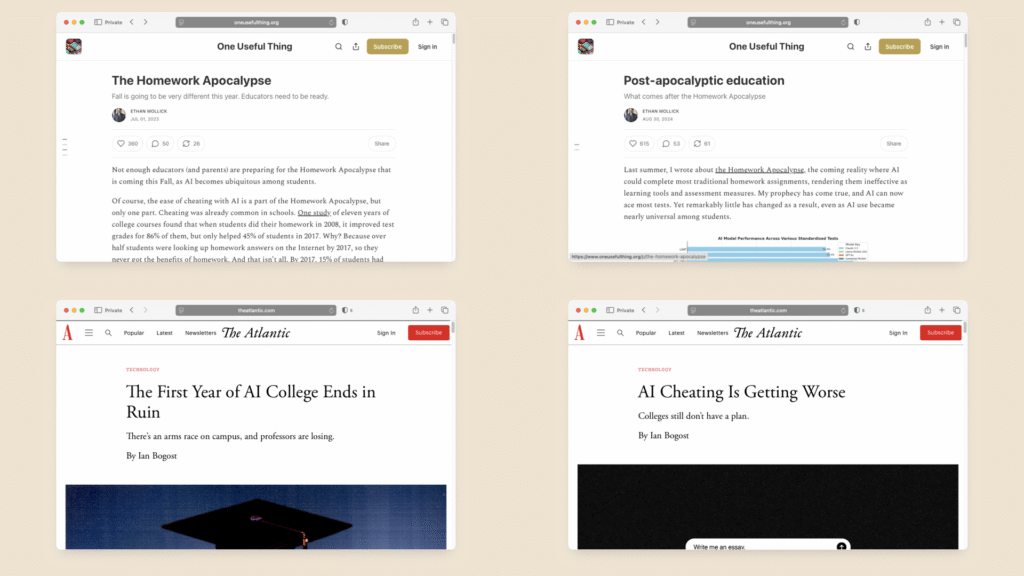
To build the case for this approach, I will be looking at two common positions in the debates around AI and education. I’ll be focusing on four pieces of writing.

Two of them are by Ethan Mollick, from his blog. He’s a professor at the University of Pennsylvania specializing in innovation and entrepreneurship, known for his work on the potential of AI to transform different fields.

The other two pieces are by Ian Bogost, published at The Atlantic. He’s a media studies scholar, author, and game designer who teaches at Washington University. He’s known for his sobering, realist critiques of the impact of technology on society.

These, to me, exemplify two strands of the debate around AI in education.
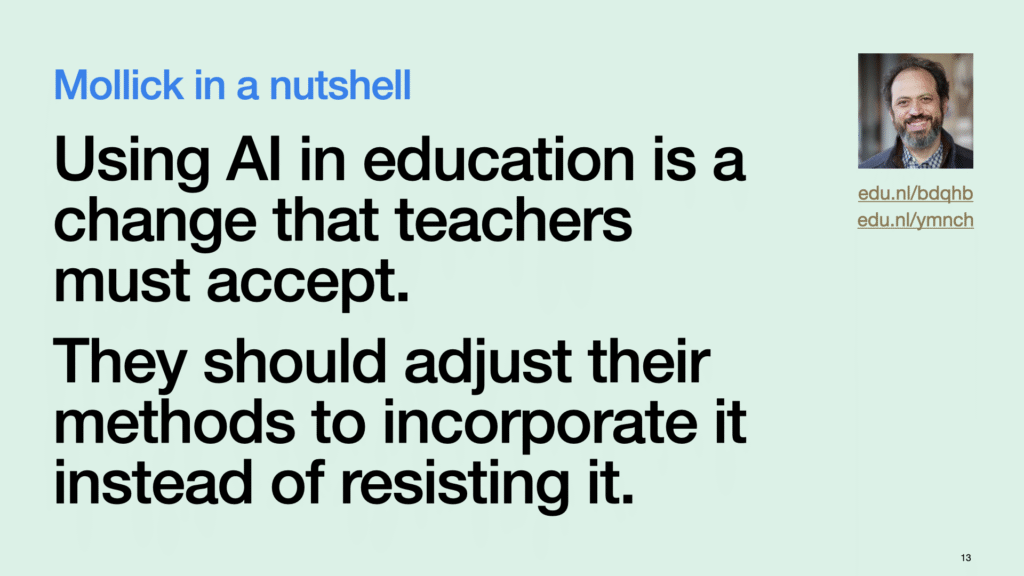
Ethan Mollick’s position, in essence, is that AI in education is an inevitable transformation that educators must embrace and redesign around, not fight.
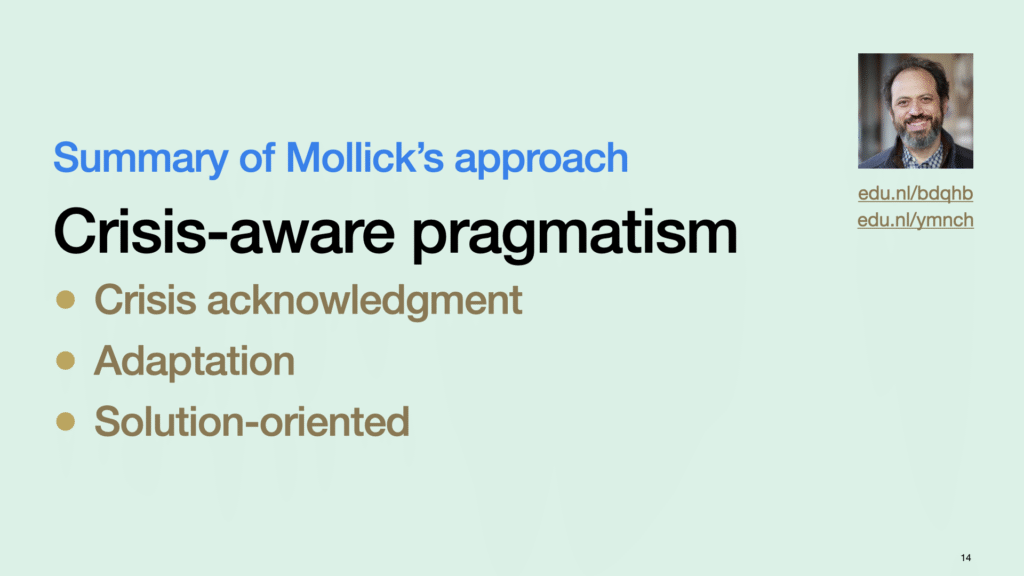
You could say Mollick is an optimist. But he is also really clear-eyed about how much disruption is going on. He even refers to it as the “Homework Apocalypse.” He talks about some serious issues: there are failures in detection, students are not learning as well (with exam performance dropping by about 17%), and there are a lot of misunderstandings about AI on both sides—students and faculty.

But his perspective is more about adapting to a tough situation. He’s always focused on solutions, constantly asking, “What can we do about this?” He believes that with thoughtful human efforts, we can really influence the outcomes positively.

On the other hand, Ian Bogost’s view is that AI has created an unsolvable crisis that’s fundamentally breaking traditional education and leaving teachers demoralized.
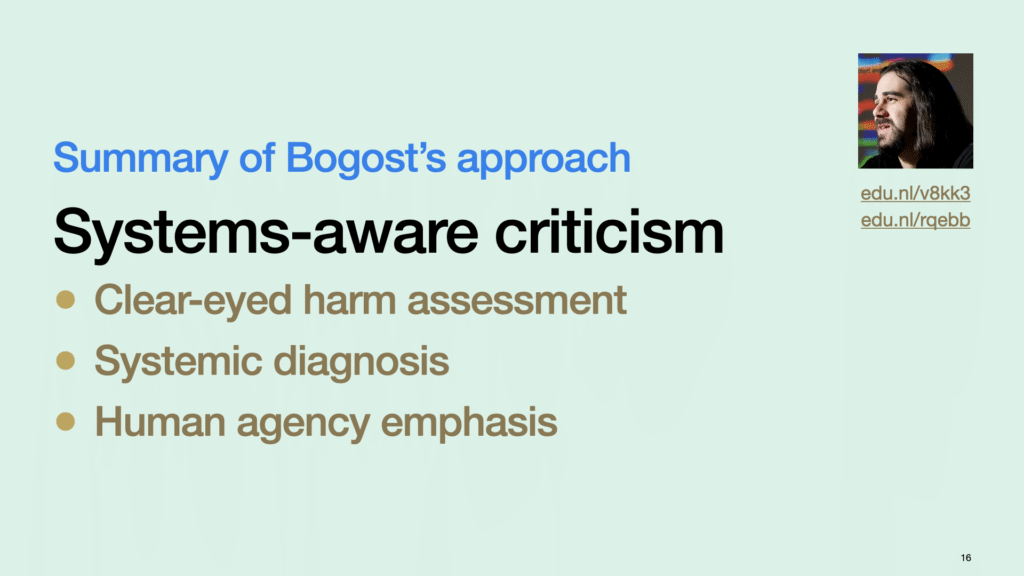
Bogost, I would describe as a realist. He accepts the inevitability of AI, noting that the “arms race will continue” and that technology will often outpace official policies. He also highlights the negative impact on faculty morale, the dependency of students, and the chaos in institutions.

He’s not suggesting that we should ban AI or go back to a time before it existed. He sees AI as something that might be the final blow to a profession that’s already struggling with deeper issues. At the same time, he emphasizes the need for human agency by calling out the lack of reflection and action from institutions.
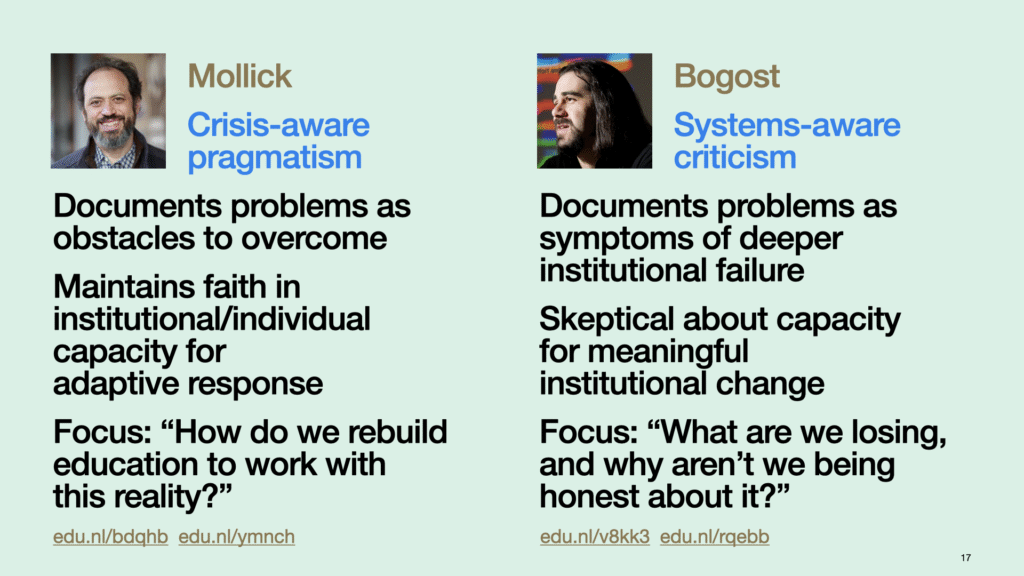
So, they both observe the same reality, but they look at it differently. Mollick sees it as an engineering challenge—one that’s complicated but can be tackled with smart design. On the other hand, Bogost views it as a social issue that uncovers deeper problems that can’t just be fixed with technology.

Mollick thinks it’s possible to rebuild after a sort of collapse, while Bogost questions if the institutions that are supposed to do that rebuilding are really fit for the job.
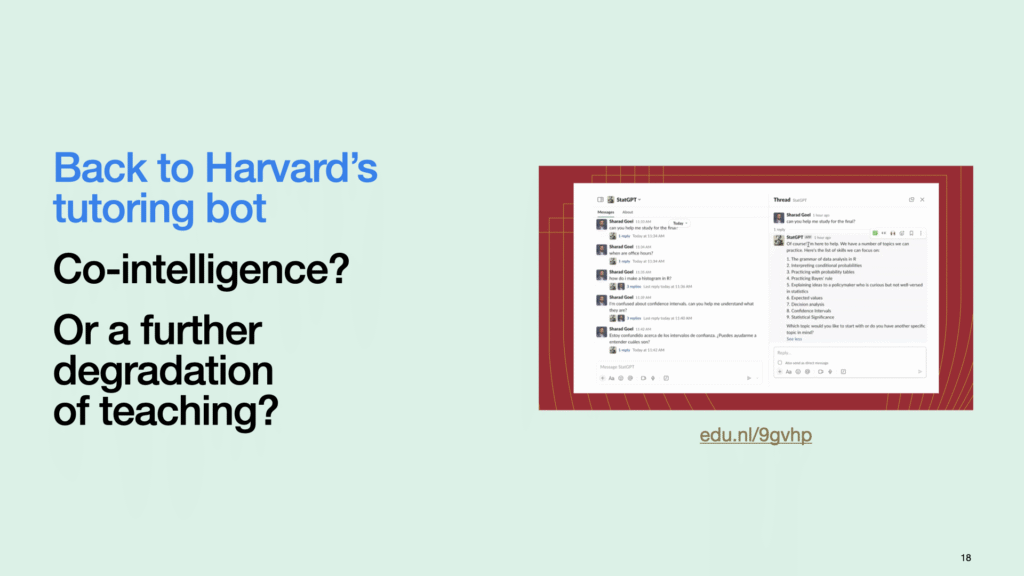
Mollick would likely celebrate it as an example of co-intelligence. Bogost would likely ask what the rollout of the bot would be at the expense of, or what deeper problems its deployment unveils.
Getting past the conflict between these two views isn’t just about figuring out the best technical methods or the right order of solutions. The real challenge lies in our ability as institutions to make real changes, and we need to be careful that focusing on solutions doesn’t distract us from the important discussions we need to have.
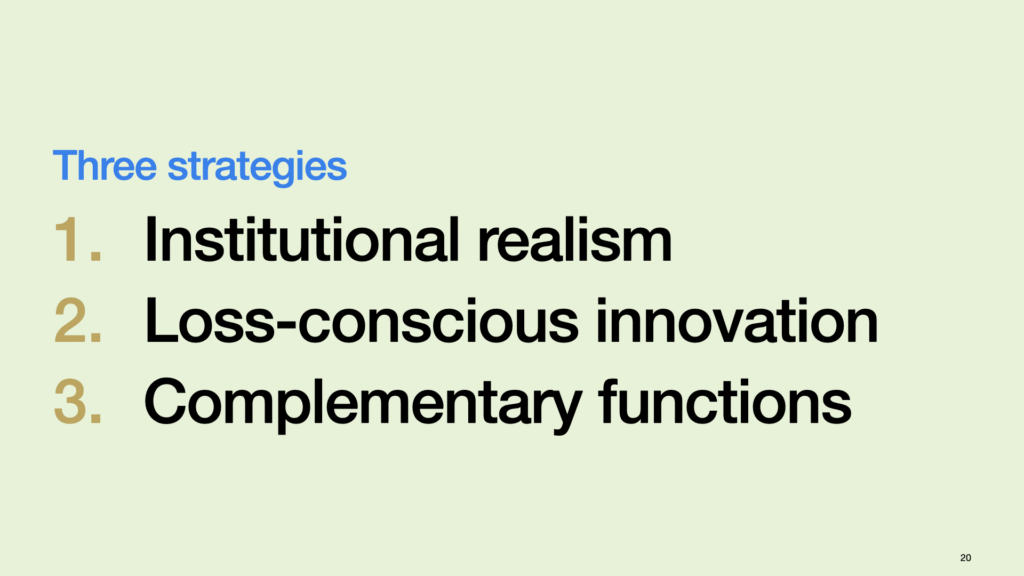
I see three strategies that work together to create an approach that addresses the conflict between these two perspectives in a way that I believe will be more effective.
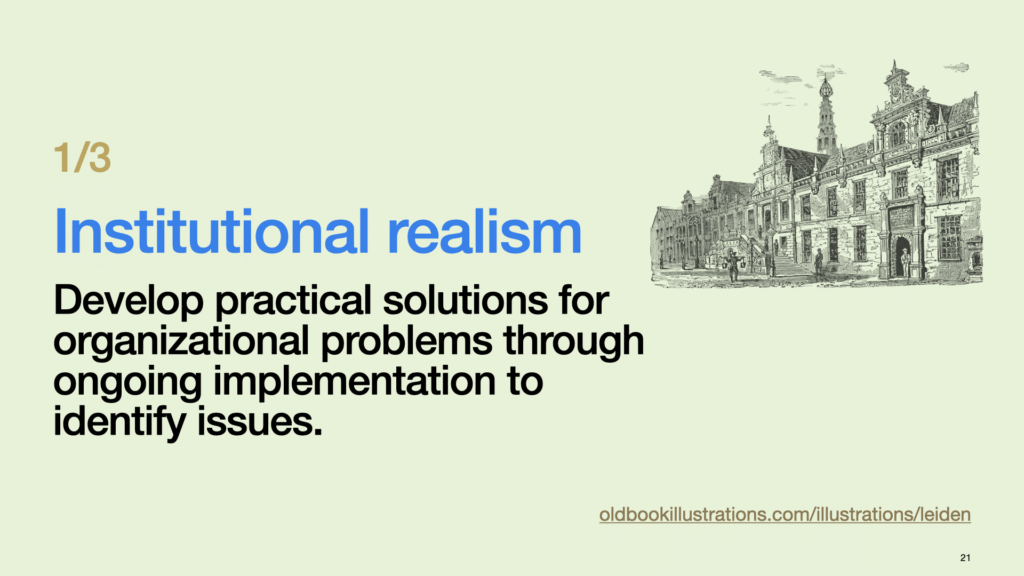
First, institutional realism is about designing interventions assuming institutions will resist change, capture innovations, or abandon initiatives. Given this, we could focus on individual teacher practices, learner-level tools, and changes that don’t require systemic transformation. We could treat every implementation as a diagnostic probe revealing actual (vs. stated) institutional capacity.

Second, loss-conscious innovation is about before implementing AI-enhanced practices, explicitly identifying what human learning processes, relationships, or skills are being replaced. We could develop metrics that track preservation alongside progress. We could build “conservation” components into new approaches to protect irreplaceable educational values.
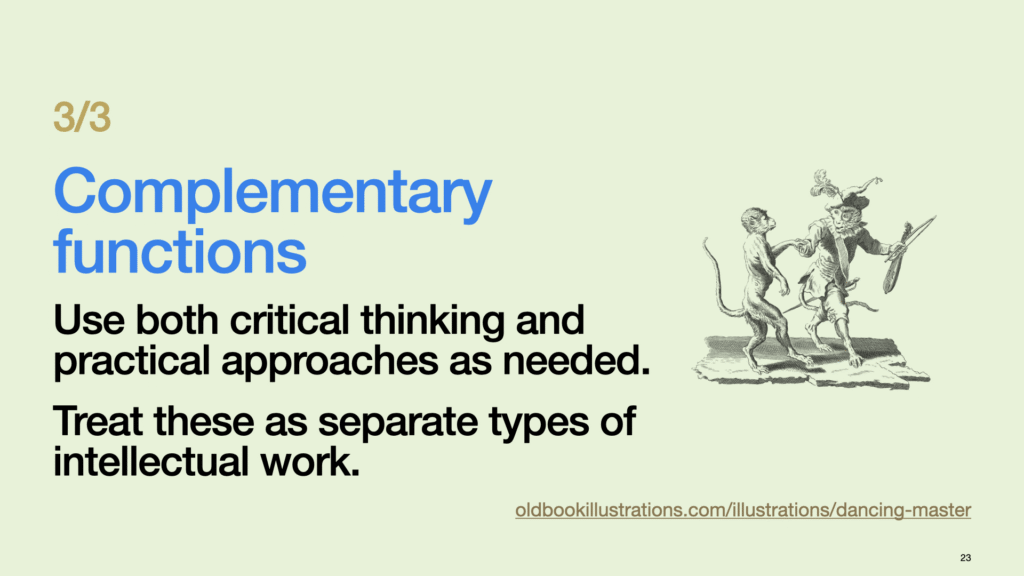
Third, and finally, we should recognize that Mollick-style solution-building and Bogost-style critical analysis serve different but essential roles. Practitioners need actionable guidance; while the broader field needs diagnostic consciousness. We should avoid a false synthesis but instead maintain both approaches as distinct intellectual work that informs each other.
In short, striking a balance may not be the main focus; it’s more about taking practical actions while considering the overall context. Progress is important, but it’s also worth reflecting on what gets left behind. Conscious adaptation.
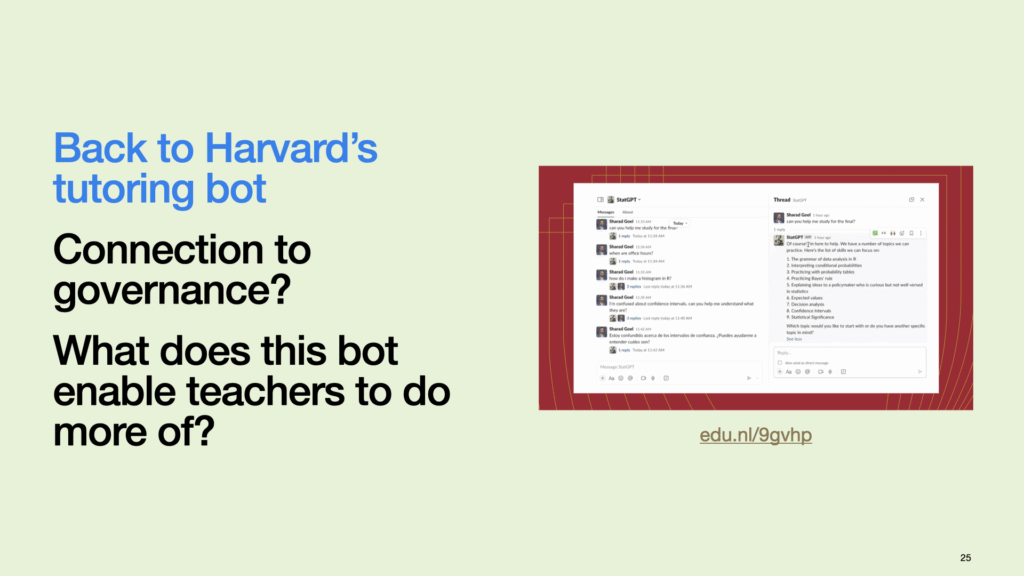
So, applying these strategies to Harvard’s chatbot, we could ask: (1) How can we create a feedback loop between an intervention like this and the things it uncovers about institutional limits, so that those can be addressed in the appropriate place? (2) How can we measure what value this bot adds for students and for teachers? What is it replacing, what is it adding, what is it making room for? (3) What critique of learning at Harvard is implied by this intervention?
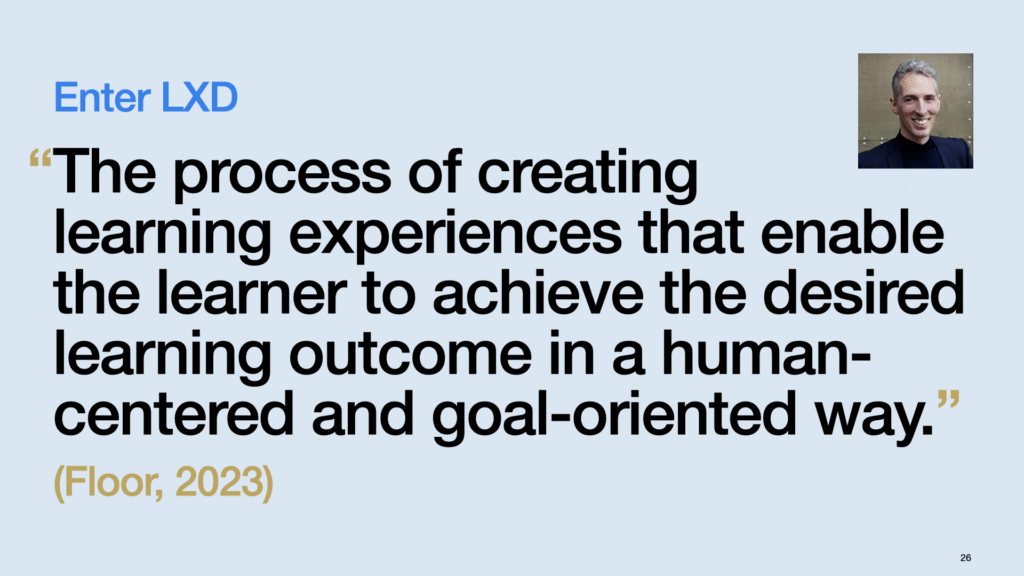
What does all of this mean, finally, for LXD? This is an LXD conference, so I don’t need to spend a lot of time explaining what it is. But let’s just use this basic definition as a starting point. It’s about experiences, it’s about centering the learner, it’s about achieving learning outcomes, etc.
Comparing my conscious adaptation approach to what typifies LXD, I can see a number of alignments.
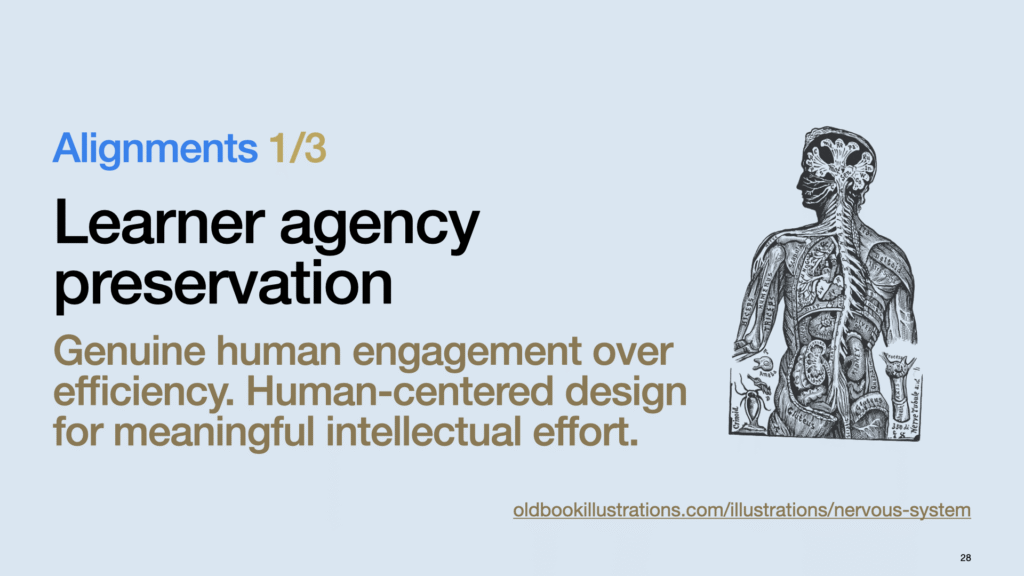
Both LXD and Conscious Adaptation prioritize authentic human engagement over efficiency. LXD through human-centered design, conscious adaptation through protecting meaningful intellectual effort from AI displacement.
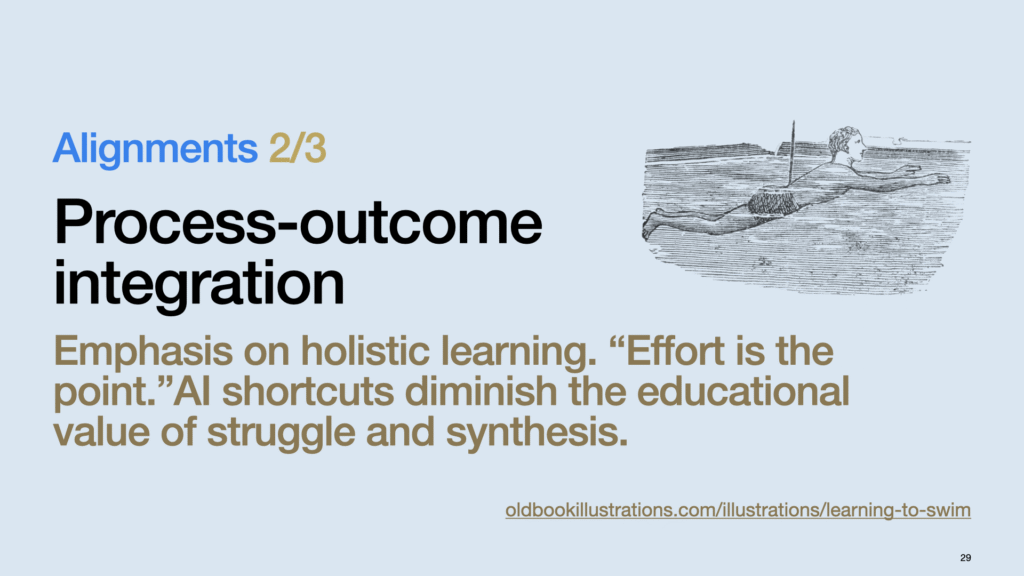
LXD’s focus on holistic learning journeys aligns with both Mollick’s “effort is the point” and Bogost’s concern that AI shortcuts undermine the educational value embedded in struggle and synthesis.
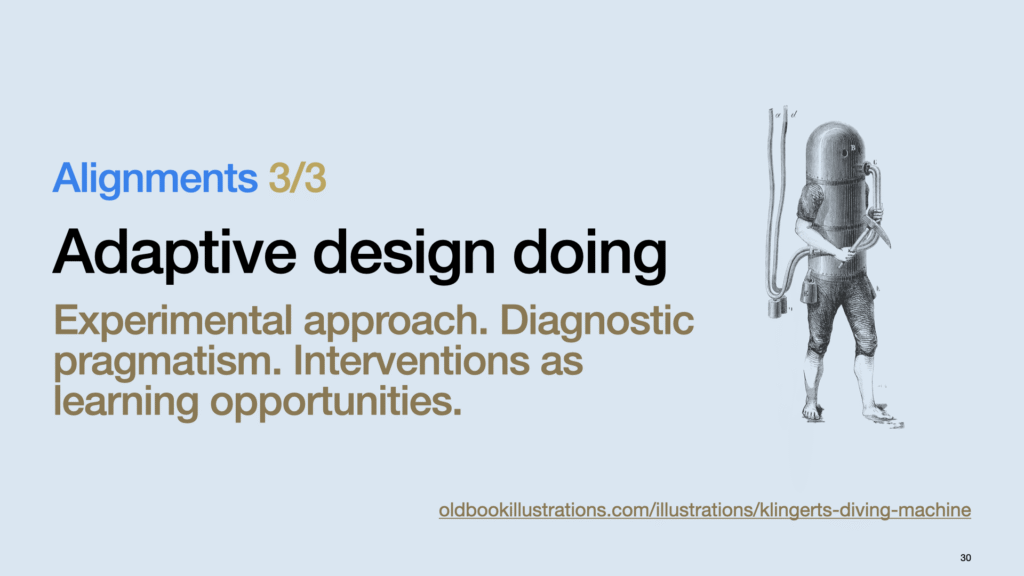
LXD’s experimental, prototype-driven approach mirrors my “diagnostic pragmatism”—both treat interventions as learning opportunities that reveal what actually works rather than pursuing idealized solutions.
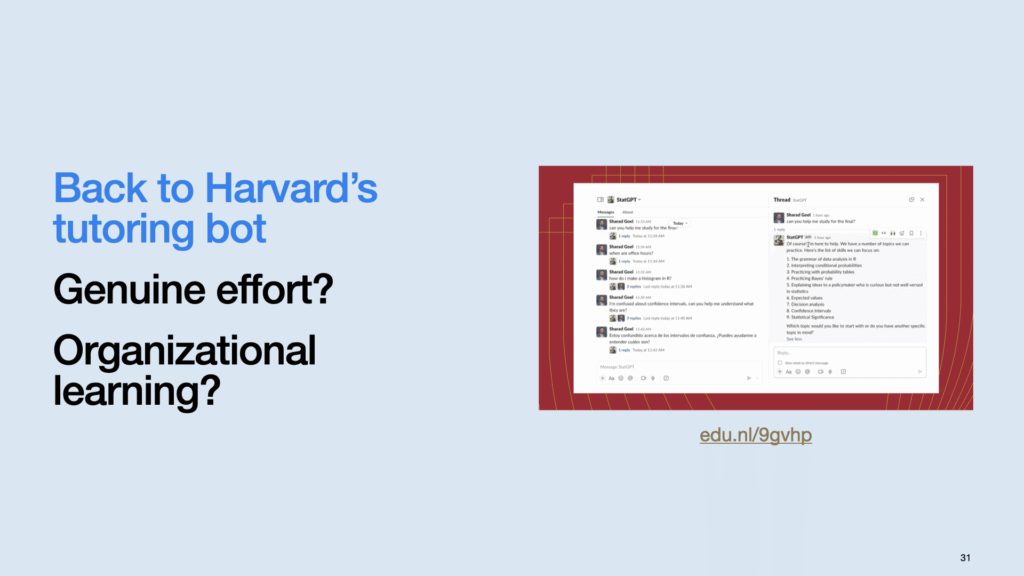
So, going back one final time to Harvard’s bot, an LXD practice aligned in this way would lead us to ask: (1) Is this leveraging GenAI to protect and promote genuine intellectual effort? (2) Are teachers and learners meaningfully engaged in the ongoing development of this technology? (3) Is this prototype properly embedded, so that its potential to create learning for the organization can be realized?
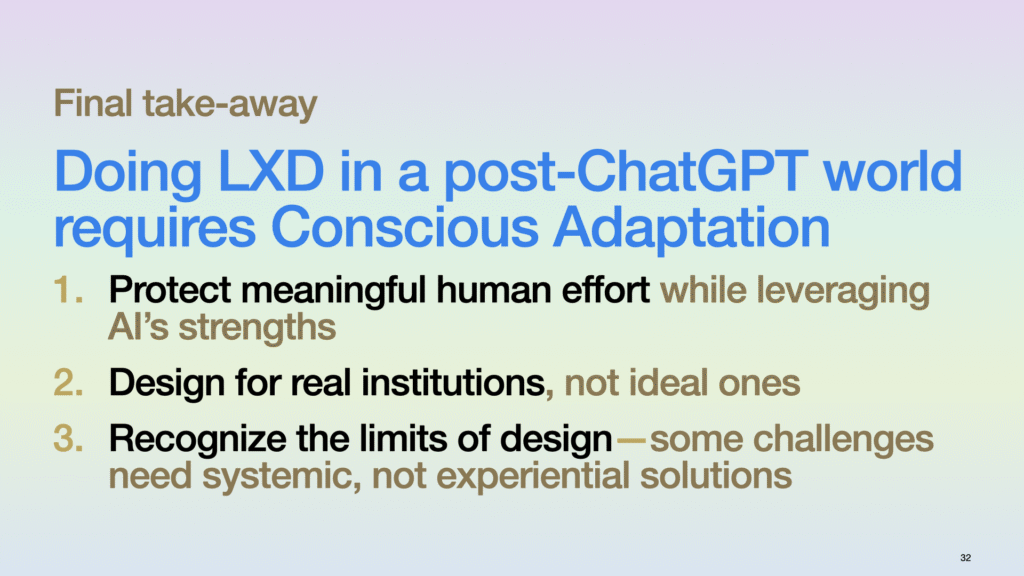
So, where does this leave us as learning experience designers? I see three practical imperatives for Conscious Adaptation.

First, we need to protect meaningful human effort while leveraging AI’s strengths. Remember that “the effort is the point” in learning. Rather than asking “can AI do this?”, we should ask “should it?” Harvard’s bot works because it scaffolds thinking rather than replacing it. We should use AI for feedback and iteration while preserving human work for synthesis and struggle.

Second, we must design for real institutions, not ideal ones. Institutions resist change, capture innovations, and abandon initiatives. We need to design assuming limited budgets, overworked staff, and competing priorities. Every implementation becomes a diagnostic probe that reveals what resistance actually tells us about institutional capacity.

Third, we have to recognize the limits of design. AI exposes deeper structural problems like grade obsession, teacher burnout, and test-driven curricula. You can’t design your way out of systemic issues, and sometimes the best move is recognizing when the problem isn’t experiential at all.

This is Conscious Adaptation—moving forward with eyes wide open.
Thanks.
Postdoc update – July 2025

I am over one year into my postdoc at TU Delft. Where did the time go? By way of an annual report, here’s a rundown of my most notable outputs and activities since the previous update from June 2024. And also, some notes on what I am up to now.

Happenings

Participatory AI and ML Engineering: On 13 February 2024 at a Human Values for Smarter Cities meeting and on 11 June 2024 at a Cities Coalition for Digital Rights meeting, I presented a talk on participatory AI and ML engineering (blogged here). This has since evolved into a study I am currently running with the working title “Vision Model Macroscope.” We are designing, building, and evaluating an interface that allows municipal workers to understand and debate value-laden technical decisions made by machine learning engineers in the construction of camera vehicles. For the design, I am collaborating with CLEVER°FRANKE. The study is part of the Human Values for Smarter Cities projected headed up by the Civic Interaction Design group at AUAS.

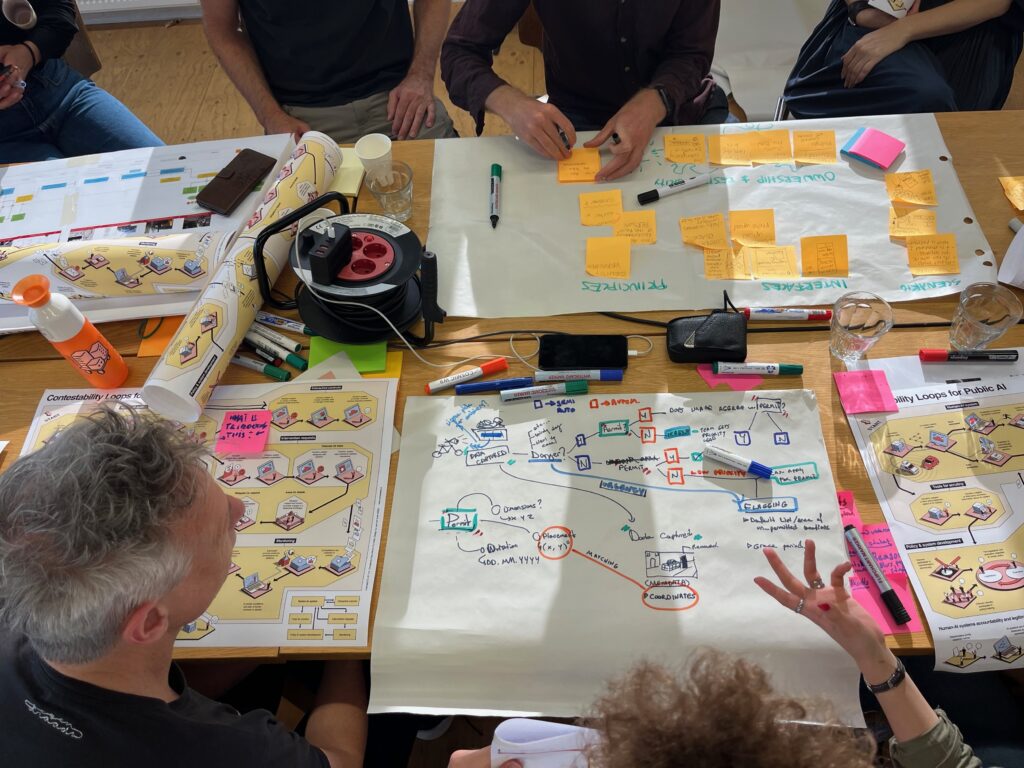
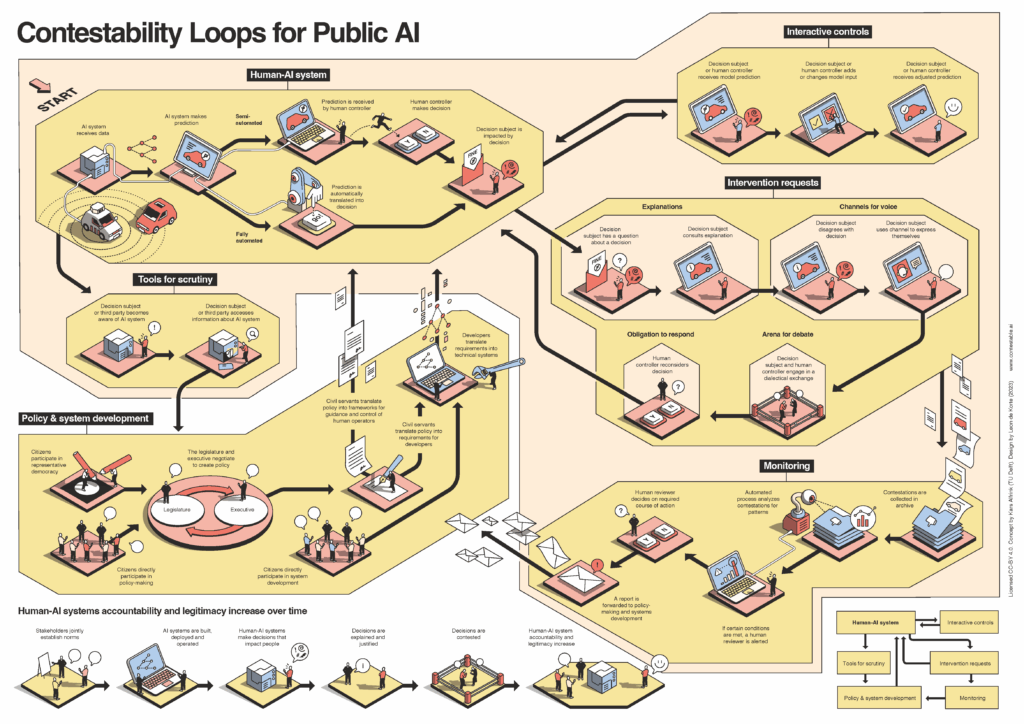
Envisioning Contestability Loops: My article “Envisioning Contestability Loops: Evaluating the Agonistic Arena as a Generative Metaphor for Public AI” (with Ianus Keller, Mireia Yurrita Semperena, Denis Bulygin, Gerd Kortuem, and Neelke Doorn) was published in She Ji on 17 June 2024. (I had already published the infographic “Contestability Loops for Public AI,” which the article revolves around, on 17 April 2024.) Later in the year, on 5 September 2024, I ran the workshop that the study builds on as a ThingsCon Salon. And on 27 September 2024, I presented the article at Lawtomation Days in Madrid, Spain, as part of the panel “Methods in law and technology research: inter- and cross-disciplinary challenges and opportunities,” chaired by Kostina Prifti (slides). (Also, John Thackara said nice things about the article online.)

Contestability Loops for Public AI infographic
Envisioning Contestability Loops workshop at ThingsCon Salon in progress.

Democratizing AI Through Continuous Adaptability: I presented on “Democratizing AI Through Continuous Adaptability: The Role of DevOps” at the TILTing Perspectives 2024 panel “The mutual shaping of democratic practices & AI,” which was chaired and moderated by Merel Noorman on 14 July 2024. I later reprised this talk at NWO ICT.OPEN on 16 April 2025 as part of the track “Human-Computer Interaction and Societal Impact in the Netherlands,” chaired by Armağan Karahanoğlu and Max Birk (PDF of slides).

From Stem to Stern: I was part of the organizing team of the CSCW 2024 workshop “From Stem to Stern: Contestability Along AI Value Chains,” which took place as a hybrid one-day session on 9 November 2024. I blogged a summary and some takeaways of the workshop here. Shoutout to Agathe Balayn and Yulu Pi for leading this endeavor.

Contestable AI Talks: I was invited to speak on my PhD research at various meetings and events organized by studios, agencies, consultancies, schools, and public sector organizations. On 3 September 2024, at the data design agency CLEVER°FRANKE (slides). On 10 January 2025, at the University of Utrecht Computational Sociology group. On 19 February 2025, at digital ethics consultancy The Green Land (slides). On 6 March 2024, at Communication and Multimedia Design Amsterdam (slides). And on 17 March 2025, at the Advisory Board on Open Government and Information Management.

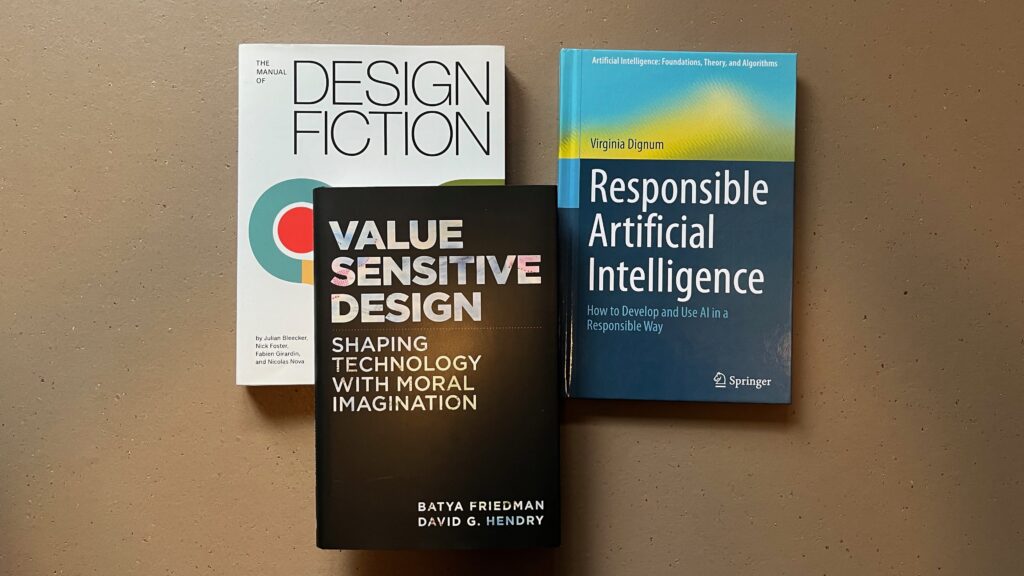
Designing Responsible AI: Over the course of 2024, Sara Colombo, Francesca Mauri, and I developed and taught for the first time a new Integrated Product Design master’s elective, “Designing Responsible AI” (course description). Later, on 28 March 2025, I was invited by my colleagues Alessandro Bozzon and Carlo van der Valk to give a single-morning interactive lecture on part of the same content at the course AI Products and Services (slides).

Books that represent the range of theory covered in the course “Designing Responsible AI.”

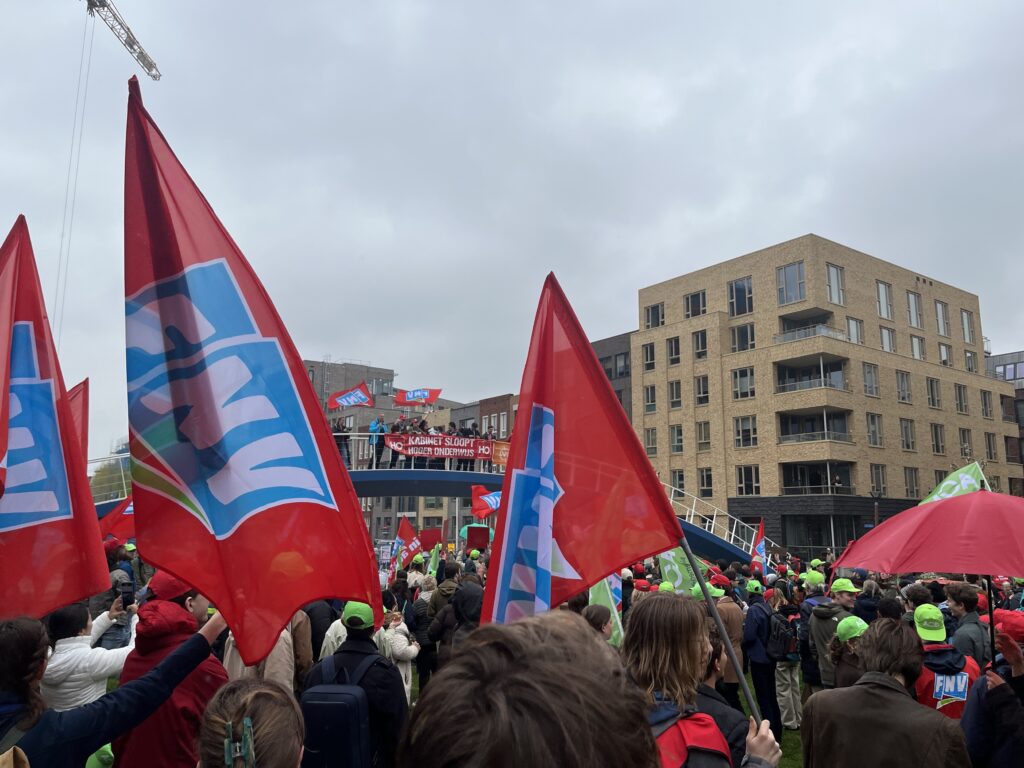
Stop the Cuts: On 2 July 2024, a far-right government was sworn in in the Netherlands (it has since fallen). They intended to cut funding to education by €2 billion. A coalition of researchers, teachers, students, and others organized to protest and strike in response. I was present at several of these actions: The alternative opening of the academic year in Utrecht on 2 September 2024. Local walkouts on 14 November 2024 (I participated in Utrecht). Mass demonstration in The Hague on 25 November 2024. Local actions on 11 December 2024 (I participated in Delft). And finally, for now at least, on 24 April 2025, at the Delft edition of the nationwide relay strike. If you read this, work in academia, and want to act, join a union (I am a member of the AOb), and sign up for the WOinActie newsletter.

End of the march during the 24 April 2025 strike in Delft.

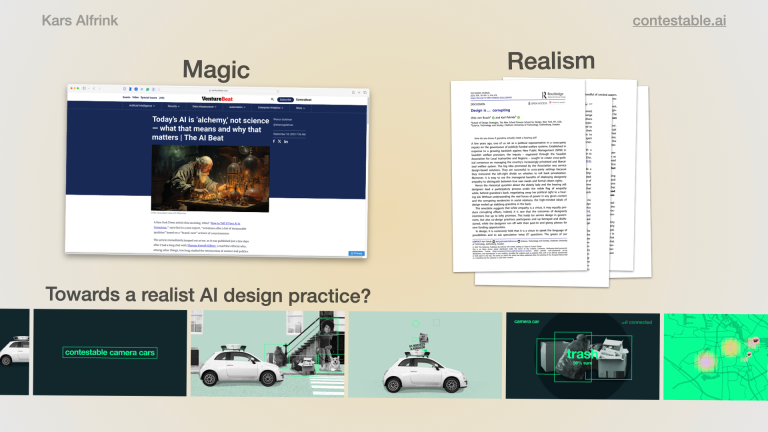
Panels: Over the past months, I was a panelist at several events. On 22 October 2024, at the Design & AI Symposium as part of the panel “Evolving Perspectives on AI and Design,” together with Iohanna Nicenboim and Jesse Benjamin, moderated by Mathias Funk (blog post). On 13 December 2024 at TH/NGS as part of the panel “Rethink Design: Book Launch and Panel Discussion on Designing With AI” chaired by Roy Bendor (video). On 12 March 2025, at the panel “Inclusive AI: Approaches to Digital Inclusion,” chaired by Nazli Cila and Taylor Stone.

Slide I used during my panel contribution at the Design & AI symposium.

Design for Human Autonomy: I was part of several activities organized by the Delft Design for Values institute related to their annual theme of autonomy (led by Michael Klenk). I was a panelist on 15 October 2024 during the kick-off event (blog post). I wrote the section on designing AI for autonomy for the white paper edited by Udo Pesch (preprint). And during the closing symposium, master’s graduation student Ameya Sawant, whom I am coaching (with Fernando Secomandi acting as chair), was honored as a finalist in the thesis competition.

Master Graduation Students: Four master students that I coached during their thesis projects graduated, which between them explored technology’s role in society through AI-mediated civic engagement, generative AI implementation in public services, experimental approaches to AI trustworthiness, and urban environmental sensing—Nina te Groen (with Achilleas Psyilidis as chair), Romée Postma (with Roy Bendor), Eline Oei (with Giulia Calabretta), and Jim Blom (with Tomasz Jaskiewicz).

Architecting for Contestability: On 22 November 2025, I ran a single-day workshop about contestability for government-employed ICT architects participating in the Digital Design & Architecture course offered by the University of Twente, on invitation from Marijn Janssen (slides).

Qualitative Design Research: On 17 December 2024, I delivered a lecture on qualitative design research for the course Empirical Design Research, on invitation from my colleague Himanshu Verma (slides). Later, on 22 April 2025, I delivered a follow-up in the form of a lecture on reflexive thematic analysis for the course Product Futures Studio, coordinated by Holly McQuillan (slides).

Democratic Generative Things: On 6 June 2025 I joined the ThingsCon unconference to discuss my contribution to the RIOT report, “Embodied AI and collective power: Designing democratic generative things” (preprint). The report was edited by edited by Andrea Krajewski and Iskander Smit.

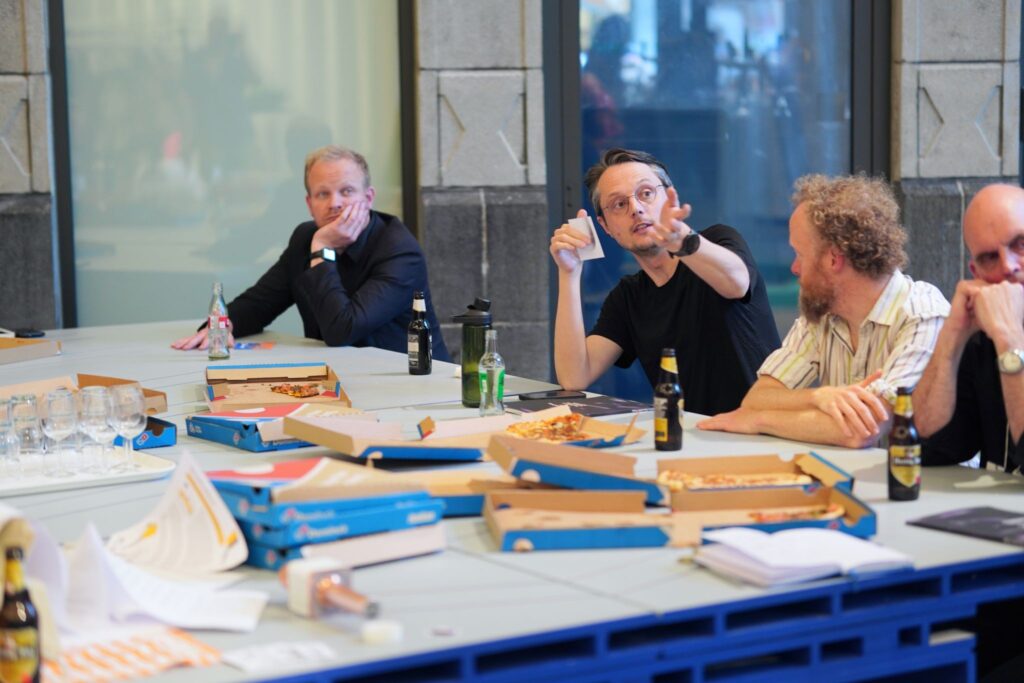
Me, holding forth during the ThingsCon RIOT unconference.

Learning Experience Design: I delivered the closing invited talk at LXDCON on 12 June 2025, reflecting on the impact of GenAI on the fields of education and design for learning (slides). Many thanks to Niels Floor for the invitation.

People’s Compute: I published a preprint of my position paper “People’s Compute: Design and the Politics of AI Infrastructures” over at OSF on 14 April 2025. I emailed it to peers and received over a dozen encouraging responses. It was also somehow picked up by Evgeny Morozov’s The Syllabus with some nice commentary attached.

On deck

So what am I up to at the moment? Keeping nice and busy.

  • I am co-authoring several articles, papers, and book chapters on topics including workplace automation, AI transparency, contestability in engineering, AI design and regulation, computational argumentation, explainable and participatory AI, and AI infrastructure politics. I do hope at least some of these will see the light of day in the coming months.
  • I am preparing a personal grant application that builds on the vision laid out in People’s Compute.
  • I will be delivering an invited talk at Enterprise UX on 21 November 2025.
  • I am acting as a scientific advisor to a center that is currently being established, which focuses on increasing digital autonomy within Dutch government institutions.
  • I will be co-teaching Designing Responsible AI again in Q1 of the next academic year.
  • I’ll serve as an associate chair on the CHI 2026 design subcommittee.
  • And I have signed up to begin our university’s teaching qualification certification.

Whew. That’s it. Thanks for reading (skimming?) if you’ve made it all the way to the end. I will try to circle back and do another update, maybe a little sooner than this one, say in six months’ time.

AI pedagogy through a design lens

At a TU Delft spring symposium on AI education, Hosana and I ran a short workshop titled “AI pedagogy through a design lens.” In it, we identified some of the challenges facing AI teaching, particularly outside of computer science, and explored how design pedagogy, particularly the practices of studios and making, may help to address them. The AI & Society master elective I’ve been developing and teaching over the past five years served as a case study. The session was punctuated by brief brainstorming using an adapted version of the SQUID gamestorming technique. Below are the slides we used.

5 things I’m thinking about

You have Alper to blame for this. Alice started it, many followed (some well worth reading) and now the meme has crossed the pond it seems. I know, we’re a bit slow in NL. So, what am I thinking about?

My upcoming holiday, which will be the first break in over a year. I am planning to completely unplug, which I am both dreading and looking forward to. It seems the longer I am self-employed, the harder it gets to just leave work behind for an extended period of time. It seems crazy to be worried about the continuity of my business when I’m only away for a week on a freaking Wadden island.

Today marks the last day of final exams at the HKU and I am lead to wonder about the future of design education as it happens there and at other similar institutes around the world. It often seems too closed off from the outside world, too insular. I am looking forward to tangling with this subject matter more in an upcoming project with River Institute.

Choosing has never come easy to me. In the past I have found it painful to choose between disciplines, skills to develop, projects to work on. And at some point I sort of decided to stop forcing choices and find ways to have them all mesh. I think that finally I am getting to a spot where I am comfortable in not choosing. So now I wonder why that is, what the value of refusing to choose is and what that means for creative disciplines.

I am essentially pessimistic about the future of this world. I have a very hard time conceiving of any future, in fact. Recently I found myself in a workshop aimed at making plans for an event in 2015 and I was totally lost. Having learnt this about myself the next question is how to act – I don’t wan’t to “play dead” as Bruce Sterling would say – so what’s the alternative?

Since it is at the core of my business I am thinking a lot about domains where games could go next. I am thinking a lot about citizen engagement, particularly when it comes to public policy, but I am mostly stumped about making inroads into that area locally.

There you have it.

“Stay hungry, stay foolish”

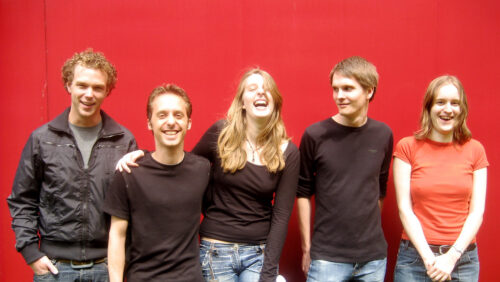
I graduated from the Utrecht School of the Arts in 2002. Now, less than seven years later, I am mentoring a group of five students who will be doing the same come September this year. I took a photo of them today, here it is:

Bright young bunch

From left to right, here’s who they are and what they’re up to:

  • Christiaan is tech lead on Hollandia, an action adventure game inspired by Dutch folklore. His research looks at ways to close the gap between creatives and technologists in small teams, using agile techniques.
  • Kjell is designing a series of experimental games using voice as their only input. He’s researching what game mechanics work best with voice control.
  • Maxine is game designer on the aforementioned Hollandia game. Her research looks at the translation of the play experience of physical toys to digital games. (In of Hollandia, you’ll be using a Wiimote to control the spinning top used by the heroine.)
  • Paul is building a physics-based platform puzzle game for two players. His research looks at the design of meaningful collaborative play.
  • Eva is making a space simulation game with realistic physics and complex controls. She’s researching what kinds of fun are elicited by such games.

Practically speaking, mentoring these guys means that I see them once a week for a 15-minute session. In this we discuss the past week’s progress and their plans for the next. They’ve set their own briefs, and are expected to be highly self-reliant. My task consists of making sure they stay on track and their work is relevant, both from an educational and a professional perspective. It’s challenging work, but a lot of fun. It forces me to make explicit the stuff I’ve picked up professionally. It’s also a lot about developing a sense for where each student individually can improve and encouraging them to challenge themselves in those areas.

I’m looking forward to seeing what they’ll deliver come September, when it’s their turn to graduate, and go out to conquer the world.

The theory and practice of urban game design

A few weeks ago NLGD asked me to help out with an urban games ‘seminar’ that they had commissioned in collaboration with the Dutch Game Garden. A group of around 50 students from two game design courses at the Utrecht School of the Arts1 were asked to design a game for the upcoming Festival of Games in Utrecht. The workshop lasted a week. My involvement consisted of a short lecture, followed by several design exercises designed to help the students get started on Monday. On Friday, I was part of the jury that determined which game will be played at the festival.

Lecture

In the lecture I briefly introduced some thinkers in urbanism that I find of interest to urban game designers. I talked about Jane Jacobs’ view of the city as a living organism that is grown from the bottom up. I also mentioned Kevin Lynch’s work around wayfinding and the elements that make up people’s mental maps of cities. I touched upon the need to have a good grasp of social interaction patterns2. Finally, I advised the students to be frugal when it comes to the inclusion of technology in the students’ game designs. A good question to always ask yourself is: can I have as much fun without this gadget?

I wrapped up the lecture by looking at 5 games, some well-known, others less so: Big Urban Game, ConQwest, Pac-Manhattan, The Soho Project and The Comfort of Strangers. There are many more good examples, of course, but each of these helped in highlighting a specific aspect of urban games design.

Workshop

Next, I ran a workshop of around 3 hours with the students, consisting of two exercises (plus one they could complete afterwards in their own time). The first one is the most interesting to discuss here. It’s a game-like elicitation technique called VNA3, which derives its name from the card types in the deck it is made up of: verbs, nouns and adjectives.

Students doing a VNA exercise

The way it works is that you take turns drawing a card from the deck and make up a one-sentence idea involving the term. The first person to go draws a verb, the second person a noun and the third an adjective. Each person builds on the idea of his or her precursor. The concept that results from the three-card sequence is written down, and the next person draws a verb card again.4 The exercise resembles cadavre exquis, the biggest difference being that here, the terms are predetermined.

VNA is a great ice-breaker. The students were divided into teams of five and, because a side-goal of the seminar was to encourage collaboration between students from the different courses, they often did not know each other. Thanks to this exercise they became acquainted, but within a creative context. The exercise also privileges volume of ideas over their quality, which is perfect in the early stages of conceptualization. Last but not least, it is a lot of fun; many students asked where they could get the deck of cards.

Jurying

On Friday, I (together with the other jury members) was treated to ten presentations by the students. Each had prepared a video containing footage of prototyping and play-testing sessions, as well as an elevator pitch. A lot of them were quite good, especially considering the fact that many students had not created an urban game before, or hadn’t even played one. But one game really stood out for me. It employed a simple mechanic: making chains of people by holding hands. A chain was started by players, but required the help of passers-by to complete. Watching the videos of chains being completed evoked a strong positive emotional response, not only with myself, but also my fellow jurors. What’s more important though, is that the game clearly engendered happiness in its participants, including the people who joined in as it was being played.

An urban game being played

In one video sequence, we see a near-completed chain of people in a mall, shouting requests at people to join in. A lone man has been observing the spectacle from a distance for some time. Suddenly, he steps forward, and joins hands with the others. The chain is completed. A huge cheer emerges from the group, hands are raised in the air and applause follows, the man joining in. Then he walks off towards the camera, grinning, two thumbs up. I could not help but grin back.5

Happy urban game participant
  1. Game Design and Development and Design for Virtual Theatre and Games []
  2. pointing to this resource, that was discussed at length on the IGDA ARG SIG []
  3. developed by Annakaisa Kultima []
  4. An interesting aside is that the deck was originally designed to be used for the creation of casual mobile games. The words were chosen accordingly. Despite this, or perhaps because of this, they are quite suitable to the design of urban games. []
  5. To clarify, this was not the game that got selected for the Festival of Games. There were some issues with the game as a whole. It was short-listed though. Another excellent game, involving mechanics inspired by photo safari, was the winner. []

Teaching design for mobile social play

Last week, the group project I am coaching at the Utrecht School of the Arts kicked off. The project is part of the school’s master of arts program. The group consists of ten students with very different backgrounds, ranging from game design & development to audio design, as well as arts management, media studies, and more. Their assignment is to come up with a number of concepts for games that incorporate mobile phones, social interactions, audio and the web. Nokia Research Center has commissioned the project, and Jussi Holopainen, game design researcher and co-author of Patterns in Game Design, is the client. In the project brief there is a strong emphasis on sketching and prototyping, and disciplined documentation of the design process. The students are working full time on the project and it will run for around 4 months.

I am very happy with the opportunity to coach this group. It’s a new challenge for me as a teacher – moving away from teaching theory and into the area of facilitation. I am also looking forward to seeing what the students will come up with, of course, as the domain they are working in overlaps hugely with my interests. So far, working with Jussi has proven to be very inspirational, so I am getting something out of it as a designer too.

Three cool projects out of the Art, Media and Technology faculty

So a week ago I visited a project market at the Art, Media and Technology faculty in Hilversum which is part of the Utrecht School of Arts and offers BA and MA courses in Interaction Design, Game Design & Development and many others.

The range of projects on show was broad and wonderfully presented. It proves the school is still able to integrate arts and crafts with commercial and societal relevant thinking. All projects (over 40 in total) were by master of arts students and commissioned by real world clients. I’d like to point out three projects I particularly enjoyed:

Koe

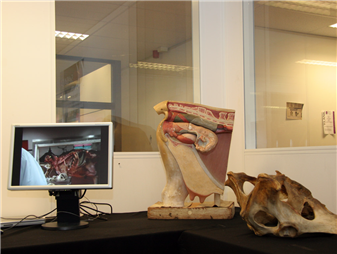
A tangible interface that models a cow’s insides and allows veterinary students to train at much earlier stage than they do now. The cow model has realistic organs made of silicon (echoes of Realdoll here) and is hooked up to a large display showing a 3D visualization of the student’s actions inside the cow. Crazy, slightly gross but very well done.

Haas

A narrative, literary game called ‘Haas’ (Dutch for hare) that allows the player to intuitively draw the level around the main character. The game’s engine reminded me a bit of Chris Crawford‘s work in that it tracks all kinds of dramatic possibilities in the game and evaluates which is the most appropriate at any time based on available characters, props, etc. Cute and pretty.

Entertaible

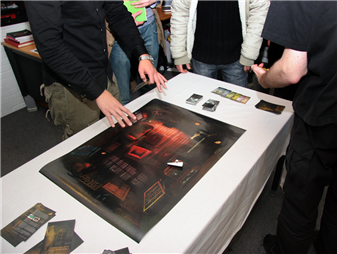
A game developed for Philips’ Entertaible which is a large flat panel multi-touch display that can track game pieces’ location, shape and orientation and has RFID capabilities as well. The game developed has the players explore a haunted mansion (stunningly visualized by the students in a style that is reminiscent of Pixar) and play a number of inventive mini-games. Very professionally done.

For a taste of the project market you can check out this photo album (from which the photos in this post are taken) as well as this video clip by Dutch newspaper AD.

Full disclosure: I currently teach a course in game design for mobile devices and earlier studied interaction and game design between 1998 and 2002 at the same school.

Where are the good European IxD schools?

Dan Saffer of Adaptive Path wrote an introductory piece for budding interaction designers. Five years ago, Robert Reimann of Cooper did the same. Both are nice overviews for novices and especially the parts on a designer’s temperament are entertaining to read.

Saffer fails to mention any good IxD schools outside of the US and UK. Which is a shame for all of us European designers. Reimann mentioned Ivrea’s now defunct IxD institute.

I’d like to start by pointing to my courageous little country’s Utrecht School of Arts, which has been teaching IxD for 15 years now (!) and today offers both BA and MA programs. They’ve recently branched off into game design, which has been quite successful.

Full disclosure: I was a student at the same school from 1998 – 2001 (BA IxD, MA Game Design) and am now teaching a course in mobile game design.

Any other good IxD schools in Europe that you know of?

Update: discussions on Saffer’s post on the IxDA’s maling list here and here; overview of IxD education (mostly in the US) here.