Books I’ve read in 2018

Goodreads tells me I’ve read 48 books in 2018. I set myself the goal of 36 so it looks like I beat it handily. But included in that count are quite a few roleplaying game books and comics. If I discard those I’m left with 28 titles. Still a decent amount but nothing particularly remarkable. Below are a few lists and some notes to go with them.

Most of the non-fiction is somewhere on the intersection of design, technology and Left politics. A lot of this reading was driven by my desire to develop some kind of mental framework for the work we were doing with Tech Solidarity NL. More recently—since I started my PhD—I’ve mostly been reading textbooks on research methodology. Hidden from this list is the academic papers I’ve started consuming as part of this new job. I should figure out a way of sharing some of that here or elsewhere as well.

I took a break from technology and indulged in a deep dive into the history of the thirty year’s war with a massive non-fiction treatment as well as a classic picaresque set in the same time period. While reading these I was transitioning into my new role as a father of twin boys. Somewhat related was a brief history of The Netherlands, which I’ve started recommending to foreigners who are struggling to understand our idiosyncratic little nation and go beyond superficialities.

Then there’s the fiction, which in the beginning of the year consisted of highbrow weird and historical novels but then ventured into classic fantasy and (utopian) sci-fi territory. Again, mostly because of a justifiable desire for some escapism in the sleep deprived evenings and nights.

Having mentioned the arrival of our boys a few times it should come as no surprise that I also read a couple of parenting books. These were more than enough for me and really to be honest I think parenting is a thing best learned through practice. Especially if you’re raising two babies at once.

So that’s it. I’ve set myself the modest goal of 24 books for this year because I’m quite sure most of my reading will be papers and such. Here’s to a year of what I expect will be many more late night and early morning reading sessions of escapist weird fiction.
Previous years: 2017, 2016, 2015, 2011, 2009.

Books I’ve read in 2017

Returning to what is something of an annual tradition, these are the books I’ve read in 2017. I set myself the goal of getting to 36 and managed 38 in the end. They’re listed below with some commentary on particularly memorable or otherwise noteworthy reads. To make things a bit more user friendly I’ve gone with four broad buckets although as you’ll see within each the picks range across genres and subjects.

Fiction

I always have one piece of fiction or narrative non-fiction going. I have a long-standing ‘project’ of reading cult classics. I can’t settle on a top pick for the first category so it’s going to have to be a tie between Lowry’s alcohol-drenched tale of lost love in pre-WWII Mexico, and Salter’s unmatched lyrical prose treatment of a young couple’s liaisons as imagined by a lecherous recluse in post-WWII France.

When I feel like something lighter I tend to seek out sci-fi written from before I was born. (Contemporary sci-fi more often than not disappoints me with its lack of imagination, or worse, nostalgia for futures past. I’m looking at you, Cline.) My top pick here would be the Strugatsky brothers, who blew me away with their weird tale of a world forever changed by the inexplicable visit by something truly alien.

I’ve also continued to seek out works by women, although I’ve been less strict with myself in this department than previous years. Here I’m ashamed to admit it took me this long to finally read anything by Woolf because Mrs Dalloway is every bit as good as they say it is. I recommend seeking out the annotated Penguin addition for additional insights into the many things she references.

I’ve also sometimes picked up a newer book because it popped up on my radar and I was just really excited about reading it. Most notably Dolan’s retelling of the Iliad in all its glorious, sad and gory detail, updated for today’s sensibilities.

Literary non-fiction

Each time I read a narrative treatment of history or current affairs I feel like I should be doing more of it. All of these are recommended but Kapuściński towers over all with his heart-wrenching first-person account of the Iranian revolution.

Non-fiction

A few books on design and technology here, although most of my ‘professional’ reading was confined to academic papers this year. I find those to be a more effective way of getting a handle on a particular subject. Books published on my métier are notoriously fluffy. I’ll point out Löwgren for a tough but rewarding read on how to do interaction design in a non-dogmatic but reflective way.

I got into leftist politics quite heavily this year and tried to educate myself a bit on contemporary anti-capitalist thinking. Fisher’s book is a most interesting and also amusing diagnosis of the current political and economic world system through a cultural lens. It’s a shame he’s no longer with us, I wonder what he would have made of recent events.

Game books

I decided to work my way through a bunch of roleplaying game books all ‘powered by the apocalypse’ – a family of games which I have been aware of for quite a while but haven’t had the opportunity to play myself. I like reading these because I find them oddly inspirational for professional purposes. But I will point to the original Apocalypse World as the one must-read as Baker remains one of the designers I am absolutely in awe of for the ways in which he manages to combine system and fiction in truly inventive ways.

  • The Perilous Wilds, Jason Lutes
  • Urban Shadows: Political Urban Fantasy Powered by the Apocalypse, Andrew Medeiros
  • Dungeon World, Sage LaTorra
  • Apocalypse World, D. Vincent Baker

Poetry

I don’t usually read poetry for reasons similar to how I basically stopped reading comics earlier: I can’t seem to find a good way of discovering worthwhile things to read. The collection below was a gift, and a delightful one.

As always, I welcome suggestions for what to read next. I’m shooting for 36 again this year and plan to proceed roughly as I’ve been doing lately—just meander from book to book with a bias towards works that are non-anglo, at least as old as I am, and preferably weird or inventive.

Previous years: 2016, 2015, 2011, 2009.

Books I’ve read in 2016

I’ve read 32 books, which is four short of my goal and also four less than the previous year. It’s still not a bad score though and quality wise the list below contains many gems.

I resolved to read mostly books by women and minority authors. This lead to quite a few surprising experiences which I am certainly grateful for. I think I’ll continue to push myself to seek out such books in the year to come.

There are only a few comics in the list. I sort of fell off the comics bandwagon this year mainly because I just can’t seem to find a good place to discover things to read.

Anyway, here’s the list, with links to my reviews on Goodreads. A * denotes a particular favourite.

Books I’ve read in 2015

On this final day of the year let’s do some more looking back. The last time I posted books read was in 2011. But that doesn’t mean I stopped reading. On the contrary.

Goodreads tells me I read 36 books in 2015, which was the goal I set myself for this year. I will admit not all of these are big reads. Some are short pamphlets and there is also a comic or two thrown in.

I think I am going to stick with this target for next year and I will also stick with reading widely. A few books were read because of a project at Hubbub for which I felt the need to delve more deeply in the subject matter. This is a good way to stretch intellectually. I also started experimenting with asking people who know me personally what novel I should read next which has led to some delightful discoveries. So I will continue to do that too.

Anyway, here they are in order of date read. Particular favourites are marked with a ❤️. I’ve written short reviews for most of these so I’ve provided links to those too.

Books I’ve read in 2009

This is the last list I’ll be posting on stuff from 2009, I promise. After this it’s all about looking forward. I’ve been tracking my reading on aNobii for some time. Here’s a list of the books I’ve found particularly worthwhile, ordered chronologically. My three absolute favorites are marked in bold.

  • Faith in Fakes, Umberto Eco
  • Cat’s Cradle, Kurt Vonnegut
  • Stranger in a Strange Land, Robert A. Heinlein
  • What I Talk About When I Talk About Running, Haruki Murakami
  • Black Dogs, Ian McEwan
  • Out of Control, Kevin Kelly
  • Invisible Cities, Italo Calvino
  • Game Design Workshop (2nd edition), Tracy Fullerton
  • The New York Trilogy, Paul Auster
  • Fight Club, Chuck Paluhniuk
  • A Clockwork Orange, Anthony Burgess
  • The Image of the City, Kevin Lynch
  • Trainspotting, Irvine Welsh
  • Underworld, Don DeLillo
  • Rum Punch, Elmore Leonard
  • Digital Ground, Malcolm McCullough
  • The Big Sleep, Raymond Chandler

Common themes: cities, complexity, society & the individual, inner & outer space, design.

I’ve been quite picky with what I read last year and will probably continue to do so this year. Many of these have heaps of dog ears and margin notes and its a wonderful feeling to have them sitting in my studio bookshelf, ready to be picked up and used when required.

Sketching the experience of toys

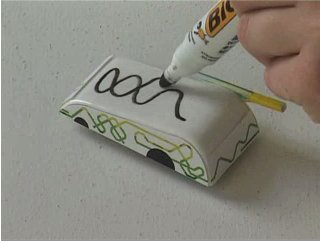
A frame from the Sketch-A-Move video

“Play is the highest form of research.”

—Albert Einstein1

That’s what I always say when I’m playing games, too.

I really liked Bill Buxton‘s book Sketching User Experiences. I like it because Buxton defends design as a legitimate profession separate from other disciplines—such as engineering—while at the same time showing that designers (no matter how brilliant) can only succeed in the right ecosystem. I also like the fact that he identifies sketching (in its many forms) as a defining activity of the design profession. The many examples he shows are very inspiring.

One in particular stood out for me, which is the project Sketch-A-Move by Anab Jain and Louise Klinker done in 2004 at the RCA in London. The image above is taken from the video they created to illustrate their concept. It’s about cars auto-magically driving along trajectories that you draw on their roof. You can watch the video over at the book’s companion website. It’s a very good example of visualizing an interactive product in a very compelling way without actually building it. This was all faked, if you want to find out how, buy the book.2

The great thing about the video is not only does it illustrate how the concept works, it also gives you a sense of what the experience of using it would be like. As Buxton writes:3

“You see, toys are not about toys. Toys are about play and the experience of fun that they help foster. And that is what this video really shows. That, and the power of video to go beyond simply documenting a concept to communicating something about experience in a very visceral way.”

Not only does it communicate the fun you would have playing with it, I think this way of sketching actually helped the designers get a sense themselves of wether what they had come up with was fun. You can tell they are actually playing, being surprised by unexpected outcomes, etc.

The role of play in design is discussed by Buxton as well, although he admits he needed to be prompted by a friend of his: Alex Manu, a teacher at OCAD in Toronto writes in an email to Buxton:4

“Without play imagination dies.”

“Challenges to imagination are the keys to creativity. The skill of retrieving imagination resides in the mastery of play. The ecology of play is the ecology of the possible. Possibility incubates creativity.”

Which Buxton rephrases in one of his own personal mantras:5

“These things are far too important to take seriously.”

All of which has made me realize that if I’m not having some sort of fun while designing, I’m doing something wrong. It might be worth considering switching from one sketching technique to another. It might help me get a different perspective on the problem, and yield new possible solutions. Buxton’s book is a treasure trove of sketching techniques. There is no excuse for being bored while designing anymore.

  1. Sketching User Experiences p.349 []
  2. No, I’m not getting a commission to say that. []
  3. Ibid. 1, at 325 []
  4. Ibid., at 263 []
  5. Ibid. []

Dan

Please people. Lay off the Dan Brown. I can’t commute without seeing at least one person reading a book of his. If you’re interested in crackpot theories about templars, Jesus and Sangreal – just pick up Holy Blood, Holy Grail (Brown stole borrowed all his Da Vinci Code ‘revelations’ from that book anyway). If you’re really interested in what conspiracy theories can do to a person, read Foucalt’s Pendulum – a much, much better way to spend your time reading.

Technorati: ,