-
OK Spool, it’s been fun, sad to see you go. *Clicks unsubscribe.*
Month: December 2007
links for 2007-12-21
-
Apparently Mozilla is catching on and focussing more on user experience now. This description of how they designed a new feature is an example of that.
-
Playyoo’s chief architect David walks through the basics of the game creator.
-
Tom blogs a quote from Alan Kay he finds helpful (which was blogged by Mr. Greenfield, originally). It’s helpful for me too, thinking a lot about game literacy lately.
-
Some useful hands on suggestions for how to document rich interactions on the web.
-
A social site for gamers. Looks clean. Have signed up for an invite, will report back.
links for 2007-12-20
-
A service tracking Twitter hash tags. I’ve never been a fan of these, mainly because they make for poorly readable tweets, but this still is an interesting step towards better explicit metadata on Twitter. (Still not sure we actually need it though.)
-
“Games can have any amount of skill and chance at the same time, but you cannot imagine a game with neither skill nor chance, as that would mean the outcome was always the same and hence it would not be a game in any meaningful sense.”
-
Can hardly believe the quality of this little app. Free screen-grabbing and online storage. I’ve been looking for something like this for a long time.
Storyboarding multi-touch interactions
I think it was around half a year ago that I wrote “UX designers should get into everyware”. Back then I did not expect to be part of a ubicomp project anytime soon. But here I am now, writing about work I did in the area of multi-touch interfaces.
Background
The people at InUse (Sweden’s premier interaction design consultancy firm) asked me to assist them with visualising potential uses of multi-touch technology in the context of a gated community. That’s right—an actual real-world physical real-estate development project. How cool is that?

This residential community is aimed at well-to-do seniors. As with most gated communities, it offers them convenience, security and prestige. You might shudder at the thought of living in one of these places (I know I have my reservations) but there’s not much use in judging people wanting to do so. Planned amenities include sports facilities, fine dining, onsite medical care, a cinema and on and on…
Social capital
One of the known issues with these ‘communities’ is that there’s not much evidence of social capital being higher there than in any regular neighbourhood. In fact some have argued that the global trend of gated communities is detrimental to the build-up of social capital in their surroundings. They throw up physical barriers that prevent free interaction of people. These are some of the things I tried to address: To see if we could support the emergence of community inside the residency using social tools while at the same counteracting physical barriers to the outside world with “virtual inroads” that allow for free interaction between residents and people in the periphery.
Being in the world
Another concern I tried to address is the different ways multi-touch interfaces can play a role in the lives of people. Recently Matt Jones addressed this in a post on the iPhone and Nokia’s upcoming multi-touch phones. In a community like the one I was designing for, the worst thing I could do is make every instance of multi-touch technology an attention-grabbing presence demanding full immersion from its user. In many cases ‘my’ users would be better served with them behaving in an unobtrusive way, allowing almost unconscious use. In other words: I tried to balance being in the world with being in the screen—applying each paradigm based on how appropriate it was given the user’s context. (After all, sometimes people want or even need to be immersed.)
Process
InUse had already prepared several personas representative of the future residents of the community. We went through those together and examined each for scenarios that would make good candidates for storyboarding. We wanted to come up with a range of scenarios that not only showed how these personas could be supported with multi-touch interfaces, but also illustrate the different spaces the interactions could take place in (private, semiprivate and public) and the scales at which the technology can operate (from small key-like tokens to full wall-screens).

I drafted each scenario as a textual outline and sketched the potential storyboards on thumbnail size. We went over those in a second workshop and refined them—making adjustments to better cover the concerns outlined above as well as improving clarity. We wanted to end up with a set of storyboards that could be used in a presentation for the client (the real-estate development firm) so we needed to balance user goals with business objectives. To that end we thought about and included examples of API-like integration of the platform with service providers in the periphery of the community. We also tried to create self-service experiences that would feel like being waited on by a personal butler.
Outcome
I ended up drawing three scenarios of around 9 panels each, digitising and cleaning them up on my Mac. Each scenario introduces a persona, the physical context of the interaction and the persona’s motivation that drives him to engage with the technology. The interactions visualised are a mix of gestures and engagements with multi-touch screens of different sizes. Usually the persona is supported in some way by a social dimension—fostering serendipity and emergence of real relations.

All in all I have to say I am pretty pleased with the result of this short but sweet engagement. Collaboration with the people of InUse was smooth (as was expected, since we are very much the same kind of animal) and there will be follow-up workshops with the client. It remains to be seen how much of this multi-touch stuff will find its way into the final gated community. That as always will depend on what makes business sense.
In any case it was a great opportunity for me to immerse myself fully in the interrelated topics of multi-touch, gesture, urbanism and sociality. And finally, it gave me the perfect excuse to sit down and do lots and lots of drawings.
links for 2007-12-19
-
Handy unobtrusive JavaScript to track downloads in Google Analytics without manually tagging every file.
-
Could it be… A well designed GTD Mac app that *also* features web based access to all actions? It seems too good to be true. Have signed up for preview, will report back. Thanks Alper!
-
“I want to download widgets off the Web, scan barcodes with my oven to share recipes with my friends on last.microwave, […]. This is what I mean about 3C products tapping into creativity, community and connectedness […]”
-
“[…] the mechanism for connection should be visible, rather than discreet. It should go out of its way to invite extension […]. The use of the mechanism, the act of extending should feel really satisfying too.”
-
Well written piece by Jane that illuminates why she as an anthropologist would want to work in social software.
-
A physics puzzle game that has you drawing objects to complete a level. Looks like fun. Via Hessel.
-
This is doing the rounds currently. A nice list by Ev of Blogger and Twitter fame on how to evaluate a new product idea. Useful!
-
“Overgeneralized lists of business “rules” are not to be taken too literally. There are exceptions to everything.” Despite the disclaimer another enjoyable list from Ev.
links for 2007-12-18
-
On the feasibility of a Google Earth powered virtual world.
-
“What we want is to make something that can illustrate the effects of real devastation if we want it to, without emotionally swindling you if you just want to think about urban growth.”
links for 2007-12-15
-
My friend Hessel’s game 1A90 gets a mention in this TIGSource roundup of Gamma256 entries! It rules. Go play it.
-
Pretty Processing stuff. Via Hessel.
-
Indie games developed with D. Also via Hessel.
-
“When we get stuck in work, play is the way we get unstuck.” This oldish research by fellow Utrechters backs that claim up.
-
A bluetooth headset with pretty impressive noise cancellation. I want one.
links for 2007-12-14
-
Dopplr has launched. If you’re not in there yet, make sure you sign up. It truly is a beautiful part of the web, not ‘just’ a beautiful web site.
-
Article on this year’s best game characters wraps up by naming “you” a memorable character (much like TIME did a while back). The authors perpetuation of the story/game dichotomy jars me a little to be honest.
-
Video of some sweet phone interactions: shaking your phone to feel how many messages are in your inbox, or how much juice is left in your battery — literally!
-
“This volume looks at games as systems in which young users participate, as gamers, producers, and learners.”
-
Greenfield interviewed by a Belgian IT mag. Recommended reading for my Dutch speaking friends.
-
Congratulations to my friends at Info.nl with the award for Volkskrant Banen!
links for 2007-12-13
-
List of all the finalists for the Independent Games Festival Mobile. A few depressing attempts to recreate the console experience, many fun looking casual puzzlers and a few that really try to take advantage of ‘the mobile platform’.
Playyoo goes beta
Today Playyoo went beta. Playyoo is a mobile games community I have been involved with as a freelance interaction designer since july of this year. I don’t have time for an elaborate post-mortem, but here are some preliminary notes on what Playyoo is and what part I’ve played in its conception.
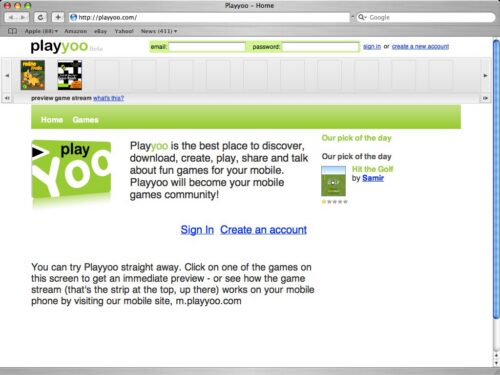
Playyoo brings some cool innovations to the mobile games space. It allows you to snack on free casual mobile games while on the go, using a personalized mobile web page. It stores your high scores and allows you to interact with your friends (and foes) on an accompanying regular web site. Playyoo is a platform for indie mobile game developers. Anyone can publish their Flash Lite game on it. Best of all — even if you’re not a mobile games developer, you can create a game of your own.
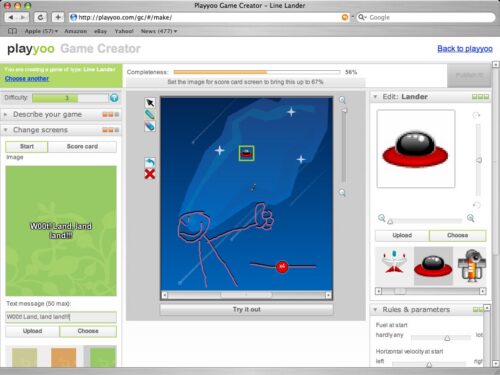
It’s that last bit I’ve worked on the most. I took care of the interaction design for an application imaginatively called the Game Creator. It allows you to take well known games (such as Lunar Lander) and give them your own personal twist. Obviously this includes the game’s graphics, but we’ve gone one step further. You can change the way the game works as well.
So in the example of Lunar Lander you can make the spaceship look like whatever you want. But you can also change the gravity, controlling the speed with which your ship drops to the surface. Best of all, you can create your own planet surface, as easy as drawing a line on paper. This is why Lunar Lander in the Playyoo Game Creator is called Line Lander. (See? Another imaginative title!)
At the moment there are six games in the Game Creator: Tic-Tac-Toe, Pairs, Revenge, Snake, Ping-Pong, and the aforementioned Line Lander. There’s long list of other games I’d like to put in there. I’m sure there will be more to come.
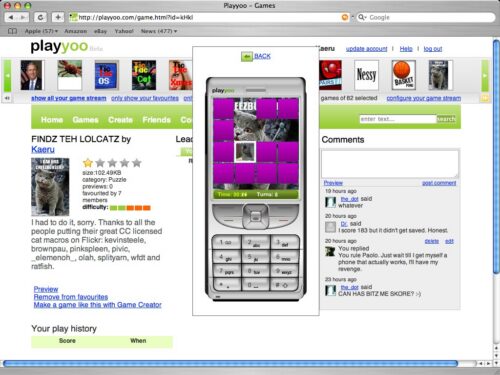
Since today’s launch, people have already started creating crazy stuff with it. There’s a maze-like snake game, for instance. And a game where you need to land a spider crab on the head of some person called Rebecca… I decided to chip in with a pairs game full of lolcats (an idea I’ve had since doing the very first wireframe.) Anyway, the mind boggles to think of what people might come up with next! That’s the cool part about creating a tool for creative expression.
So although making a game is very different from playing one, I hope I managed to make it fun nonetheless. My ambition was to create a toy-like application that makes ‘creating’ a game a fun and engaging way to kill a few minutes — much like Mii creation on the Nintendo Wii, or playing with Spore‘s editors (although we still haven’t had the chance to actually play with latter, yet.) And who knows, perhaps it’ll inspire a few people to start developing games of their own. That would probably be the ultimate compliment.
In any case, I’d love to hear your comments, both positive and negative. And if you have a Flash Lite compatible phone, be sure to sign up with Playyoo. There is no other place offering you an endless stream of snack sized casual games on your phone. Once you’ve had a taste of that, I’m sure you’ll wonder how you ever got by without it.