Design challenges for short-session gaming

Screenshot of a particularly funny Elite Beat Agents sequence

I’ve just finished reading an excellent series of post by two video game journalists on the apparent revival of short-session games. (What’s not to love about an article that finishes by asserting that Desktop Tower Defense beats BioShock at its own mechanic?) It’ll be in tomorrow’s link post but here’s the link anyway. Being involved with a casual gaming project myself lately, I’ve spent a some time thinking about what the design challenges for this sub-genre are. In other words: what make short-session games hard to pull off? I think it breaks down to these things:

  1. You need to get the player in flow as soon as possible. This means you can’t bother him with lengthy intros (or even menus). It also means the game’s mechanics should be as self-explanatory as possible. I’m reminded of the first time I started up Elite Beat Agents the other day and was given a super-short tutorial on how to play the game, then was dumped into the action right away (this is good).
  2. No stories please. Short-session gaming forces you to design for play, not for narrative (as it should be, in my opinion). It’s about giving the player an engaging activity and interesting choices, nothing more.
  3. Traditional distribution models make no sense for small games. Luckily, we now have network connectivity on virtually all gaming devices (not to mention PCs and mobile phones). The wait is for an open platform for game developers to experiment on while at the same time being able to make a buck. But even now, networked marketplaces on consoles have encouraged experimentation.
  4. The visual layer does not have to be retro. Although most short-session game experiences remind us of the good old games from the beginning days of electronic gaming, there’s no reason why these games should look retro.
  5. Throw some of that processing at the rules, not the visuals. Short-session, small and simple don’t necessarily mean crude. Don’t go all-out on my 4th point’s visuals without forgetting about all the cool complex behaviours you can create with today’s processors.

There’s much more to think and talk about, but I think these are the highlights. Particularly getting people into flow ASAP and coupling this with interesting distribution mechanisms is I think worth some more discussion.


Mirroring mental models — games modelling players

Will Wright demoing Spore at TED 2007

Today I sent in the slides of my Euro IA Summit presentation for the proceedings. The rough outline of my talk is done, the most important thing now is to find the proper examples to illustrate all the fuzzy theoretical thinking. That means (at least for me) doing a lot of Flickr photo searches. This time I’ll also be experimenting with using some short video-clips. Games are better seen in motion after all (and best experienced through play of course). Chronicling my thinking on the subject of playful IAs on this blog has been very helpful in organising my thoughts by the way, I’ll definitely try it again the next time I need to do a talk.

On mental models

One idea I managed to squeeze into the presentation in addition to the stuff I’ve been blogging about so far is about mental models. I think it was Ben Cerveny who mentioned in his Reboot 7.0 talk (MP3) that some of the pleasure of playing games is derived from the gradual mental model building a player goes through. The player uses the visual layer of a game to learn about the underlying structures. When a player masters a game, the visual layer more or less fades away and becomes a symbolic landscape through which he manipulates a far richer model of the game in his mind.

From a UX perspective because usually when designing web sites and apps we try to adhere to existing mental models as much as possible to prevent confusion and frustration. This is a very valid approach of course. However, regardless of how well done the UX design, there will always be some mental modelling on the user’s part. Best make this as engaging as possible I guess. This, again, is where games come in.

Will Wright acknowledges the fact that players build models of a game but he proposes to take it one step further. In an old(ish) talk at Accelerating Change 2004 he proposed the idea that a game can construct a model of the player as well. Parallels with online recommendation engines are apparent here. As Wright points out, in games (as in web environments) everything can be measured. This way, the experience can be tailored to a player/user. He’s applying this principle in the upcoming Spore, where game content (created by other players) is dynamically included based on inferred player preferences.

It can be argued that certain web professionals are way ahead of the games industry in this field. Perhaps there are some interesting opportunities for collaboration or career moves here?

The experience of playful IAs

Solving a Rubik's Cube

It’s time for a short update on my thinking about Playful IAs (the topic of my Euro IA Summit talk). One of the under-served aspects so far is the actual user experience of an architecture that is playful.

Brian Sutton-Smith describes a model describing the ways in which games are experienced in his book Toys as Culture. I first came across this book in (not surprisingly) Rules of Play. He lists five aspects:

  1. Visual scanning
  2. Auditory discrimination
  3. Motor responses
  4. Concentration
  5. Perceptual patterns of learning

Of most importance to my subject is the 5th one.

Game design, like the design of emergent IAs is a 2nd order design problem. You can only shape the user’s experience indirectly. One of the most important sources of pleasure for the user is the way you offer feedback on the ways he or she has explored and discovered the information space.

Obviously, I’m not saying you should make the use of your service deliberately hard. However, what I am saying is that if you’re interested in offering a playful experience on the level of IA, then Sutton-Smith’s perceptual patterns of learning is the best suited experiential dimension.

Learning about emergence from games

I’m still trying to get a grip on why I think games are such a good reference point for IAs and IxDs. I’ll try to take another stab at it in this post. Previously I wrote about how games might be a good way to ‘sell’ algorithmic architectures to your client. Even if you’re not actively pushing your clients to adopt ideas such as on-the-fly creation of site navigation, sooner or later I’m convinced you’ll find yourself confronted with a project where you’re not asked to develop a definitive information architecture. Instead you’ll be charged with the task to come up with mechanisms to generate these procedurally. When this is this case, you’re truly facing a second-order design problem. How can games help here?

One of the defining characteristics of games are their complexity. A few years ago Ben Cerveny gave a brilliant talk on play (MP3) at Reboot 7.0 and mentioned this specifically — that much of the pleasure derived from game-play is the result of the player coming to terms with complex patterns. This complexity is something different from pure randomness and most certainly different from a ‘mere’ state machine. In other words, games show emergence.

There are many examples of emergent systems. The Game of Life springs to mind. This system isn’t really a game but shows a remarkable richness in patterns, despite (or maybe because of) the fact that it is based on a set of deceptively simple rules (which apparently took its creator, John Conway, over 2 years to perfect!) The thing is though, The Game of Life is not interactive.

A wonderful example of a complex emergent system that is interactive is the real game Go. It has a set of very simple rules, but playing it well takes a huge amount of practice. The joy of playing Go for me (an absolute beginner) is largely due to discovering the many different permutations play can go through.

So getting back to my earlier remark: If you’re convinced you’ll need to get a better handle on solving the second-order design problems presented by the design of complex emergent systems, games are an excellent place to start learning. They are emergent first and interactive second, the perfect twin to the web environments we’ll be shaping in the future.

UX and the aesthetics of interactivity

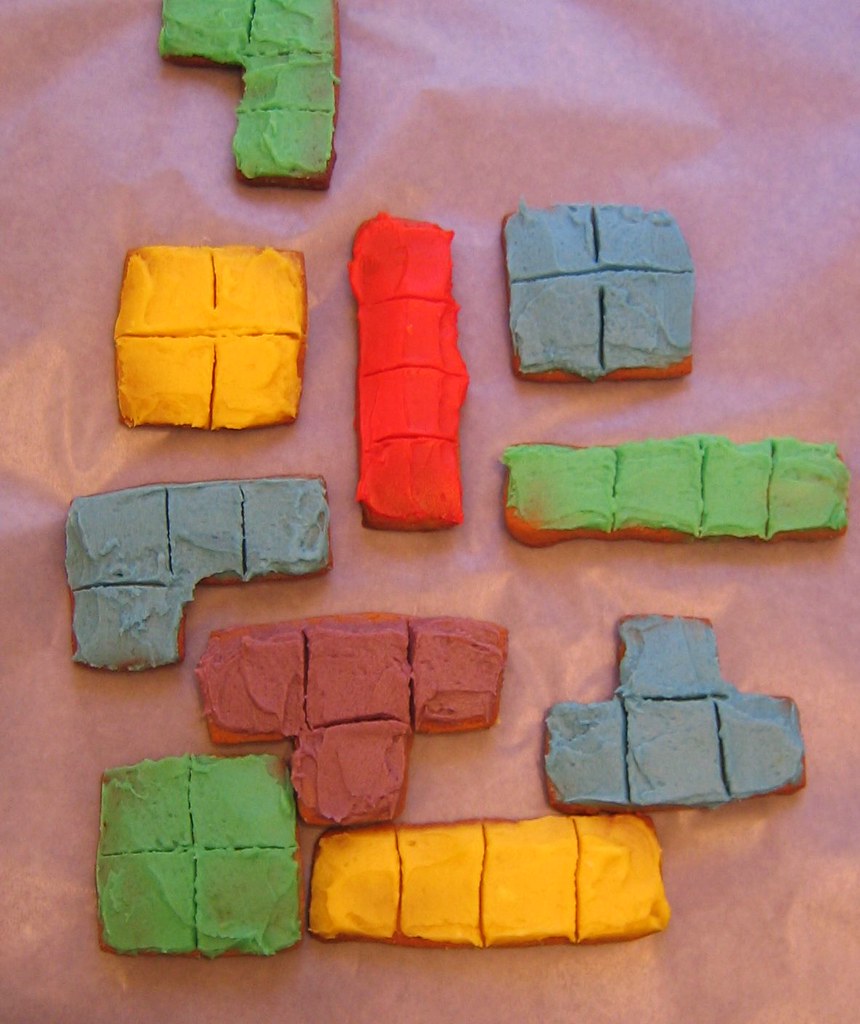
Tetris cookies

I’ve been trying to regularly post some thoughts on the topic of playful IA here. Previously I blogged about how games could be a useful frame for thinking about complex algorithmic architectures. Last week I posted some thoughts on the application of game mechanics in web apps. There, Rahul was kind enough to point me to the fascinating blog of ‘Danc’ Daniel Cook, titled Lost Garden, where there is one post in particular that resonates with my own pre-occupations lately.

In ‘Short thoughts on games and interaction design‘ (which honestly isn’t that short) Danc Cook looks at some of the ways game design techniques can be applied to the interaction design of web apps. In summary, according to Danc Cook game design techniques allow you to:

  1. Create an engaging experience that goes beyond simply completing a task efficiently.
  2. Support free and deep exploration and introduce and teach new interactions that violate conventions.

Some things you shouldn’t borrow from games without giving it a lot of thought are:

  1. Spatial metaphors
  2. Visual themes

These are some of the things most people think of first as characteristic of games but really, they are only surface, superficial, not determinant of the actual interactivity of the system.

I think one of the greatest arguments for a deeper understanding of games by interaction designers, information architects and other user experience specialists is that they are the medium that is all about the aesthetics of interactivity. It is true that they have no utilitarian character, they aim to create a pleasurable experience through systems of risks and rewards, restraints and freedoms, nested feedback loops and on and on. As a UX practitioner, it can never hurt to have a deep appreciation of the aesthetics of the medium you work in daily (beyond simply supporting user goals, or selling product, or whatever).

Game mechanics in web apps

A while ago there was a discussion on the IAI members list about game mechanics on web sites. Andrew Hinton pointed to the Google Image Labeler and LinkedIn‘s ‘profile completeness’ status bar and asked: “Can anyone else think of a use of a game mechanic like this to jump-start this kind of activity?” (Where “this kind of activity” is basically defined as something people wouldn’t normally do for its own sake, like say tagging images.)

I was thinking about this for a while the past week and seem to have ended up at the following:

On LinkedIn, having a (more or less complete) profile presumably serves some extrinsic goal. I mean, by doing so you maybe hope you’ll land a new job more easily. By slapping a status bar onto the profile that gives feedback on its completeness, the assumption is that this will stimulate you to fill it out. In other words, LinkedIn seems unsure about the presence of extrinsic motivations and is introducing an intrinsic one: getting a 100% ‘complete’ profile and as such making a game (in a very loose sense of the term) out of its professional network service. A good idea? I’m not sure…

Screenshot of Google Image Labeler

On Google Image Labeler, the starting point for its design was to come up with a way to have people add meta-data to images. Google actually ‘bought’ the game (originally called The ESP Game) from CAPTCHA inventor Luis von Ahn, who before that did reCAPTCHA and after went on to create Peekaboom and Phetch. Anyway, in the case of the Image Labeler (contrary to LinkedIn) there was no real extrinsic goal to begin with so a game had to be created. Simply having fun is the only reason people have when labelling images.

Note that Flickr for instance has found other ways to get people to tag images. What happened there is (I think) a very nice way of aligning extrinsic goals with intrinsic (fun, game-like) ones.

‘Pure’ games by their very nature have only intrinsic goals, they are artificial and non-utilitarian. When you consider introducing game-like mechanics into your web site or application (which presumably serves some external purpose, like sharing photos) think carefully about the extrinsic motivations your users will have and come up with game-like intrinsic ones that reinforce these.

Update: Alper finished the LinkedIn profile completeness game and was disappointed to find there is no pot of gold at the end of the rainbow, mirroring the experience many players of real games have when finishing a game.

Slides and video of my Reboot 9.0 talk

So I’ve been busy uploading stuff. The slides to my Reboot 9.0 talk are up at SlideShare. I uploaded a video recorded by Iskander with his N70 to Vimeo. Finally, since SlideShare still doesn’t import the notes that go with the slides in PowerPoint, I’ve also put up a big PDF (almost 50 MB). Please refer to the notes in the PDF for all the Flickr photo credits too.

Slides

Slides also on SlideShare.

Video

Mobile Social Play @ Reboot 9.0 from Kaeru on Vimeo

Notes

  • There’s a bit too much um-ing and ah-ing for my tastes. I need to do more practice, practice, practice before these things!
  • This will be the last time I use Darth Vader as the opening slide, I promise.
  • It’s too bad I didn’t have more time to go into the examples that go with the last part. Next time: less stage setting, more meat.
  • Still, I had fun. :-) Thanks again to Thomas for having me, and all the cool people at Reboot for going easy on me.

See me talk on mobile social play at Reboot 9.0

I got awesome news the other day: my proposal for a talk at Reboot 9.0 has been accepted. I’m very honoured (and a little nervous) to be presenting at a conference with so many smart attendees. Now to get my act together and create a kick-ass presentation.

If you have anything related to this (pretty broad) topic that you’d want me to address, please do leave a note in the comments.

One thing’s for sure: I’ll try to build upon what has gone before at previous Reboots, such as Ben Cerveny’s mind-blowing overview (MP3) of how play is essentially becoming a new language for us to communicate with and TL Taylor’s great talk on the dynamics of virtual worlds.

What I will be addressing is still slightly unclear to me, but the direction I’m headed is:

  1. Games can be social play, which means they can be used to forge and experiment with social relations in a ‘safe’ way. This happens whether you design for it or not, but can be nurtured.
  2. When games go mobile, the borders of the space and time in which a game is played are blurred. In this way, games bleed over into culture in a gradual way.

Enough to chew on for one talk, I guess. Again, any questions, comments and suggestions are more than welcome. See you all at Reboot 9.0.

Spatial metaphors in IA and game design

Looking at dominant metaphors in different design disciplines I’m in some way involved in, it’s obvious to me that most are spatial (no surprises there). Here’s some thoughts on how I think this is (or should be) changing. Information architecture tends to approach sites as information spaces (although the web 2.0 hype has brought us a few ‘new’ ones, on which more later.) I do a lot of IA work. I have done quite a bit of game design (and am re-entering that field as a teacher now.) Some of the designers in that field I admire the most (such as Molyneux and Wright) approach games from a more or less spatial standpoint too (and not a narrative perspective, like the vast majority do). I think it was Molyneux who said games are a series of interesting choices. Wright tends to call games ‘possibility spaces’, where a player can explore a number of different solutions to a problem, more than one of which can be viable.

I don’t think I’m going anywhere in particular here, but when looking at IA again, as I just said, the field is currently coming to terms with new ways of looking at the web and web sites; the web as a network, web as platform, the web of data, and so on. Some of these might benefit from a more procedural, i.e. game design-like, stance. I seem to remember Jesse James Garrett giving quite some attention to what he calls ‘algorithmic architecture’ (using Amazon as an example) where the IA is actually creating something akin to a possibility space for the user to explore.

Perhaps when we see more cross-pollination between game design and information architecture and interaction design for the web, we’ll end up with more and more sites that are not only more like desktop applications (the promise of RIA’s) but also more like games. Wouldn’t that be fun and interesting?

Three cool projects out of the Art, Media and Technology faculty

So a week ago I visited a project market at the Art, Media and Technology faculty in Hilversum which is part of the Utrecht School of Arts and offers BA and MA courses in Interaction Design, Game Design & Development and many others.

The range of projects on show was broad and wonderfully presented. It proves the school is still able to integrate arts and crafts with commercial and societal relevant thinking. All projects (over 40 in total) were by master of arts students and commissioned by real world clients. I’d like to point out three projects I particularly enjoyed:

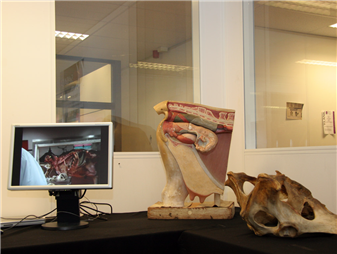
Koe

A tangible interface that models a cow’s insides and allows veterinary students to train at much earlier stage than they do now. The cow model has realistic organs made of silicon (echoes of Realdoll here) and is hooked up to a large display showing a 3D visualization of the student’s actions inside the cow. Crazy, slightly gross but very well done.

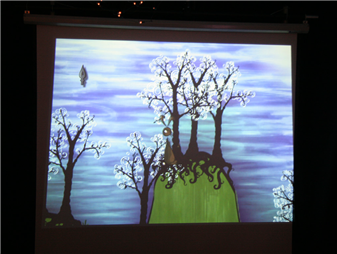
Haas

A narrative, literary game called ‘Haas’ (Dutch for hare) that allows the player to intuitively draw the level around the main character. The game’s engine reminded me a bit of Chris Crawford‘s work in that it tracks all kinds of dramatic possibilities in the game and evaluates which is the most appropriate at any time based on available characters, props, etc. Cute and pretty.

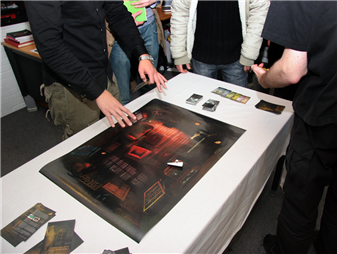
Entertaible

A game developed for Philips’ Entertaible which is a large flat panel multi-touch display that can track game pieces’ location, shape and orientation and has RFID capabilities as well. The game developed has the players explore a haunted mansion (stunningly visualized by the students in a style that is reminiscent of Pixar) and play a number of inventive mini-games. Very professionally done.

For a taste of the project market you can check out this photo album (from which the photos in this post are taken) as well as this video clip by Dutch newspaper AD.

Full disclosure: I currently teach a course in game design for mobile devices and earlier studied interaction and game design between 1998 and 2002 at the same school.