Web of data — third of five IA Summit 2007 themes

(Here’s the third post on the 2007 IA Summit. You can find the first one that introduces the series and describes the first theme ‘tangible’ here and the second one on ‘social’ here.)

Typically, IAs have concerned themselves with the design of web sites. The metaphor most suited and used for the web so far has been space. Even the term ‘information architecture’ points to this. Nowadays, besides having to tackle the social dimension (as per the previous trend mentioned) IAs are forced to rethink the spatial metaphor in favour of a new one: the web as platform. This means designing for a web of data, where sites become data sources and tools to view and manipulate that data. This is a far cry from the old hierarchical model. Like design for social software, IAs are still exploring this new territory.

There was an excellent panel on this subject (notes and audio at The Chicken Test), with amongst others Tom Coates and Matt Biddulph (both previously employed by the BBC). Coates’ presentations (Native to a Web of Data and Greater than the sum of its parts) are essential resources. He gave a super short overview of what designing for the web of data is all about. Matt went beyond screen based media into the realm of physical computing (see the first trend) showing some cool examples of Arduino prototypes feeding into Second Life.

Jared Spool talked about the usability challenges of web 2.0 and focussed on (among many things) the shortcomings of RSS and the dangers of mash-ups. RSS as a technology is pretty cool, but no normal user intuitively understands its application. This is a technology still looking for a killer app. Mash-ups are typically made by enthusiastic amateurs looking to combine available data sources or interfaces. This means we’ll see a wave of sites with serious usability issues. I’m not sure that’s a bad thing per se, but still something to look out for.
Spatial metaphors in IA and game design

Looking at dominant metaphors in different design disciplines I’m in some way involved in, it’s obvious to me that most are spatial (no surprises there). Here’s some thoughts on how I think this is (or should be) changing. Information architecture tends to approach sites as information spaces (although the web 2.0 hype has brought us a few ‘new’ ones, on which more later.) I do a lot of IA work. I have done quite a bit of game design (and am re-entering that field as a teacher now.) Some of the designers in that field I admire the most (such as Molyneux and Wright) approach games from a more or less spatial standpoint too (and not a narrative perspective, like the vast majority do). I think it was Molyneux who said games are a series of interesting choices. Wright tends to call games ‘possibility spaces’, where a player can explore a number of different solutions to a problem, more than one of which can be viable.

I don’t think I’m going anywhere in particular here, but when looking at IA again, as I just said, the field is currently coming to terms with new ways of looking at the web and web sites; the web as a network, web as platform, the web of data, and so on. Some of these might benefit from a more procedural, i.e. game design-like, stance. I seem to remember Jesse James Garrett giving quite some attention to what he calls ‘algorithmic architecture’ (using Amazon as an example) where the IA is actually creating something akin to a possibility space for the user to explore.

Perhaps when we see more cross-pollination between game design and information architecture and interaction design for the web, we’ll end up with more and more sites that are not only more like desktop applications (the promise of RIA’s) but also more like games. Wouldn’t that be fun and interesting?

Using concept models to design for the web of data

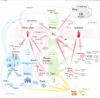
Flickr concept model by mApplogic

I’m lucky enough to be doing some concepting and interaction design work for a social web site. This presented me with the opportunity to integrate some stuff I found while reading on social software, and the web as platform/network. Here’s how I’ve been integrating some of it.

I was inspired by the concept model of the Flickr ecosystem I saw in Luke Wroblewski’s presentation on social interaction design (which was done by Bryce Glass) to try and create one myself. Coincidentally there’s a whole chapter in Dan Brown’s book (which Peter was smart enough to purchase and was lying around the office) on creating concept models.

One of the things I wanted to do is make the site play nice with the web of data. To that end, I decided to apply Tom Coates’ 3 basic page types to the design of the site. So what I did was first create a concept model (of course following some research of the site’s business and user goals) and then look at the nouns and verbs in the model. For each noun I created a single object view page and a list view page. For each verb I created a manipulation interface page. Of course, all list type pages would get RSS feeds in the eventual site.

For instance if you have a model that states ‘Reviewer rates Book’ then you’d end up with a page for each reviewer and book, a page to list reviewers, a page to list books and a manipulation interface for rating a book.

Doing this resulted in a nice list of pages that I could then analyse for completeness and/or redundancy. Of course this only works if your concept model accurately reflects what the site should achieve. If your model sucks, your list of pages will too.

Another caveat lies in the fact that a concept model tends to be very effective for mapping the functional aspects of a site, but not very suitable for creating an overview of its content (which is often more push oriented). If the kind of site you’re creating involves more information architecture than interaction design you might want to do some additional content inventory work and fold that into the page list.

One last challenge would be organizing these pages in a coherent whole (beyond coupling lists to single items to interfaces). I can imagine I’d attempt some card sorting to achieve that.

Finally, for creating the concept model I used the specialized (and free) tool CmapTools which is pretty nice in that it goes beyond visually modelling the concepts but actually tracking the statements you implicitly make when linking concepts to each other.

Anyone else have experience with trying to integrate some of the stuff Coates was talking about in their design of a site?