ARTO

Time for a status update on my stay in Singapore. I have already entered the final three months of my time here. Time flies when you’re having fun eating everything in sight, it turns out.

On the work front I have indeed found the time to do some thinking about what my next big thing will be. Nothing has firmed up to the point where I feel like sharing it here but I am enjoying the conversations I am having with various people about it.

In the meantime, I have been keeping busy working with a local startup called ARTO. I have taken on the role of product designer and I am also responsible for product management of the user-facing parts of the thing we are building.

That “thing” is about art. There are many people who are interested in art but don’t know where to start when it comes to finding, enjoying and acquiring it. We’re building a mobile and TV app that should make that a whole lot more easy and fun.

When I say art I mean commercial, popular and contemporary art of the 2D variety. So painting, illustration, photography, etc. Things you might buy originals or prints of and put on your living room wall. Others are doing a fine job on the high end of the art market. We think there are parts remaining that have been underserved to date.

There are many moving parts to this product, ranging from a recommendation engine, content management system, mobile app, TV app and more so I am never bored. There is always something to figure out in terms of what to build and how it should work and look. For the past couple of years I was always too busy managing the studio to really get into the details of design but now I can totally focus on that and it really is a pleasure.

On the people side we have a small but growing team of brilliant individuals haling from various parts of the region including Vietnam, Myanmar and India. This lends an additional layer of fun challenge to the goings on as we constantly negotiate our differences but also discover the many commonalities afforded by the globalised tech industry. I also get to travel to Ho Chi Minh City regularly which is a nice change from the extreme order that is Singapore.

It is early days so I not only get to help shape the product from the very start but also the company itself. This includes figuring out and maintaining design and development processes. For this I find my Boydian explorations quite useful, paired with what is now more than 13 years of industry experience (how did that happen?) I have also conducted more hiring interviews in the past few months than I did in the ten years before.

In a month or two a first version of the product should be in the market. When we’ve gotten to that point I will do another of these updates. In the meantime just know I am up to my armpits in thinking-through-making about art discovery and enjoyment on screens small and large. If you have anything related to share, or would like to be one of the first to test-drive the thing when it arrives, let me know.

“The really good creative people are always organized, it’s true. The difference is efficiency. If you have an agenda—a schedule—you will be better. In order to have moments of chaos and anarchy and creativity, you have to be very ordered so that when the moment arrives it doesn’t put things out of whack.”

Reminiscent of “play is free movement within a more rigid system” – I always enjoy using professional cooking as source of inspiration for improving design.

(via The Standard – Can the Brains Behind elBulli Take the Chaos Out of Creativity?)

A landscape generated from silence

So a few weeks ago, before he went surfing in Morocco, m’colleague Alper reported in an elaborate fashion on the project he and I did for the artist Sarah van Sonsbeeck. If you’re into data visualization and information design and you haven’t read it already, I encourage you to do so right now. I thought I’d post some additions and comments to Alper’s post here, going into some details related to working with 3D graphics in Processing, aesthetic considerations, and some other bits.

Final rendering of the silence landscape

Dealing with 3D in Processing

As Alper writes, part of what we were doing involved generating a 3D landscape from the sound volume and location data Sarah had gathered. What I found was that working with 3D in Processing can be cumbersome, especially with regards to camera controls. I had a hard time getting a sense of the 3D model we were generating, since the camera controls I had at my disposal were limited and a hassle to use. I can imagine that if you do this kind of work a lot, you have a kind of container Processing sketch that has all the camera controls in place. I didn’t, so ultimately I decided to go to a tool that had all the camera controls already: Google SketchUp. I could have gone to a more professional tool such as 3ds Max or Maya, but SketchUp is freely available and suited me fine. Using Marius Watz’s unlekkerLib, I exported the geometry of our landscape to a DXF file and imported it to SketchUp and that was that.

An early Processing sketch attempting to generate a shape from the data

Rendering

SketchUp is fine for manipulating and exploring a 3D model, but its rendering left something to be desired. It had been a while since I dabbled in 3D graphics (back in art school, making games) but I did recall that global illumination rendering yields pretty pictures. Sarah had told us from the outset that above everything else, it was important for the output of our exercise to be aesthetically pleasing. According to her, in the art world, beauty is paramount. So I did some Googling (as one does) and bumped into Sunflow. Karsten Schmidt had experimented with using Sunflow as a renderer directly from Processing, but this library turned out to be outdated for the current version of Processing. There is however, a Sunflow exporter for Sketchup. So I used Sketchup to set up the basics of the scene I wanted to render (camera angle and such) exported and then manually edited the resulting Sunflow file. The Sunflow wiki was a great help for understanding the anatomy of the Sunflow file format. In addition, this page, which shows examples of many shader settings, was very helpful when it came to figuring out the materials we ended up using. A snow-like material with a “sun sky” light, which makes the whole thing look like Antarctica, seemed like a good fit for the subject; silence.

An intermediate rendering of the landscape done with SketchUp

Aesthetics

Alper rightly points out neither of us is a graphic designer. But this does not mean certain aesthetic considerations came into play during this project. For instance, towards the end, we had renderings of the landscape floating above an infinite plane, as if it’s an object of sorts. I felt this did not do justice to the concept we were pursuing, so we eventually decided to merge the mesh with the underlying plane. We achieved this by simply adding a band of average noise level around the datascape and regenerating it. Optically, thanks to the nice illumination in Sunflow, there is no border between the landscape and the plane that recedes to the horizon.

A Sunflow rendering of the landscape, still floating above the ground

There’s more to be said about this project but I feel like wrapping up. A few final words with regards to the utility of this piece as data visualization then. I think from this perspective it is practically useless. As a piece of graphic art that provides a visceral sense of the data gathered by Sarah during her walks however, I think it is quite successful. Keep in mind she’s used this as part of another publication, where a set of annotations is overlaid on it.

I would also love to do an interactive version of this, allowing for free movement through the 3D space, as well as additional information layers with annotations by the artist and geographic context. Who knows, we might come around to this some time.

But for now, this is it: a picture of a landscape, generated from silence.

Work now so you can play later

There’s a lot going on at the Leapfrog studio, which explains at least in part why things have gone quiet around here. However, I wanted to take the time to alert you to some upcoming events that might be of interest.

An urban game in the Rotterdam city center

On Sunday September 27 around 50 young people will play an urban game I designed for Your World — Rotterdam European Youth Capital 2009.1 It is part of a two-day event called Change Your World, which enables groups of youth to set up a new ‘movement’ with financial support and advice from professionals. You might want to hang around the Rotterdam city center during the day, to witness what is sure to be an interesting spectacle. More info should show up soon enough at the Your World website.

A pervasive game in the Hoograven neighborhood of Utrecht

Around the same time, from September 18 to October 11, you’ll be able to play Koppelkiek in the Hoograven area of Utrecht. This is a game I’ve created for the Dutch Design Double program.2 To play, you take photos of yourself with others in a range of situations and upload them to the game’s website. It’s designed to subtly permeate your daily life. With the help of our players we’re hoping to create a collection of photos that provide a unique look into life in the neighborhood. Do join in if you’re in the area. Also, we’ll have a playtest on September 16. If you’re interested in playing a round or two, drop me a line.3

Data visualizations of silence

I’m wrapping up some data visualization work I’ve done for the artist Sarah van Sonsbeeck.4 Sarah’s work revolves (amongst other things) around the concept of silence. Alper and I took a dataset she generated during a few of her ‘silence walks’ using a GPS tracker and a sound level meter and created a number of static visualizations in Processing. Some of the output can be seen at the exhibition Een Dijk van een Kust. More will probably be on display at another occasion. Also, I’ve learnt some new tricks that I intend to share here soon.

What else, what else…

  • I’m still meaning to write something up about the work that went into Mega Monster Battle Arena™ but it will have to wait. I attended two of the three shows and enjoyed both throughly. There’s some photos up at the opera’s website.
  • We’re in the process of finishing up the This happened – Utrecht #3 videos. Once they’re all done we’ll add them to the event’s page on the .org site along with the slides. Planning for our fourth event has already started. Mark your calendar for October 26 and subscribe to our newsletter so you won’t miss the registration’s opening.
  • And finally, I’m slowly but surely giving shape to a new venture which will focus on the use of play in public space to effect social change. Its name is Hubbub. The crazy designers at BUROPONY are developing a sweet brand identity and a first placeholder site is up. Stay tuned for more news on that.

That’s about it for now, thanks for your attention. I promise to provide content with more meat and less self-promotion in upcoming posts.

  1. Karel Millenaar, game designer extraordinaire at FourceLabs and a fellow resident of the Dutch Game Garden, has helped me out on this one. []
  2. I’ve asked Tijmen Schep of PineppleJazz, NetNiet.org and the new Utrecht medialab to be my partner on this one. []
  3. Around the same time a lot of other interesting stuff related to design and society will be going on, such as the third edition of Utrecht Manifest, the biennial for social design. []
  4. I was turned on to this gig by the ubiquitous Alper Çuğun. []

“Stay hungry, stay foolish”

I graduated from the Utrecht School of the Arts in 2002. Now, less than seven years later, I am mentoring a group of five students who will be doing the same come September this year. I took a photo of them today, here it is:

Bright young bunch

From left to right, here’s who they are and what they’re up to:

  • Christiaan is tech lead on Hollandia, an action adventure game inspired by Dutch folklore. His research looks at ways to close the gap between creatives and technologists in small teams, using agile techniques.
  • Kjell is designing a series of experimental games using voice as their only input. He’s researching what game mechanics work best with voice control.
  • Maxine is game designer on the aforementioned Hollandia game. Her research looks at the translation of the play experience of physical toys to digital games. (In of Hollandia, you’ll be using a Wiimote to control the spinning top used by the heroine.)
  • Paul is building a physics-based platform puzzle game for two players. His research looks at the design of meaningful collaborative play.
  • Eva is making a space simulation game with realistic physics and complex controls. She’s researching what kinds of fun are elicited by such games.

Practically speaking, mentoring these guys means that I see them once a week for a 15-minute session. In this we discuss the past week’s progress and their plans for the next. They’ve set their own briefs, and are expected to be highly self-reliant. My task consists of making sure they stay on track and their work is relevant, both from an educational and a professional perspective. It’s challenging work, but a lot of fun. It forces me to make explicit the stuff I’ve picked up professionally. It’s also a lot about developing a sense for where each student individually can improve and encouraging them to challenge themselves in those areas.

I’m looking forward to seeing what they’ll deliver come September, when it’s their turn to graduate, and go out to conquer the world.

An assortment of weird things in public spaces

I’ve been researching street art and related topics lately, and have come across a range of interesting things people have placed in public spaces. I thought it would be fun (and perhaps enlightening) to collect them here. Each entry follows a similar format, listing what was left, by whom and with what intent, what it was made of, and what the reactions were.

Clearly, ‘playing’ in public spaces is not without risk. Reactions can vary widely and are dependent on such a huge range of things that you can essentially not predict what will happen. If you want to leave things with the aim of changing the public’s attitude, you’d best embrace this unpredictability, make use of it, and not be naive about it.

Photo of Banksy piece on Essex Road, London

Banksy (2008)

World famous street artist Banksy has created many interventions in public space. A recent one in London being a mural showing a girl raising a flag bearing the logo of Tesco’s while two children look on, hands on their harts. The piece is filmed for an hour and the result shows a huge amount of people stopping and looking at it. (Which is interesting in the context of to the next example.)

Photo credit: Ben Bell on Flickr.

Photo of Tuymans piece in Antwerp

Luc Tuymans (2008)

As an experiment, critically acclaimed contemporary painter Luc Tuymans paints a mural on the walls of a busy pedestrian street in Antwerp. Hardly anyone (less than 10%) pays the work any attention, as this video shows. What does this say about people, what does it say about contemporary art?

Photo credit: Pkeyn on Flickr.

The ATHF Mooninite LED display

ATHF Mooninite (2007)

LED displays showing a Mooninite, a character from the Aqua Teen Hunger Force animated show are attached to metal surfaces throughout 10 major cities in the USA. They are part of a guerilla marketing campaign to promote an upcoming ATHF film. After being up for a few weeks, Boston police are alerted to their presence and mistaken for possible bombs, launching a full-on scare. The artists responsible for putting them up (Peter Berdovsky, 27, and Sean Stevens, 28) are arrested but later released.

Photo credit: Emilgh on Flickr.

Mario Question Block placed in Santa Ana by Psticks

Super Mario Bros. Blocks (2006)

Street artist Poster Child publishes instructions for the creation of blocks faced with question marks taken from the game Super Mario Bros. online. Inside the blocks are the traditional power-ups from the game. His intention is to comment on the onslaught of advertising in public space. Many create the blocks and put them up in various public places, some as a statement, other for fun. One group of young women is arrested for doing the same, but are ultimately not charged.

Photo credit: Block by Psticks taken from Poster Child’s site.

Three officers inspecting one of the saucers

British UFOs (1967)

The RAE Rag Committee plants six small-sized saucers at equal distances on a straight line in the south of England. The saucers are made from fiberglass resin, contain electronics to make them bleep when tilted at certain angles and are filled with a mixture of flour and water boiled at high temperature to represent alien life. The resulting reaction is comparable to the War of the Worlds scare of 1938. The intention of the hoaxers: to raise funds for charity. They were not persecuted, although some authorities were less than amused.

Description based on an article by John Keeling in Fortean Times #228 from which the image is taken as well.

Can you think of any other weird things placed in public spaces? Do let me know.

Three cool projects out of the Art, Media and Technology faculty

So a week ago I visited a project market at the Art, Media and Technology faculty in Hilversum which is part of the Utrecht School of Arts and offers BA and MA courses in Interaction Design, Game Design & Development and many others.

The range of projects on show was broad and wonderfully presented. It proves the school is still able to integrate arts and crafts with commercial and societal relevant thinking. All projects (over 40 in total) were by master of arts students and commissioned by real world clients. I’d like to point out three projects I particularly enjoyed:

Koe

A tangible interface that models a cow’s insides and allows veterinary students to train at much earlier stage than they do now. The cow model has realistic organs made of silicon (echoes of Realdoll here) and is hooked up to a large display showing a 3D visualization of the student’s actions inside the cow. Crazy, slightly gross but very well done.

Haas

A narrative, literary game called ‘Haas’ (Dutch for hare) that allows the player to intuitively draw the level around the main character. The game’s engine reminded me a bit of Chris Crawford‘s work in that it tracks all kinds of dramatic possibilities in the game and evaluates which is the most appropriate at any time based on available characters, props, etc. Cute and pretty.

Entertaible

A game developed for Philips’ Entertaible which is a large flat panel multi-touch display that can track game pieces’ location, shape and orientation and has RFID capabilities as well. The game developed has the players explore a haunted mansion (stunningly visualized by the students in a style that is reminiscent of Pixar) and play a number of inventive mini-games. Very professionally done.

For a taste of the project market you can check out this photo album (from which the photos in this post are taken) as well as this video clip by Dutch newspaper AD.

Full disclosure: I currently teach a course in game design for mobile devices and earlier studied interaction and game design between 1998 and 2002 at the same school.

K-141 АПЛ Курск

Sometimes you learn something strange while tagging vacation shots. At least that was the case with this photo I took in Venice:

K-141 АПЛ Курск

Looking for some proper tags I Googled “K-141” and found a Wikipedia article on the Russian submarine Kursk. I pulled out the proper Russian text to use as tags but was puzzled about the reason behind the stencil.

I decided to let my direct colleagues in on the mystery and mailed it around at the office. Soon after, Peter pointed out that the same stencil art was blogged at zombizi zero-six and Wooster Collective.

Quite entertaining, but it gets even weirder. He pointed out this link, which apparently proves the stencil spree was part of Russia’s presence at the 51st Venice Biennale…

Bart rightly pointed out that it’s strange they didn’t get caught doing it. I mean: wouldn’t it be easy for the police to hold the Russians at the Biennale responsible for this blatant act of “vandalism”?

Anyway. You learn something new every day, don’t you?

Paris mashed up

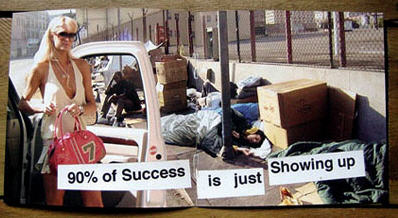
Street art hero Banksy strikes again: he’s spread 500 mashed up copies of Paris Hilton’s new album through 48 record stores in the UK. This excellent video shows how he goes about Photoshopping and pasting up the booklet, inserting a new CD and sneaking it into an HMV shop. The music on the spoof album was created by hip-hop producer Danger Mouse.

Shot of mashed up Paris booklet

Guys like him make life in the 21st century slightly more bearable; Banksy proves ordinary citizens can provide some counterweight to mass media with well-executed and highly targeted actions. HMV doesn’t agree: “It’s not the type of behaviour you’d want to see happening very often”.

Thanks to Bart for the heads-up.

An invitation to The Sultan’s Elephant

A photo of The Sultan's Elephant by Hessel

A while ago, my friend Hessel posted this excellent photo to Flickr. I’ve noticed this insanely cool performance around the interweb earlier. Now, just as back then I really wish that giant elephant and the accompanying girl will frequent one of my country’s small cities even though that doesn’t seem likely. Please Sultan’s Elephant, come to the Netherlands, I’ll give you some peanuts when you do!