Playful IAs — slides for my Euro IA Summit 2007 talk

After a considerable amount of fiddling with SlideShare I’ve finally managed to upload a version of the slides that go with my Playful IAs presentation. This more or less as I presented it at the Euro IA Summit 2007 and includes an approximate transcript of my talk. I hope to get an audio/video recording of most of it in the near future as well. When I do I’ll update this page.

Update: I’ve posted a short summary of the central argument of my talk.

Slides also on SlideShare.

Download a version including an approximate transcript (14,5 MB).

I had some great reactions to this talk and I want to thank all the people who engaged with me in discussions afterwards. It’s given me a good picture of what areas I should develop further in future subsequent talks. I’m also pleasantly surprised to see that contrary to what some people think, the IA community (the European one at least) is very much open to new ideas. That’s really nice to experience firsthand.

A lot of people asked for a list of books and other good sources on the topics I covered. Here’s an incomplete list of stuff I’ve used at some stage to inform my thinking:

If that doesn’t keep you busy for a while, you could always have a dig through my del.icio.us links. There’s plenty of good stuff there. Of course of if you ever find anything you think would be of interest to me, do let me know. Just tag it for:kaeru.


Finding playful patterns at dConstruct 2007

Fortune cookie with design wisdom and dConstruct 2007 bag

I didn’t announce it on this blog, but if you’re following me on Twitter or Jaiku, took a look at the Upcoming event page or share trips with me on Dopplr you’re probably aware that I attended dConstruct 2007 in Brighton.

By way of a short conference report I’d like to list some of the references to games and play that jumped out at me during the day. It might be that I’m slowly but surely going a little crazy or that have really discovered the secret order of the universe, but either way I was pleasantly surprised that most talks suggested that successful experience design benefits from an understanding of the dynamics of play. Here goes:

  1. Game design is a second order design problem, meaning you cannot directly design the experience of play but only the ‘stuff’ that facilitates it. Jared Spool pointed out that successful experience design is invisible, it’s only when it’s done wrong that we notice it. This makes good experience design hard to sell, and I would say the same goes for great game design.
  2. The practice of game design is very much a multidisciplinary one, with a lot of specialties on board. Similarly, there is no way you’ll be able to do good experience design when you use a relay-race-like proces. You need to have people from a lot of different backgrounds solving problems collaboratively (or a few people who can do a lot of different stuff really well.) Jared Spool briefly pointed this out, Leisa Reichelt gave a lot of good suggestions on how to facilitate this with washing-machine methodologies and Tom Coates finished his talk encouraging cross-disciplinary collaboration too.
  3. Because good experience design (like game design) is a second order design problem, and it can only be done multidisciplinary, you can only do it in an iterative and incremental way. Good games get play-tested to death to ensure they’re fun, good experiences (on the web or wherever) need the same treatment. Leisa Reichelt had some interesting ideas on how to actually pull this off: Introducing UX to Agile, by having design and development teams both working in the same rhythm, but handling different stuff in their own iterations, with a lot of hand-over and communication back and forth. Well worth trying out I think.
  4. More thoughts on the invisible nature of experience was provided by Peter Merholz, who used a quote from Tim O’Reilly: “Designing from the outside in”. Start with the UI and then figure out the data and logic. I wouldn’t equate user experience with user interface (because – again – the experience cannot be directly designed) but I think it’s a good quote nonetheless. I liked Merholz’s emphasis on the importance of an experience vision most of all.
  5. I was great to hear Denise Wilton and George Oates talk about B3ta and Flickr. A lot of people are probably aware of the gamey origins of Flickr but it was enlightening to finally see some of it on the big screen. It came as no surprise to hear that Ludicorp‘s process in making Flickr was very much washing-machine style (although they did 0 user testing for a long time!)
  6. Matt Webb was perhaps the speaker who most explicitly drew parallels between game design and experience design. (He mentioned Raph Koster’s A Theory of Fun, for instance.) He also pointed out that customisation is vital to any experience, that a product should be able to recombine with others in its ecosystem, as well as allow for personalisation. Both customisation and personalisation encourage play. Tom Coates later mentioned something very similar – that your product (which as he was eager to point out is more than just your website) should be re-combinable and extendable with and by others.
  7. One of the major themes in interaction and game design for me is behaviour, the way products encourage behaviour in their users and the kinds of behaviours they have embedded in themselves. Matt Webb also mentioned that people love to tell stories about the experiences they’ve had. This is very true of gaming, which is all about verbs, actions, doing stuff. Game design is not storytelling, the storytelling happens after the game.
  8. I had completely forgotten about Disco, the CD burning app with simulated smoke effects that serve no purpose besides play. So thanks to Matt Webb I now have an example to complement the Wii Help Cat! (Come to think of it, the discussions surrounding Stamen Design‘s Twitter Blocks might be another good one.)

In conclusion, I think it’s great that Clearleft used this year’s edition to introduce the web development community to the wonderful world of experience design. I was also very happy to see a few people on stage I had not seen present before, but knew had a lot of good stuff to say. The pre- and after-party were both a lot of fun (thanks to Media Temple, Yahoo! Developer Network and the BBC for sponsoring those with free drink and food.) And if you’re curious, I understand there will be podcasts of all the sessions online soon, so keep an eye on the site.

Mirroring mental models — games modelling players

Will Wright demoing Spore at TED 2007

Today I sent in the slides of my Euro IA Summit presentation for the proceedings. The rough outline of my talk is done, the most important thing now is to find the proper examples to illustrate all the fuzzy theoretical thinking. That means (at least for me) doing a lot of Flickr photo searches. This time I’ll also be experimenting with using some short video-clips. Games are better seen in motion after all (and best experienced through play of course). Chronicling my thinking on the subject of playful IAs on this blog has been very helpful in organising my thoughts by the way, I’ll definitely try it again the next time I need to do a talk.

On mental models

One idea I managed to squeeze into the presentation in addition to the stuff I’ve been blogging about so far is about mental models. I think it was Ben Cerveny who mentioned in his Reboot 7.0 talk (MP3) that some of the pleasure of playing games is derived from the gradual mental model building a player goes through. The player uses the visual layer of a game to learn about the underlying structures. When a player masters a game, the visual layer more or less fades away and becomes a symbolic landscape through which he manipulates a far richer model of the game in his mind.

From a UX perspective because usually when designing web sites and apps we try to adhere to existing mental models as much as possible to prevent confusion and frustration. This is a very valid approach of course. However, regardless of how well done the UX design, there will always be some mental modelling on the user’s part. Best make this as engaging as possible I guess. This, again, is where games come in.

Will Wright acknowledges the fact that players build models of a game but he proposes to take it one step further. In an old(ish) talk at Accelerating Change 2004 he proposed the idea that a game can construct a model of the player as well. Parallels with online recommendation engines are apparent here. As Wright points out, in games (as in web environments) everything can be measured. This way, the experience can be tailored to a player/user. He’s applying this principle in the upcoming Spore, where game content (created by other players) is dynamically included based on inferred player preferences.

It can be argued that certain web professionals are way ahead of the games industry in this field. Perhaps there are some interesting opportunities for collaboration or career moves here?

The experience of playful IAs

Solving a Rubik's Cube

It’s time for a short update on my thinking about Playful IAs (the topic of my Euro IA Summit talk). One of the under-served aspects so far is the actual user experience of an architecture that is playful.

Brian Sutton-Smith describes a model describing the ways in which games are experienced in his book Toys as Culture. I first came across this book in (not surprisingly) Rules of Play. He lists five aspects:

  1. Visual scanning
  2. Auditory discrimination
  3. Motor responses
  4. Concentration
  5. Perceptual patterns of learning

Of most importance to my subject is the 5th one.

Game design, like the design of emergent IAs is a 2nd order design problem. You can only shape the user’s experience indirectly. One of the most important sources of pleasure for the user is the way you offer feedback on the ways he or she has explored and discovered the information space.

Obviously, I’m not saying you should make the use of your service deliberately hard. However, what I am saying is that if you’re interested in offering a playful experience on the level of IA, then Sutton-Smith’s perceptual patterns of learning is the best suited experiential dimension.

Learning about emergence from games

I’m still trying to get a grip on why I think games are such a good reference point for IAs and IxDs. I’ll try to take another stab at it in this post. Previously I wrote about how games might be a good way to ‘sell’ algorithmic architectures to your client. Even if you’re not actively pushing your clients to adopt ideas such as on-the-fly creation of site navigation, sooner or later I’m convinced you’ll find yourself confronted with a project where you’re not asked to develop a definitive information architecture. Instead you’ll be charged with the task to come up with mechanisms to generate these procedurally. When this is this case, you’re truly facing a second-order design problem. How can games help here?

One of the defining characteristics of games are their complexity. A few years ago Ben Cerveny gave a brilliant talk on play (MP3) at Reboot 7.0 and mentioned this specifically — that much of the pleasure derived from game-play is the result of the player coming to terms with complex patterns. This complexity is something different from pure randomness and most certainly different from a ‘mere’ state machine. In other words, games show emergence.

There are many examples of emergent systems. The Game of Life springs to mind. This system isn’t really a game but shows a remarkable richness in patterns, despite (or maybe because of) the fact that it is based on a set of deceptively simple rules (which apparently took its creator, John Conway, over 2 years to perfect!) The thing is though, The Game of Life is not interactive.

A wonderful example of a complex emergent system that is interactive is the real game Go. It has a set of very simple rules, but playing it well takes a huge amount of practice. The joy of playing Go for me (an absolute beginner) is largely due to discovering the many different permutations play can go through.

So getting back to my earlier remark: If you’re convinced you’ll need to get a better handle on solving the second-order design problems presented by the design of complex emergent systems, games are an excellent place to start learning. They are emergent first and interactive second, the perfect twin to the web environments we’ll be shaping in the future.

UX and the aesthetics of interactivity

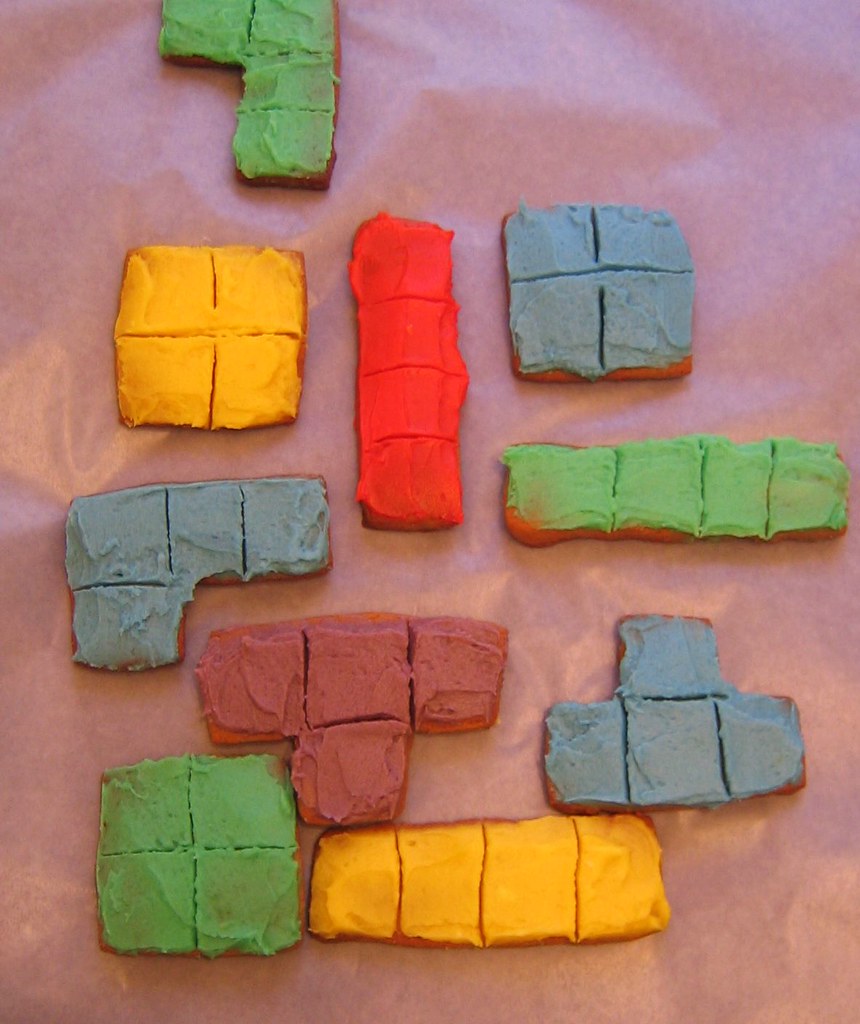
Tetris cookies

I’ve been trying to regularly post some thoughts on the topic of playful IA here. Previously I blogged about how games could be a useful frame for thinking about complex algorithmic architectures. Last week I posted some thoughts on the application of game mechanics in web apps. There, Rahul was kind enough to point me to the fascinating blog of ‘Danc’ Daniel Cook, titled Lost Garden, where there is one post in particular that resonates with my own pre-occupations lately.

In ‘Short thoughts on games and interaction design‘ (which honestly isn’t that short) Danc Cook looks at some of the ways game design techniques can be applied to the interaction design of web apps. In summary, according to Danc Cook game design techniques allow you to:

  1. Create an engaging experience that goes beyond simply completing a task efficiently.
  2. Support free and deep exploration and introduce and teach new interactions that violate conventions.

Some things you shouldn’t borrow from games without giving it a lot of thought are:

  1. Spatial metaphors
  2. Visual themes

These are some of the things most people think of first as characteristic of games but really, they are only surface, superficial, not determinant of the actual interactivity of the system.

I think one of the greatest arguments for a deeper understanding of games by interaction designers, information architects and other user experience specialists is that they are the medium that is all about the aesthetics of interactivity. It is true that they have no utilitarian character, they aim to create a pleasurable experience through systems of risks and rewards, restraints and freedoms, nested feedback loops and on and on. As a UX practitioner, it can never hurt to have a deep appreciation of the aesthetics of the medium you work in daily (beyond simply supporting user goals, or selling product, or whatever).

Game mechanics in web apps

A while ago there was a discussion on the IAI members list about game mechanics on web sites. Andrew Hinton pointed to the Google Image Labeler and LinkedIn‘s ‘profile completeness’ status bar and asked: “Can anyone else think of a use of a game mechanic like this to jump-start this kind of activity?” (Where “this kind of activity” is basically defined as something people wouldn’t normally do for its own sake, like say tagging images.)

I was thinking about this for a while the past week and seem to have ended up at the following:

On LinkedIn, having a (more or less complete) profile presumably serves some extrinsic goal. I mean, by doing so you maybe hope you’ll land a new job more easily. By slapping a status bar onto the profile that gives feedback on its completeness, the assumption is that this will stimulate you to fill it out. In other words, LinkedIn seems unsure about the presence of extrinsic motivations and is introducing an intrinsic one: getting a 100% ‘complete’ profile and as such making a game (in a very loose sense of the term) out of its professional network service. A good idea? I’m not sure…

Screenshot of Google Image Labeler

On Google Image Labeler, the starting point for its design was to come up with a way to have people add meta-data to images. Google actually ‘bought’ the game (originally called The ESP Game) from CAPTCHA inventor Luis von Ahn, who before that did reCAPTCHA and after went on to create Peekaboom and Phetch. Anyway, in the case of the Image Labeler (contrary to LinkedIn) there was no real extrinsic goal to begin with so a game had to be created. Simply having fun is the only reason people have when labelling images.

Note that Flickr for instance has found other ways to get people to tag images. What happened there is (I think) a very nice way of aligning extrinsic goals with intrinsic (fun, game-like) ones.

‘Pure’ games by their very nature have only intrinsic goals, they are artificial and non-utilitarian. When you consider introducing game-like mechanics into your web site or application (which presumably serves some external purpose, like sharing photos) think carefully about the extrinsic motivations your users will have and come up with game-like intrinsic ones that reinforce these.

Update: Alper finished the LinkedIn profile completeness game and was disappointed to find there is no pot of gold at the end of the rainbow, mirroring the experience many players of real games have when finishing a game.

Interface design — fifth and final IA Summit 2007 theme

(Here’s the fifth and final post on the 2007 IA Summit. You can find the first one that introduces the series and describes the first theme ‘tangible’ here, the second one on ‘social’ here, the third one on ‘web of data’ here and the fourth one on ‘strategy’ here.)

It might have been the past RIA hype (which according to Jared Spool has nothing to do with web 2.0) but for whatever reason, IAs are moving into interface territory. They’re broadening their scope to look at how their architectures are presented and made usable by users. The interesting part for me is to see how a discipline that has come from taxonomies, thesauri and other abstract information structures approaches the design of user facing shells for those structures. Are their designs dramatically different from those created by interface designers coming from a more visual domain concerned with surface? I would say: at least a little…

I particularly enjoyed Stephen Anderson’s presentation on adaptive interfaces. He gave many examples of interfaces that would change according to user behaviour, becoming more elaborate and explanatory or very minimal and succinct. His main point was to start with a generic interface that would be usable by the majority of users, and then come up with ways to adapt it to different specific behaviours. The way in which those adaptations were determined and documented as rules reminded me a lot of game design.

Margaret Hanley gave a solid talk on the “unsexy side of IA”, namely the design of administration interfaces. This typically involves coming up with a lot of screens with many form fields and controls. The interfaces she created allowed people to edit data that would normally not be accessible through a CMS but needed editing nonetheless (product details for a web shop, for instance). Users are accustomed to thinking in terms of editing pages, not editing data. The trickiest bit is to find ways to communicate how changes made to the data would propagate through a site and be shown in different places. There were some interesting ideas from the audience on this, but no definite solution was found.

UX designers should get into everyware

I’ve been reading Adam Greenfield’s Everyware on and off and one of the things that it has me wondering the most lately is: are UX professionals making the move to design for ubiquitous computing?

There’re several places in the book where he explicitly mentions UX in relation to everyware. Let’s have a look at the ones I managed to retrieve using the book’s trusty index…

On page 14 Greenfield writes that with the emergence of ubicomp at the dawn of the new millennium, the user experience community took up the challenge with “varying degrees of enthusiasm, scepticism and critical distance”, trying to find a “language of interaction suited to a world where information processing would be everywhere in the human environment.”

So of course the UX community has already started considering what it means to design for ubicomp. This stuff is quite different to internet appliances and web sites though, as Greenfield points out in thesis 09 (pp.37-39):

“Consistently eliciting good user experiences means accounting for the physical design of the human interface, the flow of interaction between user and device, and the larger context in which that interaction is embedded. In not a single one of these dimensions is the experience of everyware anything like that of personal computing.” (p.37)

That’s a clear statement, on which he elaborates further on, mentioning that traditional interactions are usually of a “call-and-response rhythm: user actions followed by system events.” Whereas everyware interactions “can’t meaningfully be constructed as ‘task-driven.’ Nor does anything in the interplay between user and system […] correspond with […] information seeking.” (p.38)

So, UX designers moving into everyware have their work cut out for them. This is virgin territory:

“[…] it is […] a radically new situation that will require the development over time of a doctrine and a body of standards and conventions […]” (p.39)

Now, UX in traditional projects has been prone to what Greenfield calls ‘value engineering’. Commercial projects can only be two of these three things: fast, good and cheap. UX would support the second, but sadly it is often sacrificed for the sake of the other two. Not always though, but this is usually dependent on who is involved with the project:

“[…] it often takes an unusually dedicated, persistent, and powerful advocate […] to see a high-quality design project through to completion with everything that makes it excellent intact. […] the painstakingly detailed work of ensuring a good user experience is frequently hard to justify on a short-term ROI basis, and this is why it is often one of the first things to get value-engineered out of an extended development process. […] we’ve seen that getting everyware right will be orders of magnitude more complicated than achieving acceptable quality in a Web site, […] This is not the place for value engineers,” (p.166)

So if traditional projects need UX advocates on board with considerable influence, comparable to Steve Jobs’s role at Apple, to ensure a descent user experience will it even be possible to create ubiquitous experiences that are enjoyable to use? If these projects are so complex, can they be even gotten ‘right’ in a commercial context? I’m sorry to say I think not…

Designers (used broadly) will be at the forefront of deciding what everyware looks like. If you don’t think they will, at least I’m sure they should. They’re not the only ones to determine its shape though, Greenfield points out that both regulators and markets have important parts to play too (pp.172-173):

“[…] the interlocking influences of designer, regulator, and market will be most likely to result in beneficial outcomes if these parties all treat everyware as a present reality, and if the decision makers concerned act accordingly.” (p.173)

Now there’s an interesting notion. Having just come back from a premier venue for the UX community to talk about this topic, the IA Summit, I’m afraid to say that I didn’t get the impression IAs are taking everyware seriously (yet.) There were no talks really concerned with tangible, pervasive, ubiquitous or ambient technologies. Some basic fare on mobile web stuff, that’s all. Worrying, because as Greenfield points out:

“[UX designers] will best be able to intervene effectively if they develop appropriate insights, tools, and methodologies ahead of the actual deployment of ubiquitous systems.” (pp.173-174)

This stuff is real, and it is here. Greenfield points to the existence of systems such as Octopus in Hong Kong and E-ZPass in the US. Honestly, if you think beyond the tools and methods we’ve been using to communicate our designs, IxDs and IAs are well-equipped to handle everyware. No, you won’t be required to draw wireframes or sitemaps; but you’ll damn well need to put in a lot of the thinking designers do. And you’ll still need to be able to communicate those designs. It’s time to get our hands dirty:

“What fully operational systems such as Octopus and E-ZPass tell us is that privacy concerns, social implications, ethical questions, and practical details of the user experience are no longer matters for conjecture or supposition. With ubiquitous systems available for empirical enquiry, these things we need to focus on today.” (p.217)

So, to reiterate the question I started with: are there any UX designers out there that have made the switch from web-work to ubicomp? Anyone considering it? I’d love to hear about your experiences.

Harmonious interfaces, martial arts and flow states

Screenshot of the game flOw

There’s been a few posts from the UX community in the recent past on flow states (most notably at 37signals’s Signal vs. Noise). This got me thinking about my own experiences of flow and what this tells me about how flow states could be induced with interfaces.

A common example of flow states is when playing a game (the player forgets she is pushing buttons on a game pad and is only mindful of the action at hand). I’ve experienced flow while painting but also when doing work on a PC (even when creating wireframes in Visio!) However, the most interesting flow experiences were while practising martial arts.

The interesting bit is that the flow happens when performing techniques in partner exercises or even fighting matches. These are all situations where the ‘system’ consists of two people, not one person and a medium mediated by an interface (if you’re willing to call a paint brush an interface that is).

To reach a state of flow in martial arts you need to stop thinking about performing the technique while performing it, but in stead be mindful of the effect on your partner and try to visualize your own movements accordingly. When flow happens, I’m actually able to ‘see’ a technique as one single image before starting it and while performing it I’m only aware of the whole system, not just myself.

Now here’s the beef. When you try to translate this to interface design, it’s clear that there’s no easy way to induce flow. The obvious approach, to create a ‘disappearing’ interface that is unobtrusive, minimal, etc. is not enough (it could even be harmful). In stead I’d like to suggest you need to make your game, software or site behave more like a martial arts fighter. It needs to push or give way according to the actions of it’s partner. You really need to approach the whole thing as an interconnected system where forces flow back and forth. Flow will happen in the user when he or she can work in a harmonious way. Usually this requires a huge amount of mental model adaptation on the user’s part… When will we create appliances that can infer the intentions of the user and change their stance accordingly? I’m not talking about AI here, but what I would like to see is stuff more along the lines of flOw.