“Stay hungry, stay foolish”

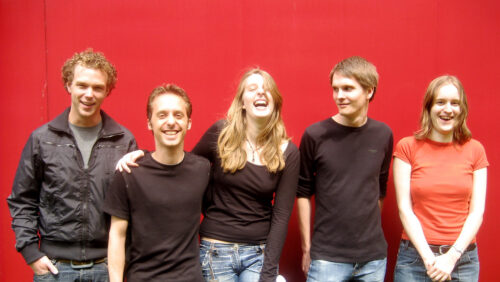
I graduated from the Utrecht School of the Arts in 2002. Now, less than seven years later, I am mentoring a group of five students who will be doing the same come September this year. I took a photo of them today, here it is:

Bright young bunch

From left to right, here’s who they are and what they’re up to:

  • Christiaan is tech lead on Hollandia, an action adventure game inspired by Dutch folklore. His research looks at ways to close the gap between creatives and technologists in small teams, using agile techniques.
  • Kjell is designing a series of experimental games using voice as their only input. He’s researching what game mechanics work best with voice control.
  • Maxine is game designer on the aforementioned Hollandia game. Her research looks at the translation of the play experience of physical toys to digital games. (In of Hollandia, you’ll be using a Wiimote to control the spinning top used by the heroine.)
  • Paul is building a physics-based platform puzzle game for two players. His research looks at the design of meaningful collaborative play.
  • Eva is making a space simulation game with realistic physics and complex controls. She’s researching what kinds of fun are elicited by such games.

Practically speaking, mentoring these guys means that I see them once a week for a 15-minute session. In this we discuss the past week’s progress and their plans for the next. They’ve set their own briefs, and are expected to be highly self-reliant. My task consists of making sure they stay on track and their work is relevant, both from an educational and a professional perspective. It’s challenging work, but a lot of fun. It forces me to make explicit the stuff I’ve picked up professionally. It’s also a lot about developing a sense for where each student individually can improve and encouraging them to challenge themselves in those areas.

I’m looking forward to seeing what they’ll deliver come September, when it’s their turn to graduate, and go out to conquer the world.

What I’m doing at the Festival of Games

tglobe

I’ve helped out with the program of this year’s NLGD Festival of Games. If you’re into gaming’s fringe phenomena, then this edition is not to be missed. The conference’s theme is “play global, global play” and will celebrate the impact of gaming beyond the screen. I curated several sessions focused on urban games and alternate reality games, some of which I will be present at myself. Here they are in no particular order:

  • Adrian Hon of Six to Start is coming over to Utrecht for a keynote titled “Why stories in games suck”. Adrian was one of the people behind the ambitious and influential ARG Perplex City. For a taste of what this session might be like, check out Dan Hon’s1 talk “Everything you know about ARGs is WRONG”.

  • During a parallel session, Evert Hoogendoorn will look at performance in games. Evert heads up the Design for Virtual Theater and Games program at the Utrecht School of the Arts. Knowing Evert, this session won’t be just about performance…

  • I’ll be moderating a session consisting of three case studies. You’ll get an exclusive look behind the scenes of the practice of three seasoned designers of urban games and ARGs. The presentations will be short but sweet, each followed by ample time for Q&A. The people I’ve asked to present are the aforementioned Adrian Hon, Nathalie Brähler of Cultural Oil and Ronald Lenz of 7scenes.

  • The elusive Minkette and myself will run a three-hour workshop, where you’ll get a crash course in designing simple but fun street games. We’re hoping to make this session very accessible, but also very much hands-on, physical and active. Minkette has been involved with Punchdrunk, Hide & Seek and The Soho Project; what better facilitator can you wish for?

  • The games developed during the workshop will be available for playtesting during a separate open session. You’ll get to play fun little games, and will be asked to vote on your favourite. The winner will receive an awesome prize.

  • Update: Before the open playtest session, I’ll be hosting a lunch session open to all people working in the area of social and tangible play. It’s on the program as “ARG lunch” but don’t let that fool you. If you make urban games, pervasive games, or any type of game that’s not limited to what happens on the screen, you’re welcome to join us. We’ll be looking at how we can join forces in certain strategic areas, but the session is also just about getting to know each other.

And there you have it. I’m quite happy with the way the program has shaped up, and I am excited to see how the sessions turn out (though I’m sure they’ll be great). If this has wet your appetite, why not head over to the NLGD Festival of Games website and get yourself a ticket right now? I hope to see you there!

  1. Dan is Adrian’s brother and business partner [↩]

Looking back on a second This happened – Utrecht

Some more catching up with things that occurred recently; on Monday February 23 we1 had our second This happened. I am quite satisfied with how things went.

Image no longer available: “Blank projector screen at This happened – Utrecht #2 by Ties Alfrink”, photo by tiesalfrink on Flickr.

For one; we had some unplanned cohesion2 amongst talks.3 Three out of four talks discussed the use of field research (to use the term broadly). It was good to have some discussion of how this is put in practice, as I often find ethnographic techniques being presented as some kind of silver bullet, but without any clear demonstration of its application. It was also cool to see field research being applied effectively in such different contexts (primary school, the elderly, South Africa).

To my relief, a significantly larger percentage of the audience (compared to last time) was female.4 This was something we had worked consciously towards, since the first edition’s testosterone quotient was a bit too high. In my opinion, a more diverse audience is conducive to the kind of relaxed, open and honest atmosphere we are pursuing. The main way we tried to draw in a more balanced mix of people was by inviting more female speakers. Three out of four talks were by women. All of them were great. It seems to have worked.

I love that This happened seems to be a venue for the kind of unassuming and honest presentations we somehow stop giving once we leave design school (or at least I have). I can’t think of other events where I am treated to such wonderful war stories from the front-lines of interaction design.

Image no longer available: “Sanne Kistemaker, Alexander Zeh and Ianus Keller at This happened – Utrecht #2 by Ties Alfrink”, photo by tiesalfrink on Flickr.

The discussions after each session were good again as well. Lots of thoughtful questions, critical, but fair. Alper was kind enough to keep minutes, and has blogged the most salient parts over at his site (in Dutch).5

Our friends in London launched a new website that now contains videos and slides of all talks from past events. The Utrecht sessions are on there too, so go have a look. It already is an amazing collection of high-quality content. Some of my current favourites are Troika, Crispin Jones and Schulze & Webb.6

The next This happened – Utrecht (number three) is set for June 29. Hope to see you there.

  1. Alexander, Ianus and I [↩]
  2. Iskander spotted it first, this is a blog post in Dutch discussing the parallels between the talks [↩]
  3. Honestly, this was not something we had aimed for beforehand. [↩]
  4. I realize in the tech scene this has once again become a hot topic, see for instance this discussion over at Chris Messina’s blog. [↩]
  5. I’ve collected more posts on our second edition over at Delicious. [↩]
  6. While you’re there, why not vote for This happened in the Brit Insurance Design of the Year 2009 awards at the Design Museum? [↩]

On sketching

Catching up with this slightly neglected blog (it’s been 6 weeks since the last proper post). I’d like to start by telling you about a small thing I helped out with last week. Peter Boersma1 asked me to help out with one of his UX Cocktail Hours. He was inspired by a recent IxDA Studio event where, in stead of just chatting and drinking, designers actually made stuff. (Gasp!) Peter wanted to do a workshop where attendees collaborated on sketching a solution to a given design problem.

Part of my contribution to the evening was a short presentation on the theory and practice of sketching. On the theory side, I referenced Bill Buxton’s list of qualities that define what a sketch is2, and emphasized that this means a sketch can be done in any material, not necessarily pencil and paper. Furthermore I discussed why sketching works, using part of an article on embodied interaction3. The main point there, as far as I am concerned is that when sketching, as designers we have the benefit of ‘backtalk’ from our materials, which can provide us with new insights. I wrapped up the presentation with a case study of a project I did a while back with the Amsterdam-based agency Info.nl4 for a social web start-up aimed at independent professionals. In the project I went quite far in using sketches to not only develop the design, but also collaboratively construct it with the client, technologists and others.

The whole thing was recorded; you can find a video of the talk at Vimeo (thanks to Iskander and Alper). I also uploaded the slides to SlideShare (sans notes).

The second, and most interesting part of the evening was the workshop itself. This was set up as follows: Peter and I had prepared a fictional case, concerning peer-to-peer energy. We used the Dutch company Qurrent as an example, and asked the participants to conceptualise a way to encourage use of Qurrent’s product range. The aim was to have people be more energy efficient, and share surplus energy they had generated with the Qurrent community. The participants split up in teams of around ten people each, and went to work. We gave them around one hour to design a solution, using only pen and paper. Afterwards, they presented the outcome of their work to each other. For each team, we asked one participant to critique the work by mentioning one thing he or she liked, and one thing that could be improved. The team was then given a chance to reply. We also asked each team to briefly reflect on their working process. At the end of the evening everyone was given a chance to vote for their favourite design. The winner received a prize.5

Wrapping up, I think what I liked most about the workshop was seeing the many different ways the teams approached the problem (many of the participants did not know each other beforehand). Group dynamics varied hugely. I think it was valuable to have each team share their experiences on this front with each other. One thing that I think we could improve was the case itself; next time I would like to provide participants with a more focused, more richly detailed briefing for them to sink their teeth in. That might result in an assignment that is more about structure and behaviour (or even interface) and less about concepts and values. It would be good to see how sketching functions in such a context.

  1. the Netherlands’ tallest IA and one of several famous Peters who work in UX [↩]
  2. taken from his wonderful book Sketching User Experiences [↩]
  3. titled How Bodies Matter (PDF) by Klemer and Takayama [↩]
  4. who were also the hosts of this event [↩]
  5. I think it’s interesting to note that the winner had a remarkable concept, but in my opinion was not the best example of the power of sketching. Apparently the audience valued product over process. [↩]

The 2nd Dutch ‘This happened’ is coming this way

We’re less than four weeks removed from the second edition of ‘This happened – Utrecht’. As you may know, this is an event I am organizing and curating together with Alexander and Ianus. We’re trying to offer an alternative to flashy product-focused (and fuzzy theory-based) sessions that are prevalent in the interaction design event landscape. ‘This happened’ presentations are short stories about how a project came to be, warts and all. Think of them as the DVD extras for interaction design.

This happened – Utrecht #1

On Monday February 23, we’ll return to Theater Kikker in Utrecht, the Netherlands for #2. Our first edition was a success, and I’m really looking forward to continuing the experiment. Here’s who we’ve invited this time to come and shed light on one of their projects:

  • Niels Keetels, a game design researcher at the HKU, will be talking about Softbody. A game that is interesting because of its lush expressive visuals, as well as the clever balancing of open-ended and goal-directed play. Oh, and how many games fo you know that had their mechanics inspired by honest-to-goodness field research?
  • Sanne Kistemaker of Muzus will present Piece of Family, which was developed in collaboration with Vodafone. It’s a communication device designed for the elderly, composed of a sketchpad and a scanner, which instantly posts whatever’s written to a blog. The design won a prestigious Dutch Design Award.
  • Irene van Peer, a celebrated product designer, will talk about the Mahlangu Hand-washer, which was featured in the New York Times 8th Annual Year in Ideas. It is both a product (developed as part of a sanitation project in Africa) that involves converting the cap of an empty bottle into a homemade tap, as well as a set of instructions that can be passed on from person to person.
  • Finally, we have Naomi Schiphorst and Mieke Vullings of MIMOA, who will show how their free and open online guide to modern architecture came into being. The site is aimed at a broad audience, not just architects, and aims to build a durable community.

Head over to the This happened – Utrecht website for expanded descriptions of the talks (in Dutch). The registration will open on Monday February 9. I hope to see you there!

The theory and practice of urban game design

A few weeks ago NLGD asked me to help out with an urban games ‘seminar’ that they had commissioned in collaboration with the Dutch Game Garden. A group of around 50 students from two game design courses at the Utrecht School of the Arts1 were asked to design a game for the upcoming Festival of Games in Utrecht. The workshop lasted a week. My involvement consisted of a short lecture, followed by several design exercises designed to help the students get started on Monday. On Friday, I was part of the jury that determined which game will be played at the festival.

Lecture

In the lecture I briefly introduced some thinkers in urbanism that I find of interest to urban game designers. I talked about Jane Jacobs’ view of the city as a living organism that is grown from the bottom up. I also mentioned Kevin Lynch’s work around wayfinding and the elements that make up people’s mental maps of cities. I touched upon the need to have a good grasp of social interaction patterns2. Finally, I advised the students to be frugal when it comes to the inclusion of technology in the students’ game designs. A good question to always ask yourself is: can I have as much fun without this gadget?

I wrapped up the lecture by looking at 5 games, some well-known, others less so: Big Urban Game, ConQwest, Pac-Manhattan, The Soho Project and The Comfort of Strangers. There are many more good examples, of course, but each of these helped in highlighting a specific aspect of urban games design.

Workshop

Next, I ran a workshop of around 3 hours with the students, consisting of two exercises (plus one they could complete afterwards in their own time). The first one is the most interesting to discuss here. It’s a game-like elicitation technique called VNA3, which derives its name from the card types in the deck it is made up of: verbs, nouns and adjectives.

Students doing a VNA exercise

The way it works is that you take turns drawing a card from the deck and make up a one-sentence idea involving the term. The first person to go draws a verb, the second person a noun and the third an adjective. Each person builds on the idea of his or her precursor. The concept that results from the three-card sequence is written down, and the next person draws a verb card again.4 The exercise resembles cadavre exquis, the biggest difference being that here, the terms are predetermined.

VNA is a great ice-breaker. The students were divided into teams of five and, because a side-goal of the seminar was to encourage collaboration between students from the different courses, they often did not know each other. Thanks to this exercise they became acquainted, but within a creative context. The exercise also privileges volume of ideas over their quality, which is perfect in the early stages of conceptualization. Last but not least, it is a lot of fun; many students asked where they could get the deck of cards.

Jurying

On Friday, I (together with the other jury members) was treated to ten presentations by the students. Each had prepared a video containing footage of prototyping and play-testing sessions, as well as an elevator pitch. A lot of them were quite good, especially considering the fact that many students had not created an urban game before, or hadn’t even played one. But one game really stood out for me. It employed a simple mechanic: making chains of people by holding hands. A chain was started by players, but required the help of passers-by to complete. Watching the videos of chains being completed evoked a strong positive emotional response, not only with myself, but also my fellow jurors. What’s more important though, is that the game clearly engendered happiness in its participants, including the people who joined in as it was being played.

An urban game being played

In one video sequence, we see a near-completed chain of people in a mall, shouting requests at people to join in. A lone man has been observing the spectacle from a distance for some time. Suddenly, he steps forward, and joins hands with the others. The chain is completed. A huge cheer emerges from the group, hands are raised in the air and applause follows, the man joining in. Then he walks off towards the camera, grinning, two thumbs up. I could not help but grin back.5

Happy urban game participant
  1. Game Design and Development and Design for Virtual Theatre and Games [↩]
  2. pointing to this resource, that was discussed at length on the IGDA ARG SIG [↩]
  3. developed by Annakaisa Kultima [↩]
  4. An interesting aside is that the deck was originally designed to be used for the creation of casual mobile games. The words were chosen accordingly. Despite this, or perhaps because of this, they are quite suitable to the design of urban games. [↩]
  5. To clarify, this was not the game that got selected for the Festival of Games. There were some issues with the game as a whole. It was short-listed though. Another excellent game, involving mechanics inspired by photo safari, was the winner. [↩]

Cities, systems, literacy, games

If you were asked to improve your own neighbourhood, what would you change? And how would you go about communicating those changes?

Cities are systems, or rather, many systems that interconnect. Like buildings, they can be thought of as having layers, each changing at its own pace. If those layers are loosely coupled, the city — like the building — can adapt.

Recently, new urban layers/systems have started to emerge. They are made up of rapidly proliferating computing power, carried by people and embedded in the environment, used to access vast amounts of data.

…

At the same time, games have given rise to a new form of literacy — systemic literacy. However, to date, players have mostly inhabited the systems that make up games. They can read them. Writing, on the other hand, is another matter. True systemic literacy means being able to change the systems you inhabit.

True read/write systemic literacy can be used to craft games, yes. But it can also be used to see that many other problems and challenges in daily life are systemic ones.

To be sure, the real-time city will confront its inhabitants with many new problems. It is of the essence that the people shaping these new systems have a deep concern for their fellow humans. But it is also at least as important that people are taught the knowledge and skills — and given the tools — to change stuff about their surroundings as they see fit.

The wonderful thing is, we can shape systems, using the ‘new’ streets as a platform that transfer this knowledge and these skills to people. We can create ‘serious’ urban games that facilitate speculative modelling, so that people can improve their living environment, or at least express what they would change about it, in a playful way.

What I’ve been up to lately

You might be wondering what’s been going on at the Leapfrog studio lately, since I haven’t really posted anything substantial here in a while. Quite some stuff has happened — and I’ll hopefully get back into posting longer articles soon — but for now, here’s a list of more or less interesting things I have been doing:

This happened – Utrecht

We had our first This happened – Utrecht on November 3. I think we succeeded in creating an event that really looks at the craft of interaction design. I’m happy to say we’re planning to do three events next year — all at Theater Kikker in Utrecht — and we’ve got lots of cool speakers in mind. If you want to make sure you won’t miss them, subscribe to our newsletter (in Dutch).1

Teaching

My students are nearing the end of their project. They’ve been hard at work creating concepts for mobile social games with a musical component; they came up with 20 in total. Now they’re prototyping two of them, and I must say it’s looking good. They’ll have to present the games to the project’s commissioner — a major mobile phone manufacturer — somewhere the beginning of January 2009. I hope to be able to share some of the results here afterwards.

Office space

Since December 1 I am a resident of the Dutch Game Garden’s Business Club. That means I now have a nice office smack in the centre of Utrecht. The building’s home to lots of wonderful games companies, some, like me, operating on the fringes — like FourceLabs and Monobanda. If you’re curious and would like to drop by for a tour, a coffee and some conversation, let me know.

Brainstorm

I was invited do help compose one of the cases for the ‘Grote Amsterdamse Waterbrainwave’. A one-day brainstorm in which 45 students from various institutions were asked to come up with water-related innovations that would make the Netherlands a significant global player once again. It was organised by the Port of Amsterdam, Waternet and Verleden van Nederland2. I also attended the day itself as an outside expert on games and the creative industry in general. Read a report of the event at FD.nl (in Dutch).

Book

Dan Saffer’s book Designing Gestural Interfaces has been published by O’Reilly and is now available. Turn to page 109 and you’ll find a storyboard by yours truly used for illustration purposes. That’s the first time any work of mine is featured in print, so naturally I’m quite proud. I have yet to receive my copy, but got a sneak peek this weekend and I must say it looks promising. If you’re a designer needing to get up to speed with multi-touch, physical computing and such, this should be a good place to start.

That’s about it for now. There’s a lot of exciting stuff in the works, the outcomes of which I will hopefully be able to share with you in 2009.

  1. The creators of This happened in London have been nominated for a best of the year award by the Design Museum, by the way. Well-deserved, I would say! [↩]
  2. A cross-media campaign aimed at increasing awareness of Dutch national history. [↩]

Collaboratively designing Things through sketching

So far, Ianus, Alexander and I have announced three of the four people who’ll be speaking at the first Dutch This happened. They are Fabian of Ronimo Games, Philine of Supernana and Dirk of IR labs The final addition to this wonderful line-up is Werner Jainek of Cultured Code, the developers of Things, a task management application for Mac OS X as well as the iPhone and iPod Touch.

When I first got in touch with the guys at Cultured Code, I asked who of the four principals was responsible for interaction design. I was surprised to hear that a large part of the interaction design is a collaborative effort. This flies in the face of conventional wisdom in design circles: You’re not supposed to design by committee. Yet no-one can deny Things’ interaction design is solid, focused and cohesive.

Things touch still life by Cultured Code

Werner and his associates collaborate through vigorous sketching. Sometimes they produce many mock-ups to iron out apparently simple bits of the application. A prime example being this recurring tasks dialog. Just look at all the alternatives they explored. Their attention to detail is admirable. Also, take a look at the photos they posted when they announced Things touch. I’m sure that, if you’re a designer, you can’t help but love carefully examining the details of such work in progress.

Werner tells me he’s been busy scanning lots of sketches to share at This happened – Utrecht #1. I can’t wait to hear his stories about how the design of both the desktop and mobile app have happened.

Werner completes our line-up. Which you can see in full at thishappened.nl. There, you’ll also be able to register for the event starting this Monday (20 October). I hope to see you on 3 November, it promises to be a lovely filled with the stories behind interaction design.

How a student game became a Wii and DS title

It’s time to start revealing the speakers for This happened – Utrecht #1. First up is Fabian Akker, co-founder of the independent studio Ronimo Games. The studio was funded with money Fabian and his colleagues earned by selling the concept behind one of their games to THQ.1 The game is called De Blob, and the new version is now available on the Nintendo Wii and DS.2 As part of a 3rd year assignment at the Utrecht School of the Arts’ Game Design and Development course, De Blob was created for the municipality of Utrecht. The aim was to allow people to explore the city’s future station area, which is under heavy reconstruction. You could therefore call De Blob a serious game – a game that is not only fun but also useful. It is not often that a serious game makes the transition to a title aimed purely at entertainment. It is more often the case that an entertainment concept gets injected with some ‘serious’ content, with usually disappointing results. At This happened – Utrecht #1 Fabian, who was the original game’s lead designer, will share the story of how it came to be.

Screenshot of De Blob, created by Ronimo Games, published by THQ

I announced This happened – Utrecht #1 last week. The event takes place on Monday 3 October at 20:30. Registration will open next Monday (20 October) — space is limited so mark your calendars!

Curious about the rest of the line-up? Tomorrow, Ianus will announce our second speaker. Update: go read what Ianus has to say about Philine of Supernana.

  1. THQ is a large publisher of games, such as Saints Row and Age of Empires. [↩]
  2. The game was redeveloped by an outside studio. [↩]