A game as a museum as a game

Over at Non-fiction, Juha writes about a hypothetical game that simulates museum management. He asks:

“Could this be an interesting approach to open up museums and learn from our current and future audiences? Could a game be a museum? Could a museum be a game?”

I think the simple answer to all these questions is yes. But I’ve always been more interested in the how of things. So I’m lead to wonder…

Continue reading A game as a museum as a game

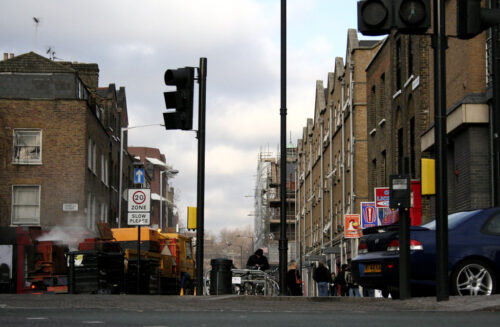
Jane Jacobs and London’s Old Street area

Honi soit qui mal y pense

I’ve been reading The Death and Life of Great American Cities at a leisurely pace since october or so. (A tempo that seems to suit the book fine. Jacobs makes me want to slow down and see.) I came across this passage during a session with the book this weekend and something about a recent visit to London clicked.

After explaining how large companies do not need to be in cities because they are to a large extent self-sufficient and thus do not have to rely on services outside themselves, Jacobs goes on to say:

“But for small manufacturers, everything is reversed. Typically they must draw on many and varied supplies and skills outside themselves, they must serve a narrow market at the point where a market exists, and they must be sensitive to quick changes in this market. Without cities, they would simply not exist. Dependent on a huge diversity of other city enterprises, they can add further to that diversity. This last is a most important point to remember. City diversity itself permits and stimulates more diversity.”

(My emphasis, by the way.)

The day before Playful ’09 I spent some time at BERG, Tinker.it! and Really Interesting Group. Nothing fancy mind you. I mean, they lent me a chair and a bit of table, plus internet. It wasn’t like I actually worked with them (although I’m sure I would enjoy it!) It was a nice experience, but most of all, it was humbling. I was struck by the spareness of the space they were in, the limited facilities at their disposal, the little room they had for all the people present.

Let me just say it was as little or less than what I’ve seen comparable groups in the Netherlands have to make do with.

And this is the thing. Over here, many of the startups I’ve encountered seem to believe they first need more and fancier facilities before they can make it big time. The Silicon Roundabout crew I mentioned earlier make a global splash at a regular basis, despite the limited (that I observed) resources at their disposal.

However, and this is where the quote from Death and Life comes in, perhaps I was looking at it the wrong way. Perhaps the Shoreditch startups are more effective than their Dutch counterparts not just because they do more with less (and because they are, clearly, insanely talented and hard working, “riding the wave of innovation, 24/7”, right guys?) but because they are in London. A city at a different scale than Amsterdam or for that matter the greater Amsterdam area, the Randstad as we call it around these parts. A city with a more diverse ecosystem of services and things, smaller services, more specialised services, ready to be employed by companies like BERG and RIG and Tinker, enhancing their abilities when needed.

The city, in this case, not as a battle suit, but more like a huge drug store stocked with a huge range of pharmaceuticals that augment then this trait, then the other.

A landscape generated from silence

So a few weeks ago, before he went surfing in Morocco, m’colleague Alper reported in an elaborate fashion on the project he and I did for the artist Sarah van Sonsbeeck. If you’re into data visualization and information design and you haven’t read it already, I encourage you to do so right now. I thought I’d post some additions and comments to Alper’s post here, going into some details related to working with 3D graphics in Processing, aesthetic considerations, and some other bits.

Final rendering of the silence landscape

Dealing with 3D in Processing

As Alper writes, part of what we were doing involved generating a 3D landscape from the sound volume and location data Sarah had gathered. What I found was that working with 3D in Processing can be cumbersome, especially with regards to camera controls. I had a hard time getting a sense of the 3D model we were generating, since the camera controls I had at my disposal were limited and a hassle to use. I can imagine that if you do this kind of work a lot, you have a kind of container Processing sketch that has all the camera controls in place. I didn’t, so ultimately I decided to go to a tool that had all the camera controls already: Google SketchUp. I could have gone to a more professional tool such as 3ds Max or Maya, but SketchUp is freely available and suited me fine. Using Marius Watz’s unlekkerLib, I exported the geometry of our landscape to a DXF file and imported it to SketchUp and that was that.

An early Processing sketch attempting to generate a shape from the data

Rendering

SketchUp is fine for manipulating and exploring a 3D model, but its rendering left something to be desired. It had been a while since I dabbled in 3D graphics (back in art school, making games) but I did recall that global illumination rendering yields pretty pictures. Sarah had told us from the outset that above everything else, it was important for the output of our exercise to be aesthetically pleasing. According to her, in the art world, beauty is paramount. So I did some Googling (as one does) and bumped into Sunflow. Karsten Schmidt had experimented with using Sunflow as a renderer directly from Processing, but this library turned out to be outdated for the current version of Processing. There is however, a Sunflow exporter for Sketchup. So I used Sketchup to set up the basics of the scene I wanted to render (camera angle and such) exported and then manually edited the resulting Sunflow file. The Sunflow wiki was a great help for understanding the anatomy of the Sunflow file format. In addition, this page, which shows examples of many shader settings, was very helpful when it came to figuring out the materials we ended up using. A snow-like material with a “sun sky” light, which makes the whole thing look like Antarctica, seemed like a good fit for the subject; silence.

An intermediate rendering of the landscape done with SketchUp

Aesthetics

Alper rightly points out neither of us is a graphic designer. But this does not mean certain aesthetic considerations came into play during this project. For instance, towards the end, we had renderings of the landscape floating above an infinite plane, as if it’s an object of sorts. I felt this did not do justice to the concept we were pursuing, so we eventually decided to merge the mesh with the underlying plane. We achieved this by simply adding a band of average noise level around the datascape and regenerating it. Optically, thanks to the nice illumination in Sunflow, there is no border between the landscape and the plane that recedes to the horizon.

A Sunflow rendering of the landscape, still floating above the ground

There’s more to be said about this project but I feel like wrapping up. A few final words with regards to the utility of this piece as data visualization then. I think from this perspective it is practically useless. As a piece of graphic art that provides a visceral sense of the data gathered by Sarah during her walks however, I think it is quite successful. Keep in mind she’s used this as part of another publication, where a set of annotations is overlaid on it.

I would also love to do an interactive version of this, allowing for free movement through the 3D space, as well as additional information layers with annotations by the artist and geographic context. Who knows, we might come around to this some time.

But for now, this is it: a picture of a landscape, generated from silence.
What the hubbub is

There’s some movement over at the website for my new venture. I mentioned Hubbub before: it is a design studio I am setting up for physical, social games that are played in public places. We hope to address social issues and the like using these games.

Recently…

Today's harvest

Also, we’ll be doing something playful and running a workshop at the upcoming Game in the City conference in Amersfoort.

To stay posted on Hubbub developments, follow us on Twitter or sign up for our newsletter. There’s good old RSS as well, of course.

Janneke Sluijs completes THUTC #4 line-up

We’ve added one more speaker to the line-up of This happened – Utrecht #4:

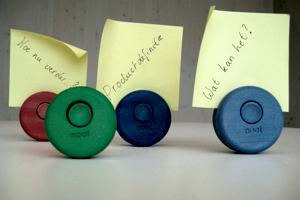
Janneke Sluijs will talk about Noot, a small tool meant to support creative sessions. Noots can be physically attached to paper artefacts that stimulate the creative process. This way, audio fragments are tagged, making it possible to retrieve the original audio context at a later time, for recollection or inspiration. Her story will focus on the origins and development of the product.

Have a look at the other three speakers in my previous post. Registration opens in a week on October 12 at 12:00 hours at thishappened.nl. The event takes place in Theater Kikker in Utrecht, on October 26.

Announcing This happened – Utrecht #4

Four weeks from now we’re running the fourth edition of This happened – Utrecht (the last one for this year). It’ll take place in Theater Kikker again, on 26 October and we’ll start at the usual time: 20:00 hours (doors op 19:30 hours). Ianus, Alexander and I have been debating this edition’s line-up fervently, and have come up with the following three great speakers for you:

Elmo Diederiks will talk about the Ambilight feature in Philips flat panel televisions. In 2002 Elmo worked as designer and researcher at Philips Research and lead the research on how dynamic lighting in the background of the TV image enhances the viewing experience. The research resulted directly in the most differentiating feature of Philips’ flat panel televisions that remains a unique selling point today.

Sue Doeksen, member of the new media art collective Zesbaans, will present De Metronoom. Six connected installations point six laser beams into the room. Visitors play the lasers like instruments and compose a soundtrack, arranging samples from classical instruments, street artists, beats and the machine room of a printing press. De Metronoom was present at the Mood Elevator party at Trouw Amsterdam and Stekkertest at Festival aan de Werf in Utrecht. Sue gives us a look behind the scenes of De Metronoom’s development – which Zesbaans is hoping to continue in the coming period – and shares their ideas on technology, performance and interface.

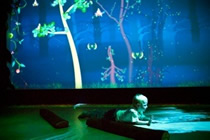
Emily Gobeille and Theo Watson will present the process behind Funky Forest, an interactive ecosystem where children create trees with their body and then divert the water flowing from the waterfall to the trees to keep them alive. The health of the trees contributes to the overall health of the forest and the types of creatures that inhabit it. The Moomah Edition of ‘Funky Forest’ expands on the original by introducing four seasons, each with a unique environment and creatures to match. Each season also features an interactive particle system. The Moomah edition is permanently installed at the Moomah Children’s Cafe in New York City.

This edition is made possible by the support from the Utrecht School of the Arts and Utrecht based web agency Rhinofly. Many thanks to them for their generosity.

Registration opens October 12 at thishappened.nl at 12:00 hours. Hope to see you there!

Work now so you can play later

There’s a lot going on at the Leapfrog studio, which explains at least in part why things have gone quiet around here. However, I wanted to take the time to alert you to some upcoming events that might be of interest.

An urban game in the Rotterdam city center

On Sunday September 27 around 50 young people will play an urban game I designed for Your World — Rotterdam European Youth Capital 2009.1 It is part of a two-day event called Change Your World, which enables groups of youth to set up a new ‘movement’ with financial support and advice from professionals. You might want to hang around the Rotterdam city center during the day, to witness what is sure to be an interesting spectacle. More info should show up soon enough at the Your World website.

A pervasive game in the Hoograven neighborhood of Utrecht

Around the same time, from September 18 to October 11, you’ll be able to play Koppelkiek in the Hoograven area of Utrecht. This is a game I’ve created for the Dutch Design Double program.2 To play, you take photos of yourself with others in a range of situations and upload them to the game’s website. It’s designed to subtly permeate your daily life. With the help of our players we’re hoping to create a collection of photos that provide a unique look into life in the neighborhood. Do join in if you’re in the area. Also, we’ll have a playtest on September 16. If you’re interested in playing a round or two, drop me a line.3

Data visualizations of silence

I’m wrapping up some data visualization work I’ve done for the artist Sarah van Sonsbeeck.4 Sarah’s work revolves (amongst other things) around the concept of silence. Alper and I took a dataset she generated during a few of her ‘silence walks’ using a GPS tracker and a sound level meter and created a number of static visualizations in Processing. Some of the output can be seen at the exhibition Een Dijk van een Kust. More will probably be on display at another occasion. Also, I’ve learnt some new tricks that I intend to share here soon.

What else, what else…

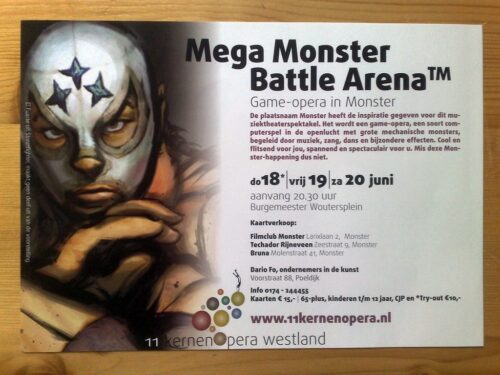
  • I’m still meaning to write something up about the work that went into Mega Monster Battle Arena™ but it will have to wait. I attended two of the three shows and enjoyed both throughly. There’s some photos up at the opera’s website.
  • We’re in the process of finishing up the This happened – Utrecht #3 videos. Once they’re all done we’ll add them to the event’s page on the .org site along with the slides. Planning for our fourth event has already started. Mark your calendar for October 26 and subscribe to our newsletter so you won’t miss the registration’s opening.
  • And finally, I’m slowly but surely giving shape to a new venture which will focus on the use of play in public space to effect social change. Its name is Hubbub. The crazy designers at BUROPONY are developing a sweet brand identity and a first placeholder site is up. Stay tuned for more news on that.

That’s about it for now, thanks for your attention. I promise to provide content with more meat and less self-promotion in upcoming posts.

  1. Karel Millenaar, game designer extraordinaire at FourceLabs and a fellow resident of the Dutch Game Garden, has helped me out on this one. [↩]
  2. I’ve asked Tijmen Schep of PineppleJazz, NetNiet.org and the new Utrecht medialab to be my partner on this one. [↩]
  3. Around the same time a lot of other interesting stuff related to design and society will be going on, such as the third edition of Utrecht Manifest, the biennial for social design. [↩]
  4. I was turned on to this gig by the ubiquitous Alper Çuğun. [↩]

This pervasive games workshop I ran at this conference

A few things I got people to do at this year’s NLGD Festival of Games:

Paper sword fight

Fight each other with paper swords…

Hunting for a frisbee with lunch-boxes on their heads

…and run around with lunch-boxes on their heads.1

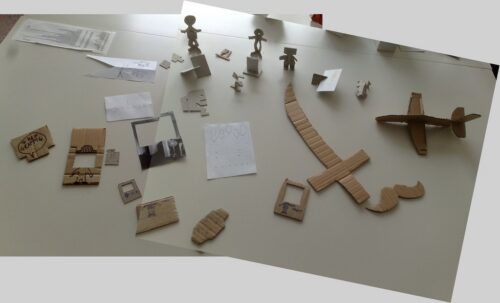
This was all part of a workshop I ran, titled ‘Playful Tinkering’. The mysterious Mink ette — who amongst many things is a designer at Six to Start — and I got people to rapidly prototype pervasive games that were be played at the conference venue the day after. The best game won a magnificent trophy shaped like a spring rider.

Some exercises we did during the workshop:

  • Play a name game Mink ette had made up shortly before the workshop in no time at all. This is good for several things: physical warm-up, breaking the ice, demonstrate the kinds of games the session is about.
  • Walk around the room and write down imaginary game titles as well as names of games you used to play as a child. Good for emptying heads and warming up mentally.
  • Walk around again, pick a post-it that intrigues you. Then guess what the game is about, and have others to fill in the blanks where need. Then play the game. This is mostly just for fun. (Nothing wrong with that.)
  • Analyse the games, break them up into their basic parts. Change one of those parts and play the game again. See what effect the change has. This is to get a sense of what games design is about, and how changing a rule impacts the player experience.
Participants brainstorming game ideas

Participants brainstorming game ideas

People then formed groups and worked on an original game. We pushed them to rapidly generate a first ruleset that could be playtested with the other groups. After this they did another design sprint, and playtested again outside the room, “in the wild”. All of this in less than four hours. Whew!

The games that were made:

  • A game that involved hunting for people that matched the descriptions on post-its that were hidden around the venue. You first needed to find a post-it, then find the person that matched the description on it and finally take a photo of them for points. This game was so quick to play it already ran at the party, hours after the workshop finished.
  • ‘Crowd Control’ — compete with other players to get the largest percentage of a group of people to do what you are doing (like nodding your head). This game won the trophy, in part because of the ferocious player recruitment style the runners employed during the playtest.
  • A sailing game, where you tried to maneuver an imaginary boat from one end of a space to the other. Your movement was constrained by the “wind”, which was a function of the amount of people on either side of your boat. It featured an ingenuous measuring mechanic which used an improvised rope made from a torn up conference tote bag.
  • The lunchbox thing was improvised during the lunch before the playtest. A student also brought in a game he was working on for his graduation to playtest.

We set up the playtest itself as follows:

The room was open to anyone passing by. Each game got their own station where they could recruit players, explain the rules, keep score, etc. Mink ette and I handed each player a red, blue and yellow tiddlywink. They could use this to vote on their favorite game in three separate categories, by handing the runners a tiddlywink. People could play more than once, and vote as often as they liked. We also kept track of how much players each game got. We handed out prizes to winners in the different categories (a lucky dip box loaded with piñata fillers). The most played game got the grand prize — the spring rider trophy I created with help from my sister and fabricated at the local fablab.2

The spring rider trophy and tiddlywinks all set for the playtest

Spring rider trophy and tiddlywinks ready for some playtesting action

It was a pleasure to have the elusive Mink ette over for the ride. I loved the way she explained what pervasive games were all about — being able to play anytime, anywhere with anything. I was also impressed with the way she managed to get people to do strange things without thinking twice.

We had a very dedicated group of participants, most of whom stuck around for the whole session and returned again for the playtest the next day. I’m very grateful for their enthusiasm. The whole experience was very rewarding, I’m keen on doing this more often at events and applying what I learnt to the workshops I run as part of my own games design practice.

Happy, happy winners!

Happy winners of the spring rider trophy flanked by Mink ette and yours truly

  1. Mayhem initiated by Evert and Marinka. [↩]
  2. I still need to write up the process of the trophy’s creation. [↩]

A third This happened – Utrecht coming this way

Around this time, an email to the ever-growing This happened – Utrecht mailing list will be sent to announce our third edition, which will take place on Monday 29 June at Theater Kikker in Utrecht.

This happened – Utrecht #3 collage

Clockwise: Trompe L’Oeil, FluxFloor, Swarm and Hyper Human.

As always, I am super excited about hearing the stories our wonderful speakers will tell about the things they’ve made. Here’s who’ll be there this time around:

  • Aldo Hoeben of fieldOfView will discuss his work on Trompe L’Oeil; a panoramic projection in the alcove of one of Utrecht’s oldest churches.
  • David Kousemaker and Tim Olden of Blendid will give us an inside look at the work behind their latest interactive light installation called Swarm.
  • Lucy McRae will go into the details of her Hyper Human project, which consists of explorations of fashion that is grown on the human body.
  • Anouk Randag of 31Volts, finally, will talk about FluxFloor, the sustainable dance floor she designed while graduating at TU Delft.

We’re going to open up registration in two weeks time on Monday 15 June at 12:00. I expect space to fill up real quick again as usual. So mark your calendars and set an alarm!

Announcing a hybrid game opera for Monster

I never thought I would make an opera. But now I have.

A bit of Monster

In a few weeks time the above market square in the town of Monster will be transformed into an arena where fighters duel each other using their pet monsters. If this sounds familiar, it is no coincidence.

Mega Monster Battle Arena is one of 11 operas produced by Dario Fo to celebrate the fifth anniversary of the Westland municipality. Dario Fo specialize in creating music theatre in close collaboration with the local community. They asked composer Daniël Hamburger to create the opera for Monster. The brief was to do ‘something’ with the town’s curious name, and to make it a production that would appeal to youth by referencing games culture.1

Daniël in turn approached me, since he had little affinity for games, and wanted the piece to not only be about games, but to be a game itself. So that’s what I helped do. By turning the game design principle of embedded narrative inside-out, we’ve managed to create a structure in which we can both tell a story using a script, and have performers improvise using game rules. Those rules I designed as a proper game. I could give you those rules and you would be able to play it yourself.

So there will be fights, and they’ll not be scripted. You won’t know beforehand who will win, and neither will we. There will also be a story, about a heroine facing off with a bad guy, in the best game and martial arts film tradition. Sieger M.G. was our third man, the piece’s writer. A rapper turned poet with a life-long games addiction, there could be no better fit.

What’s probably most exciting to me is that on top of the improvisational choreography of the duels, a live band will use a rule set of their own, composed by Daniël, that takes the game as it unfolds as its input to improvise. How’s that for adaptive music?2

It might all go horribly wrong, or it might become a wonderful spectacle. If you are like me and would like to find out which it will be, head to Monster for one of the shows. They’re scheduled for:

  • Thursday 18 June 20:30 (tryout)
  • Friday 19 June 20:30
  • Saturday 20 June 20:30

Tickets are 15 Euro and can be bought at the venue. Once the show is over, I’ll post some more detailed stuff about the actual work I did. Stay tuned.

Mega Moster Battle Arena flyer

  1. There would be tons of kids from local high schools to work with. They also wanted to use the local firemen choir. Oh, and aerial work platforms too… [↩]
  2. One of the sources of inspiration for Daniël was John Zorn. [↩]