-
A lot of statistics on past ARGs. Pretty thorough and interesting stuff. Via the IGDA ARG SIG mailing list.
-
“Computer games, architecture and urbanism: the next level” – An interesting looking book collecting essays, reviews and interviews from a wide range of luminaries.
Author: Kars Alfrink
Designer turned design researcher. Postdoc at TU Delft. Exploring contestable AI.
Helping users retell experiences
I talked about the difference between emergent and embedded narrative in games a while ago. I also introduced my Interaction 08 talk in a previous post. I’d like to now follow up with some thoughts on the storytelling that happens outside of a user’s direct interaction with a product or service – the storytelling she engages in when recounting the experience of use to other people.
Obviously, supporting the retelling of experiences is important. After all if you’re offering a cool product or service, you want others to know about it. A passionate user is probably your best advocate. It only makes sense for you to create easy ways for her to share her experiences with others. It can also deepen a user’s own experience – making the product or service part of a story wherein she is kicking ass can create a positive feedback loop.
Games have picked up on this, of course. They’ve employed numerous ways for users to retell their play-sessions. In Rules of Play, Salen and Zimmerman list a number of them:
- The replay – found in racing games for instance – literally replays the actions of the player after she completes a track, stage or level. Sometimes this is done in ways that wouldn’t be practical in the game itself1 in all cases it is done in a way that fits the feel of the game, the experience the game aims for.
- Other games take this one step further and allow players to control the view of the replay themselves. They’ll also allow users to redistribute the recording of their actions. Doom did this, it was called the recam.
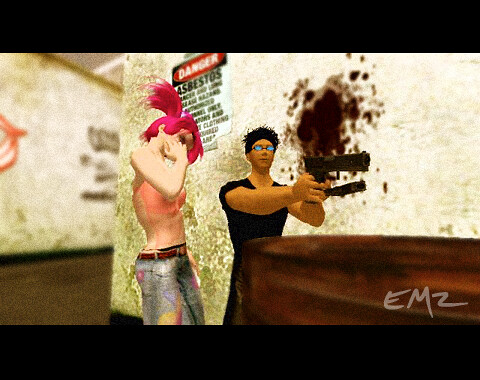
- A logical progression is found in the machinima phenomenon, where the play of a game takes a back-seat to the retelling of play, effectively making the game a tool for personal creative expression. A famous example are the many soap opera episodes produced by players of The Sims.
- Finally, with the advent of more embodied interactions in gaming there’s an upsurge of online videos of game-play. Having an embodied interface makes it much easier for bystanders to ‘read’ what’s going on, effectively opening the way for play to become like performance2.
How does this translate to the design of user experiences in digital and physical products? I think there are a few things that are important in the retelling of experiences:
- The protagonist is the user, not your product. Your product or service is the enabler for the user to look cool in a story.
- The way in which you enable retelling should be well-integrated with the experience you’re aiming for. The recam made sense for Doom because it allowed players to boast about their achievements.
- You don’t have to create all the storytelling tools yourself. You should try to play nice with the stuff that’s already out there, such as pod-casting services, video-blogging tools, sketch-casting, photo-sharing etc.
Have good examples of products and services that help their users tell stories about their experiences? Let me know in the comments!
- For instance using different camera angles, lenses or filters for a more dramatic look. [↩]
- My favorite example being this video of a couple of guys playing Guitar Hero. [↩]
links for 2007-10-31
-
I’m living in the 2nd most liveable city of Europe (according to Monocle.) I agree with most of the article, but think they are a bit mild on the Danes when it comes to tolerance. It’s easy to feign tolerance in a homogenous society as theirs after all…
-
Sterling roughly diagrams the ideas surrounding the spime concept. Perhaps most interestingly he discards the notion of panpsychism. Via Matt Jones.
-
“Roleplaying is increasingly the most socially threatening and personally dangerous leisure pastime in middle america.” Indie RPG designer Paul Czege’s dangerous gaming idea. (Old, from January 2006, but still an interesting notion.)
links for 2007-10-30
-
A new blog by Molly Wright Steenson: “Conceptual Device turns its lens to cultural ephemera like architecture, urbanism, design, music and literature, and so on.”
-
Thoughts from Merholz on the future of local content on the web. His last point, supporting decision making, is certainly an interesting IxD problem.
-
Bit of an indie classic this: Play around with string puppets in a wide range of game types.
-
Portfolio site with plenty of cool animation and character design.
-
Another reading list, this time by Dan Saffer, IxD at Adaptive Path. Some interesting picks here, particularly The Game Design Reader but no Rules of Play…
links for 2007-10-29
-
Ian Bogost interviewed on Comedy Central by Colbert. Some good sound-bites on persuasive games.
links for 2007-10-28
-
Fun: a rabbit and a snail used to label ‘faster’ and ‘slower’ on a physical interface.
More than useful — outline of my Interaction 08 talk

A while back I was happy to hear that my submission for Interaction 08 is accepted. This will be the first conference organised by the IxDA. Obviously I’m proud to be part of that. I’ll probably be building my talk a post at a time on this blog, more or less like I did with the one for the Euro IA Summit of this year. If you’re wondering wether it’ll be worth following along, let me outline the argument I made in my submission:
There’s a generation of ‘users’ expecting their digital and physical products to be customizable, personalize-able and re-combinable. These users explore the potential of these 3C products through play. This is why I think it’s worthwhile for interaction designer to get a better understanding of how to design for open-ended play. Obviously, it makes sense to do some shopping around in the theories of our colleagues in game design. Why should designers bother? Playful products have deeply engaged users that can’t stop telling stories about their experiences with them.
The focus of this talk is firmly on designing stories that emerge through play and enabling the retelling of those play experiences.
Like I said, I’ll dive deeper into these topics in the coming period. If you have any views of your own on this — or useful resources that you think I should check out — do let me know.
Update: Today the full conference program was announced and my name is actually on there. The program looks really cool, and I’m really happy to see some talks related to mine in there as well. See you in Savannah!
links for 2007-10-27
-
“The universe tends toward maximum irony. Don’t push it.” A guide to backups. Via Tom Armitage.
-
Saffer’s presentation on the application of game structures to web apps. Good stuff. Via Armitage.
-
Unusually deep puzzle action platform game that won the 4th casual game-play competition at Jay is Games. Good fun.
-
Oliveira discusses Oink’s demise and what he thinks online music stores should learn from it: price, commodity and (most importantly) choice.
-
“Anybody thinking of social software as a special category of software design needs to wake up and smell the friends list.” — Hinton on the ubiquity of sosowa.
-
Point and click adventures are far from dead. Blackwell Unbound is an indie game that makes me nostalgic for the good old days of obsessive Gabriel Knight play.
-
Upcoming ‘virtual world’ by Mind Candy. Nothing much yet here but the teaser trailer shows some high-quality character design and animation.
-
Game-play footage of a disturbing indie game in which you seem to be in semi-control of some Lovecraftian monster wreaking havoc on a forested hillside. Weird but wonderful.
-
Weird platform puzzle game where you play a black blob. Nice graphic style, fun music.
-
“innovative products come from companies with one important characteristic — willpower: The perseverance and committed resources to see a breakthrough product launched”
links for 2007-10-26
-
Impressive reading list for any user experience professional involved with the web. By my friends at FatDUX.
-
Finally Mr. Jones is publishing some posts on the design of Dopplr (which I think is nice by the way.) Here the mysteries behind Dopplr’s ‘SparkLogo’ are revealed. I wonder if they’ve considered the accessibility limitations of this approach though…
links for 2007-10-23
-
Cook on the need to embrace failure in the creative process.
-
Johnson compares average words per sentence and % complex words for himself and a number of writers. Fun stuff.
-
Wish I could participate in this London Games Festival fringe event: a 5-day cross-disciplinary game design workshop.