-
The market for mobile games is expanding with an increasingly broad demographic picking up games. The real future for mobile games is in experiences unique to the platform, not clones of console and PC titles.
Author: Kars Alfrink
Designer turned design researcher. Postdoc at TU Delft. Exploring contestable AI.
links for 2006-10-16
-
Excellent online interactive GO tutorial.
links for 2006-10-13
-
Currently undergoing a feasability study; let’s hope this new IxD institute sees the light of day.
-
Richard MacManus points to StumbleUpon as another up and coming social bookmarking site that has dramatically grown in popularity and is driving lots of traffic to his site.
-
Armitage raves about MOO and how they’re reinventing the calling card (as opposed to a business card). I can’t wait for my free sample set of ten cards to arrive.
-
Quite elaborate treatment of what good URLs are from an SEO standpoint. The only thing I’m missing is eliminating file extensions to prevent problems when switching technologies.
-
Luke Wroblewski’s presentation on social web design. I particularly like the big map of the Flickr interaction ecosystem. I’d also like to learn more about why he included game design in his constraints slide.
-
Klaus Silberbauer takes the time to express his objections to Almar’s Euro IA Summit presentation in a civil manner. I was happy to see a dissenting voice at an otherwise tame event, even though I didn’t agree with everything Almar put forward.
-
More by Trebor Scholz on ubicomp, spimes, blogjects, the internet of things and everyware. I’m glad to see someone question the technocentric optimism prevalent in the works of so many people in this field.
-
Ruben Timmerman presenteert een overzicht van tips vor gebruiksvriendelijke formulieren. Goede resource, maar zie het niet als een definitieve lijst, dubbel check Rubens feiten.
Moo’s cool
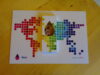 Silly title, I know. Sorry Chris.
I received my free set of 10 Flickr calling cards. They’re great, I’ll order more soon and give the nice people at Moo some of my money.
Wouldn’t it be great to have a ‘send to Moo cue queue‘ button somewhere in Flickr? So anytime I see a photo I want a print of, I can just fire it off and forget about it until I’m ready to order a batch.
Here’s some (mediocre) shots of the out of box experience.
Involving the client (a Euro IA theme)
As an IA community we’ve spent an awful amount of time educating our clients about the worth of our work. In a lot of instances we were aiming at making the client be more like us. At the summit, it was interesting to see a number of speakers stress the importance speaking the language of your client and involving them in your daily work. Some examples: Olly Wright’s talk on strategy included such lessons as understanding your client has a boss and finding out what he or she wants, speaking $$$ €€€, the fundamental language of business and making your assumptions explicit. Jared Folkman pointed out we should stop talking about users and start using the word client (certainly when working on retail websites). Doing so, we’ve already started using some of our client’s language. I mentioned agile design and development earlier and do think that one of its points that stick out for me is the focus on face-to-face meetings with the whole team (including a client). Finally, Warren Hutchinson’s presentation workshop on how to run workshops was insanely useful for learning new techniques to loosen up and get real results in client meetings.
This is the fourth post on themes spotted during the Euro IA Summit 2006. The first post was on strategy, the second on social search and the third on process & deliverables. The final post will be on accessibility. My first post-summit post can be found here.
links for 2006-10-11
-
Tom Carden suggest doing more presentations using the software you do your work in. He suggests most software supports a narrative anyway, so why not use that in stead of dead, static, PowerPoint slides?
-
List of lessons learnt by one Markus during the Future of Web Apps event. Can be read as a web 2.0 developer manifesto of sorts.
-
Well-written elaborate case study of an Adaptive Path / Soundflavor co-production. Contains some cool interface ideas as well as an educational description of the role of wireframes and specs during design and development.
-
A roundup of some simple phones primarily designed for placing a call. Many of the handsets discussed don’t seem to have had the benefit of much coherent design. Only the Jitterbug sounds cool.
-
Looking up some stuff about design research I ran across this post by Heathcote on a Scandinavian design research event.
-
Classic talk by Lawrence Lessig on free culture. Still an inspiring call to arms.
-
Hammersley can do much better than this, but it’s still fun and inspiring to see him talk on the new renaissance and our obligation to go forth and create cool sh*t.
European IAs are three years behind on their US counterparts*
Warren Hutchinson thinks this year’s Euro IA Summit was way behind on the US big brother conference in both content and form. I can’t confirm or deny this (as I’ve never been to the US summit) but I’d say any summit is better than none, and it’s clear we’re still building a practice.
He also bemoans the prevalence of conservative, ‘little IA’ thinking and a passive consumerist attitude with the majority of conference goers. True as this may be, putting yourself on a pedestal looking down on those that have been less fortunate than you in their development and exposure to big IA (or EA) thought is hardly the most productive path to take IMHO. Also, Hutchinson implies he has a tighter bond to the US summit and in some ways seems to deny a relationship with the EU design community, which I feel is a bit suspect and in some ways perhaps symptomatic of UK design thought.
I’d rather see Hutchinson take up the challenge of being an example for European IAs, designers and whatnot, as he did with his great presentation on workshops (or is that workshop on workshops?) and not slap his eager students in the face because they haven’t yet gotten the point entirely.
Just to be on the safe side: please take some of this criticism with a grain of salt. Lets have a healthy constructive discussion.
* As you can tell I don’t agree (completely) with this post’s title, which is inspired by one of the comments on Hutchinson’s post by Jonathan Mulvihill.
links for 2006-10-08
-
Louis Rosenfeld talks about how to improve analysis of site visitors’ search behaviour and how to use the subsequent insightts in a number of ways.
-
Spool expects to see more and more designers specializing in social networking design. I’d broaden it to design of social software. He quotes some stuff from Bokardo, which I don’t agree with, as usual. There sure as hell is a distinction between on and o
-
Cool (but short) presentation by Peter Merholz on experience design. One of the approaches he points out is to focus on the product ecosystem you are designing. Another is having a high-level experience vision before you set out designing.
-
Video of excellent talk by Cory Doctorow at this year’s LIFT conference. Demonstrating how DRM is essentially flawed technology and will never support an internet ready business model.
Process & deliverables (a Euro IA theme)
So sooner or later, any designer working in the professional arena doing client work will start thinking about process. What are the actual steps you go through to get to a successful outcome? Are those steps always the same? (Most design gurus would like you to think as much.) Is there one true IA process? Some attempts were made during the summit to answer these questions, most notably during the process panel lead by my colleague Peter Boersma. This got a bit stuck in discussions on how the panellists’ companies developed and managed their process and not so much into the practicalities of their respective processes. A shame.
The second day of the summit was kicked off with a wireframes panel. Wireframes are maybe the most produced deliverable by many an IA. Deliverables are a natural fit to process, which usually consists of a description of activities, roles and artefacts.
Both RUP and Agile were frequently-used terms with a memorable observation by one of the people present that during their lifetime companies seam to fluctuate between big scary processes and loose small workflows. It’s clear that any design shop adopting RUP will need to slim it down and add a much-needed user centred design component. Agile sounds cool and exciting but really only is fit for a certain type of client (a fearless one).
On the deliverables side, it struck me again how poorly we as designers are equipped to model our intended architectures in such a way that clients get it and developers can pick it up and build it. Who will fill this void?
This is the third post on themes spotted during the Euro IA Summit 2006. The first post was on strategy, the second on social search. Other posts will be on involving the client and accessibility. My first post-summit post can be found here.
Social search (a Euro IA theme)
This could also be called ‘social findability’ (with apologies to Peter Morville). A lot of stuff has been said about both the dangers and virtues of tagging and their resulting bottom-up information architectures (aka folksonomies). IAs have been working hard to come up with practical ways of merging these with traditional taxonomies, to varying degrees of success. An Italian delegation showed off a cool demo of a facetted tagging application (FaceTag) joined with some solid academic theory (as far as I could tell). The BBC presented a poster on their way of slowly including tags into their controlled vocabulary using a combination of algorithms and old-fashioned human labour. These all point to the emergence of architectures that actually apply the concept of IA pace layering introduced by Morville in his latest book. I’m sure we’ll see more of these in future.
Besides harnessing the power of massive online amateur librarianship (MOAL), another hybrid that should be further investigated is the one resulting from combining social networks with search. There wasn’t much talk about this (Peter Morville briefly mentioned it in his keynote) but it’s definitely in the air. Social search has been experimented with in the web 2.0 arena, but I get the feeling not many IAs have been involved in the effort up till now. Most current endeavours feel like whiz-bang tech demos. Where’s the first useful and usable social search engine?
Speakers on social search during the summit: Peter Morville, Andrea Resmini, Emanuele Quintarelli, Luca Rosati and Karen Loasby (poster).
This is the second post on themes spotted during the Euro IA Summit 2006. The first post was on strategy. Other posts will be on process & deliverables, involving the client and accessibility. My first post-summit post can be found here.