Strategy (a Euro IA theme)

It’s fun to track trends in IA. A lot of IA thinking originates in user centred design. The case for balancing user goals with business objectives has been made for quite a while (one of the most clear examples is in Jesse James Garrett’s diagram). The concept of a strategic IA has been gaining critical mass. At the summit, there were plenty of speakers pointing out the importance of being able to make sure your designs are perceived as relevant within a business context. This means (some if not all) IAs will have to come to grips with icky subjects such as ROI and conversion. But it’s also an excellent opportunity to finally justify doing more research. Marketing has gotten this right a while ago. Research before and after the actual realization of an architecture will enable IAs to make more informed design choices and measure the success of those same choices when the architecture is built. Getting comfortable with tools and techniques ranging from analytics, online marketing experiments to surveys, ethnographic enquiries etc, will be essential for strategic IAs. After all, it’s all about the $$$ €€€.

Speakers on strategy during the summit: Eric Reiss, Olly Wright, Ariel Guersenzvaig and Jared Folkmann.

Final thoughts

  1. Eric Reiss is worried about strategic IAs loosing touch with traditional ‘little IA’ tactics. Is it realistic to expect IAs to be both expert strategists and tacticians?
  2. When we start to talk about users in stead of customers, won’t we loose sight of what they want to buy and only think of what we want to sell them?

This is the first post on themes spotted during the Euro IA Summit 2006, other posts will be on social search, process & deliverables, involving the client and accessibility. My first post-summit post can be found here.


Euro IA Summit 2006 themes

Euro IA Summit 2006 mind-map

The second European IA Summit has come and gone. The promised live updates from Berlin weren’t delivered due to the scarcity of power sockets and flaky WiFi (a lesson for the organization of next year’s event, IMHO). I do have a few hundred photos to go through, including the contents of my Moleskine (chaotic mind-maps of each talk, for the real connoisseur.)

All in all, the summit was great. It was nice to meet old acquaintances and make new ones. We had quite a few laughs because of language and cultural differences, which is what a European event is all about I guess.

It was encouraging to see that the number of attendees was considerably larger than last year. The variety of nationalities had also increased I think, which is good of course.

The contents of talks were of a pretty high standard, while presentation skills of the speakers varied widely, as could be expected. It’s a shame when high quality content becomes hard to grasp due to bad presentation, and we had a few of those, but I still respect anyone who had the courage to step up and express their views.

On the way back I created a mind-map of all the big themes I picked up on during the weekend and intend to delve into the main ones over the course of this week in a series of mini-posts. The first one will be on strategy; the follow-ups will cover social search, process & deliverables, involving the client and accessibility.

links for 2006-09-29

I’m a European IA

Tomorrow I’m off to the 2nd European IA Summit. This year’s conference will be held in Berlin. That’s great because I’ve never been there until now. I’m planning on doing some mind mapping of talks (inspired by Lars Plougmann) so keep an eye on the Flickr photostream during the weekend. Of course, I hope the organization has managed to get some open WiFi going (last year that was a bit of a problem). Convenient power sockets would come in handy too… See you there, or see you later!

links for 2006-09-15

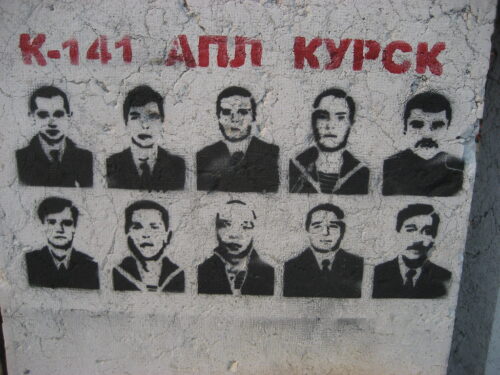
K-141 АПЛ Курск

Sometimes you learn something strange while tagging vacation shots. At least that was the case with this photo I took in Venice:

K-141 АПЛ Курск

Looking for some proper tags I Googled “K-141” and found a Wikipedia article on the Russian submarine Kursk. I pulled out the proper Russian text to use as tags but was puzzled about the reason behind the stencil.

I decided to let my direct colleagues in on the mystery and mailed it around at the office. Soon after, Peter pointed out that the same stencil art was blogged at zombizi zero-six and Wooster Collective.

Quite entertaining, but it gets even weirder. He pointed out this link, which apparently proves the stencil spree was part of Russia’s presence at the 51st Venice Biennale…

Bart rightly pointed out that it’s strange they didn’t get caught doing it. I mean: wouldn’t it be easy for the police to hold the Russians at the Biennale responsible for this blatant act of “vandalism”?

Anyway. You learn something new every day, don’t you?

Where are the good European IxD schools?

Dan Saffer of Adaptive Path wrote an introductory piece for budding interaction designers. Five years ago, Robert Reimann of Cooper did the same. Both are nice overviews for novices and especially the parts on a designer’s temperament are entertaining to read.

Saffer fails to mention any good IxD schools outside of the US and UK. Which is a shame for all of us European designers. Reimann mentioned Ivrea’s now defunct IxD institute.

I’d like to start by pointing to my courageous little country’s Utrecht School of Arts, which has been teaching IxD for 15 years now (!) and today offers both BA and MA programs. They’ve recently branched off into game design, which has been quite successful.

Full disclosure: I was a student at the same school from 1998 – 2001 (BA IxD, MA Game Design) and am now teaching a course in mobile game design.

Any other good IxD schools in Europe that you know of?

Update: discussions on Saffer’s post on the IxDA’s maling list here and here; overview of IxD education (mostly in the US) here.