-
Omroep.nl werkt al enige tijd aan een Nederlandse Digg-variant.
-
An open source iPhone killer?
-
A new productivity app called Nozbe uses Allen’s GTD as a starting point. I’m going to give it a spin and see if I have to ditch Backpack!
-
A new Terry Gilliam movie. Looks like he’s recovering from a spell of bad mojo…
-
Excellent little WordPress plug-in that generates unique monster images for each commenter on your blog.
-
“MonsterID is a method to generate a unique monster image based upon a certain identifier (IP address, email address, whatever).”
-
“Sxipper is a free plug-in for Firefox that lets you log into any website with a single click. Sxipper saves you time by keeping track of all of your user IDs, passwords, and the personal data you share every day over the web.”
-
idproxy.net uses Yahoo!’s API to sign in with a Yahoo! account, then lets you create one or more OpenIDs (of the form something.idproxy.net) to use with sites that support the OpenID standard.
-
Jon Udell argues that common parts of social network sites should be extracted and integrated into the internet’s general infrastructure. The only thing standing in the way of social networks gaining critical mass after that is fatigue.
-
Tim O’Reilly asks: “Where is the Web 2.0 address book?”
-
Metcalfe doubts whether users really want integrated social networks. I think we can integrate networks without taking away the control users have over their different identities. It’s a question of design.
Author: Kars Alfrink
Designer turned design researcher. Postdoc at TU Delft. Exploring contestable AI.
Leapfroglog now with MonsterID

Just a quick note to let my readers know the comments are now adorned with cute little MonsterIDs. I used this cool plug-in to generate unique monster pictures based on the email address a commenter leaves behind. Curious what yours looks like? Leave a comment and see. The image shown here is my monster (based on kars at leapfrog dot nl).
Update, September 2026: the plugin is long gone and so, alas, is my own monster. The one shown here is an example from the plugin’s page.
I used to have gravatars, but they didn’t work as well because hardly any commenters actually have a gravatar registered. These MonsterIDs do the hard work for the user. I like having images in the comments to be able to quickly see who commented and which comments are from the same user. It also helps tell apart people that leave behind the same name.
And, of course, these monsters look great!
links for 2007-02-16
-
“I fear that Jakob is turning into a pernicious force when it comes to advancing the field of design, because his reach means tens of thousands of people are reading this unsubstantiated crap. Such outrageous claims truly feel like the wild flailings of i
-
Mark Hurst nails it when he says: “Guess what’s a better experience for game players: talking about processor technology, or having fun?” I love my DS, and I can’t wait to get a Wii.
-
“Nintendo got religion early on the importance of expanding the audience of console gamers, where the vast majority of the industry’s sales still occur.”
-
“One of the things experienced designers are pretty good at is determining on any given project what the puzzles are and what the mysteries are.”
-
I really need to clean out my subscriptions using this method. It’s high time.
-
Gah! Het woord ‘innovatie blijkt niet één keer voor te komen in het nieuwe regeerakkoord… Tijd om te emigreren?
-
What contracts actually suit agile projects? JP Rangaswami investigates…
-
Excellent read; Eric Steven Raymond dissects open source hacker culture and lays its inner workings bear. Thinking about how this could apply to design makes my head spin.
-
Een aardig stukje over innovatie in het bedrijfsleven gebruikmakend van open source filosofieën. Dit wiki-denken noemen vind ik een beetje een stretch.
-
Latest entry in a series of posts by Warren Hutchinson on designing search systems. It describes a useful framework to keep in mind.
-
This post contains links to notes and a PDF of Boyd’s presentation at LIFT on designing social software. Huge amounts of stuff I can readily apply to my current design project. Hooray!
-
Ah this rocks, now I want the Wii even more; it seems the browser on it is so good it actually allows you to work with the wiki software we use at work.
-
Clay Shirky effortlessly deflates the hype around Second Life and criticizes mass media for not checking their facts. Should have read and posted this earlier but oh well.
Gift outcompetes exchange in design too
I just finished Eric Steven Raymond’s Homesteading the Noosphere. It’s a terrific read for anyone looking for a thorough look at the inner workings of the open source software development community. Like others, whenever reading this kind of stuff sooner or later apophenia hits and I try to tie bits to my own discipline, which isn’t programming but design.
In one of the last chapters of the essay (titled Gift Outcompetes Exchange). Raymond offers some tantalising insights into the relationships between doing complex creative work, motivation, and reward. While reading it I recognised a lot of ideas that I’ve long felt are important but could never really articulate. Now I finally have some great quotes, and (over 10 year old) research to back it up!
Psychologist Theresa Amabile of Brandeis University, cautiously summarizing the results of a 1984 study of motivation and reward, observed “It may be that commissioned work will, in general, be less creative than work that is done out of pure interest.”. Amabile goes on to observe that “The more complex the activity, the more it’s hurt by extrinsic reward.” Interestingly, the studies suggest that flat salaries don’t demotivate, but piecework rates and bonuses do.
Thus, it may be economically smart to give performance bonuses to people who flip burgers or dug ditches, but it’s probably smarter to decouple salary from performance in a programming shop and let people choose their own projects (both trends that the open-source world takes to their logical conclusions). Indeed, these results suggest that the only time it is a good idea to reward performance in programming is when the programmer is so motivated that he or she would have worked without the reward!
Other researchers in the field are willing to point a finger straight at the issues of autonomy and creative control that so preoccupy hackers. “To the extent one’s experience of being self-determined is limited,” said Richard Ryan, associate psychology professor at the University of Rochester, “one’s creativity will be reduced as well.”
So a team of designers working in the mode Raymond describes would choose their own projects and not be rewarded for their performance on projects (which is usually measured in efficiency and client satisfaction). In stead, to really keep them motivated, they’d be given a large amount of autonomy (and wouldn’t be instructed on which problems to solve and how to go about it). Of course, this only works with skilled workers, but I don’t think that’s the reason these philosophies haven’t been applied to design work on the scale they have been in programming. I think a lot of resistance for actually allowing designers work like this in a commercial setting are related to a fear of giving up control. Later on Raymond finishes the chapter with:
Indeed, it seems the prescription for highest software productivity is almost a Zen paradox; if you want the most efficient production, you must give up trying to make programmers produce. Handle their subsistence, give them their heads, and forget about deadlines. To a conventional manager this sounds crazily indulgent and doomed—but it is exactly the recipe with which the open-source culture is now clobbering its competition.
When will the first examples appear of design done in this way? When will the first projects pop up that outcompete the cathedral style designs process (or are they already among us)? Are there any designers out there actually working in this way? I’d love to hear from you.
Update: I changed the link to Flickr into one pointing to a post by Tom Coates on how Flickr was built.
links for 2007-02-14
-
I did not expect Jobs would ever publicly ‘attack’ his business partners for maintaining their silly DRM in this way. Now let’s hope this sets off some changes.
-
Video of a really cool design and prototyping environment that reminds me of DENIM but with added physics.
links for 2007-02-13
-
Net als Alper wil ik LivingColors van Philips wel hebben (kan ik eindelijk die hippe fusion restaurants aftroeven).
-
A new (?) lab at MIT focusses on the mobile experience. I’m curious what’ll come out of there in the near future.
links for 2007-02-10
-
Cool Wi-Fi sharing community. My home town is pretty impressively covered but there’s no Fonero in my neighbourhood yet, so I might sign up…
-
Eric Steven Raymond’s great essay examines how open source software development (the bazaar) differs from the traditional model (the cathedral). Great introduction to what open source is all about.
-
“With interfaces becoming more complex, and development schedules growing shorter the best prototyping tools may be simpler than you think.” Via Bart.
Using concept models to design for the web of data
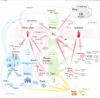
I’m lucky enough to be doing some concepting and interaction design work for a social web site. This presented me with the opportunity to integrate some stuff I found while reading on social software, and the web as platform/network. Here’s how I’ve been integrating some of it.
I was inspired by the concept model of the Flickr ecosystem I saw in Luke Wroblewski’s presentation on social interaction design (which was done by Bryce Glass) to try and create one myself. Coincidentally there’s a whole chapter in Dan Brown’s book (which Peter was smart enough to purchase and was lying around the office) on creating concept models.
One of the things I wanted to do is make the site play nice with the web of data. To that end, I decided to apply Tom Coates’ 3 basic page types to the design of the site. So what I did was first create a concept model (of course following some research of the site’s business and user goals) and then look at the nouns and verbs in the model. For each noun I created a single object view page and a list view page. For each verb I created a manipulation interface page. Of course, all list type pages would get RSS feeds in the eventual site.
For instance if you have a model that states ‘Reviewer rates Book’ then you’d end up with a page for each reviewer and book, a page to list reviewers, a page to list books and a manipulation interface for rating a book.
Doing this resulted in a nice list of pages that I could then analyse for completeness and/or redundancy. Of course this only works if your concept model accurately reflects what the site should achieve. If your model sucks, your list of pages will too.
Another caveat lies in the fact that a concept model tends to be very effective for mapping the functional aspects of a site, but not very suitable for creating an overview of its content (which is often more push oriented). If the kind of site you’re creating involves more information architecture than interaction design you might want to do some additional content inventory work and fold that into the page list.
One last challenge would be organizing these pages in a coherent whole (beyond coupling lists to single items to interfaces). I can imagine I’d attempt some card sorting to achieve that.
Finally, for creating the concept model I used the specialized (and free) tool CmapTools which is pretty nice in that it goes beyond visually modelling the concepts but actually tracking the statements you implicitly make when linking concepts to each other.
Anyone else have experience with trying to integrate some of the stuff Coates was talking about in their design of a site?
links for 2007-02-08
-
Gibson’s new novel will be out this august. I can hardly wait! This post goes into how Gibson seems to be developing a new sub genre in sci fi, which he started with Pattern Recognition.
-
Handy script that allows you to start IMing through Adium using Quicksilver.
links for 2007-02-06
-
Blunder van Yahoo!; ze zouden beter moeten weten dan de CC licenties van Flickr gebruikers te negeren.
-
A wiki where a community is trying to write a novel. Interesting and exciting, I wonder how it will turn out. Via Harm.