Strategy — fourth of five IA Summit 2007 themes

(Here’s the fourth post on the 2007 IA Summit. You can find the first one that introduces the series and describes the first theme ‘tangible’ here, the second one on ‘social’ here and the third one on ‘web of data’ here.)

Like other design disciplines, IAs are typically brought in to solve a problem. The extent to which the design problem is defined and explicated is a huge determining factor in the success of their undertaking. More often than not, an IA would take a problem and run with it, not thinking whether this is the right problem to solve, or even a problem at all!

This has always seemed like a silly situation to me. Some of the most enjoyable sessions at the summit therefore were the ones that discussed ways in which IAs can join in on strategic thinking. This way, we can help discover the actual problem that needs solving, which gives us a better chance of actually delivering a successful and valuable solution.

Gene Smith and Matthew Milan discussed conceptual models (which I’ve been playing around with for a while) and the more involved rich mapping, from soft systems thinking. Key takeaway for me was when modelling a system we should also describe its context (including the project itself). Other good stuff by people of Critical Mass (Milan again together with Sam Ladner) was provided in the form of ‘backcasting’, a very visual brainstorming method to be used in a workshop session with a client in order to envision desired project outcomes and map paths from the current situation to those outcomes (notes at The Chicken Test).

People from Avenue A Razorfish (Garrick Schmitt, Marisa Gallagher) talked about their framework for tying together lots of different user research such as click stream analysis, search logs, eye tracking and others. This reminded me of Jared Folkmann’s excellent talk at last year’s Euro IA Summit in Berlin.

Finally, I attended one nice talk (by James Robertson) on the value of contextual enquiries, which if nothing else has made me all the more determined to try this myself the next time an opportunity presents itself.
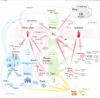
Using concept models to design for the web of data

Flickr concept model by mApplogic

I’m lucky enough to be doing some concepting and interaction design work for a social web site. This presented me with the opportunity to integrate some stuff I found while reading on social software, and the web as platform/network. Here’s how I’ve been integrating some of it.

I was inspired by the concept model of the Flickr ecosystem I saw in Luke Wroblewski’s presentation on social interaction design (which was done by Bryce Glass) to try and create one myself. Coincidentally there’s a whole chapter in Dan Brown’s book (which Peter was smart enough to purchase and was lying around the office) on creating concept models.

One of the things I wanted to do is make the site play nice with the web of data. To that end, I decided to apply Tom Coates’ 3 basic page types to the design of the site. So what I did was first create a concept model (of course following some research of the site’s business and user goals) and then look at the nouns and verbs in the model. For each noun I created a single object view page and a list view page. For each verb I created a manipulation interface page. Of course, all list type pages would get RSS feeds in the eventual site.

For instance if you have a model that states ‘Reviewer rates Book’ then you’d end up with a page for each reviewer and book, a page to list reviewers, a page to list books and a manipulation interface for rating a book.

Doing this resulted in a nice list of pages that I could then analyse for completeness and/or redundancy. Of course this only works if your concept model accurately reflects what the site should achieve. If your model sucks, your list of pages will too.

Another caveat lies in the fact that a concept model tends to be very effective for mapping the functional aspects of a site, but not very suitable for creating an overview of its content (which is often more push oriented). If the kind of site you’re creating involves more information architecture than interaction design you might want to do some additional content inventory work and fold that into the page list.

One last challenge would be organizing these pages in a coherent whole (beyond coupling lists to single items to interfaces). I can imagine I’d attempt some card sorting to achieve that.

Finally, for creating the concept model I used the specialized (and free) tool CmapTools which is pretty nice in that it goes beyond visually modelling the concepts but actually tracking the statements you implicitly make when linking concepts to each other.

Anyone else have experience with trying to integrate some of the stuff Coates was talking about in their design of a site?