Postdoc update – July 2025

I am over one year into my postdoc at TU Delft. Where did the time go? By way of an annual report, here’s a rundown of my most notable outputs and activities since the previous update from June 2024. And also, some notes on what I am up to now.

Happenings

Participatory AI and ML Engineering: On 13 February 2024 at a Human Values for Smarter Cities meeting and on 11 June 2024 at a Cities Coalition for Digital Rights meeting, I presented a talk on participatory AI and ML engineering (blogged here). This has since evolved into a study I am currently running with the working title “Vision Model Macroscope.” We are designing, building, and evaluating an interface that allows municipal workers to understand and debate value-laden technical decisions made by machine learning engineers in the construction of camera vehicles. For the design, I am collaborating with CLEVER°FRANKE. The study is part of the Human Values for Smarter Cities projected headed up by the Civic Interaction Design group at AUAS.

Envisioning Contestability Loops: My article “Envisioning Contestability Loops: Evaluating the Agonistic Arena as a Generative Metaphor for Public AI” (with Ianus Keller, Mireia Yurrita Semperena, Denis Bulygin, Gerd Kortuem, and Neelke Doorn) was published in She Ji on 17 June 2024. (I had already published the infographic “Contestability Loops for Public AI,” which the article revolves around, on 17 April 2024.) Later in the year, on 5 September 2024, I ran the workshop that the study builds on as a ThingsCon Salon. And on 27 September 2024, I presented the article at Lawtomation Days in Madrid, Spain, as part of the panel “Methods in law and technology research: inter- and cross-disciplinary challenges and opportunities,” chaired by Kostina Prifti (slides). (Also, John Thackara said nice things about the article online.)
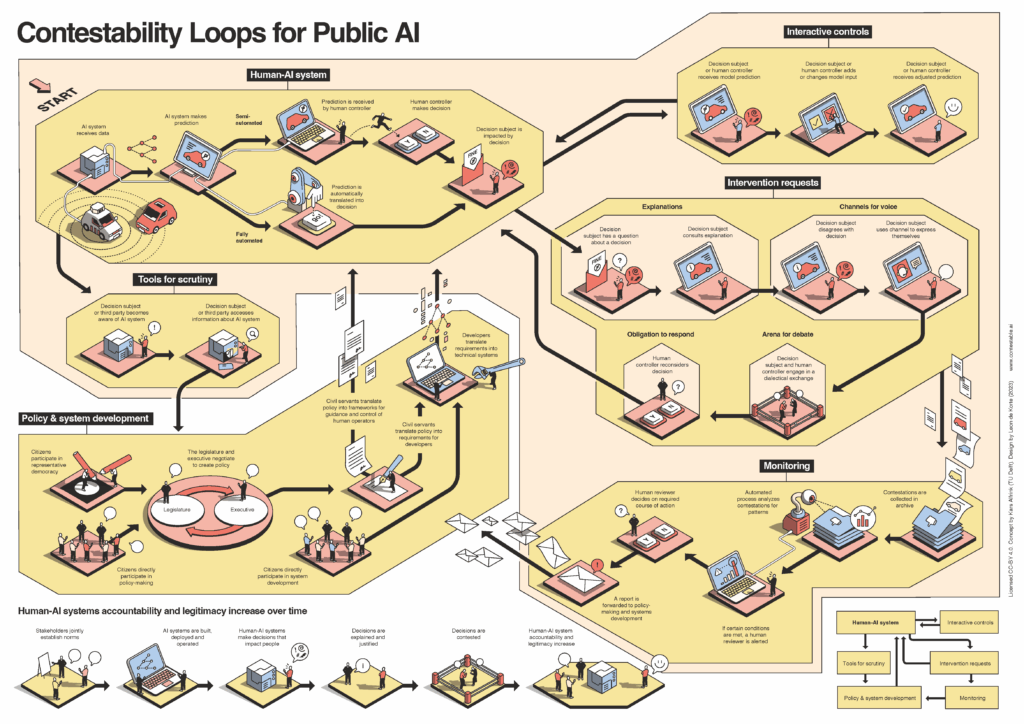
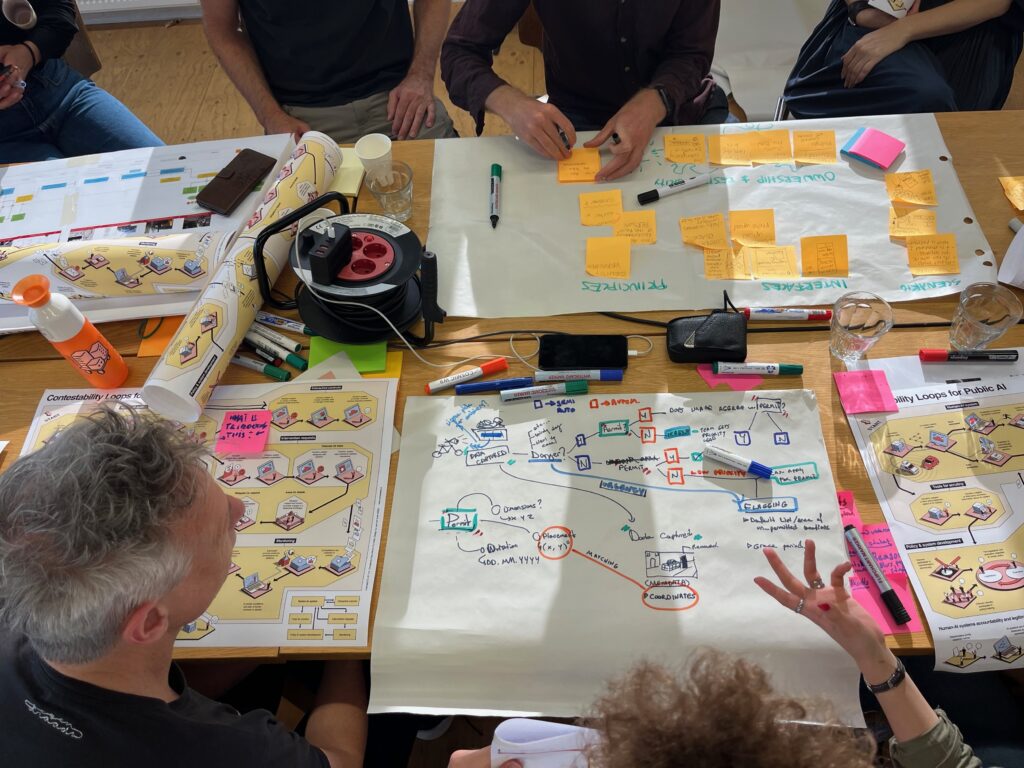
Contestability Loops for Public AI infographic
Envisioning Contestability Loops workshop at ThingsCon Salon in progress.

Democratizing AI Through Continuous Adaptability: I presented on “Democratizing AI Through Continuous Adaptability: The Role of DevOps” at the TILTing Perspectives 2024 panel “The mutual shaping of democratic practices & AI,” which was chaired and moderated by Merel Noorman on 14 July 2024. I later reprised this talk at NWO ICT.OPEN on 16 April 2025 as part of the track “Human-Computer Interaction and Societal Impact in the Netherlands,” chaired by Armağan Karahanoğlu and Max Birk (PDF of slides).

From Stem to Stern: I was part of the organizing team of the CSCW 2024 workshop “From Stem to Stern: Contestability Along AI Value Chains,” which took place as a hybrid one-day session on 9 November 2024. I blogged a summary and some takeaways of the workshop here. Shoutout to Agathe Balayn and Yulu Pi for leading this endeavor.

Contestable AI Talks: I was invited to speak on my PhD research at various meetings and events organized by studios, agencies, consultancies, schools, and public sector organizations. On 3 September 2024, at the data design agency CLEVER°FRANKE (slides). On 10 January 2025, at the University of Utrecht Computational Sociology group. On 19 February 2025, at digital ethics consultancy The Green Land (slides). On 6 March 2024, at Communication and Multimedia Design Amsterdam (slides). And on 17 March 2025, at the Advisory Board on Open Government and Information Management.

Designing Responsible AI: Over the course of 2024, Sara Colombo, Francesca Mauri, and I developed and taught for the first time a new Integrated Product Design master’s elective, “Designing Responsible AI” (course description). Later, on 28 March 2025, I was invited by my colleagues Alessandro Bozzon and Carlo van der Valk to give a single-morning interactive lecture on part of the same content at the course AI Products and Services (slides).
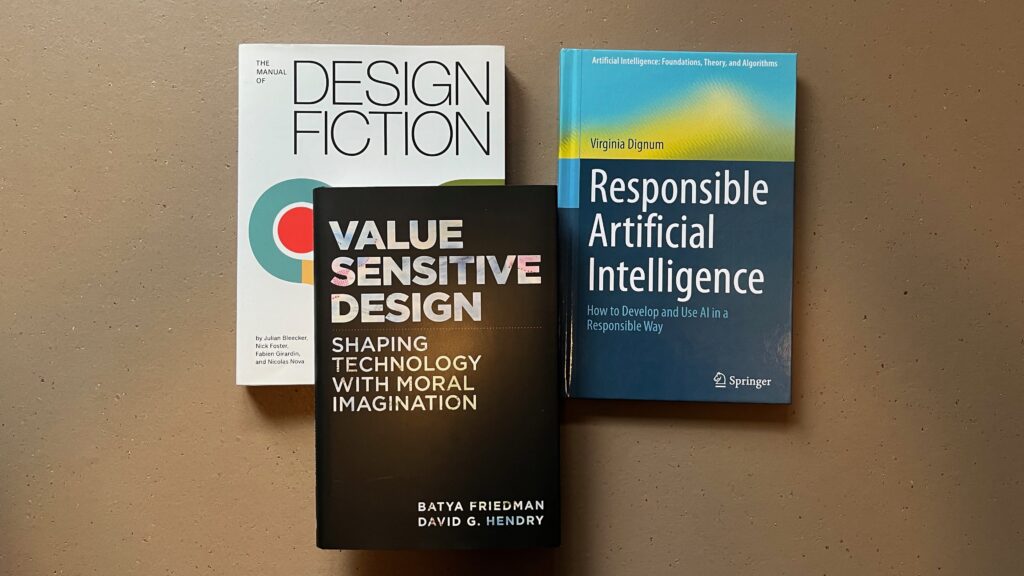
Books that represent the range of theory covered in the course “Designing Responsible AI.”

Stop the Cuts: On 2 July 2024, a far-right government was sworn in in the Netherlands (it has since fallen). They intended to cut funding to education by €2 billion. A coalition of researchers, teachers, students, and others organized to protest and strike in response. I was present at several of these actions: The alternative opening of the academic year in Utrecht on 2 September 2024. Local walkouts on 14 November 2024 (I participated in Utrecht). Mass demonstration in The Hague on 25 November 2024. Local actions on 11 December 2024 (I participated in Delft). And finally, for now at least, on 24 April 2025, at the Delft edition of the nationwide relay strike. If you read this, work in academia, and want to act, join a union (I am a member of the AOb), and sign up for the WOinActie newsletter.
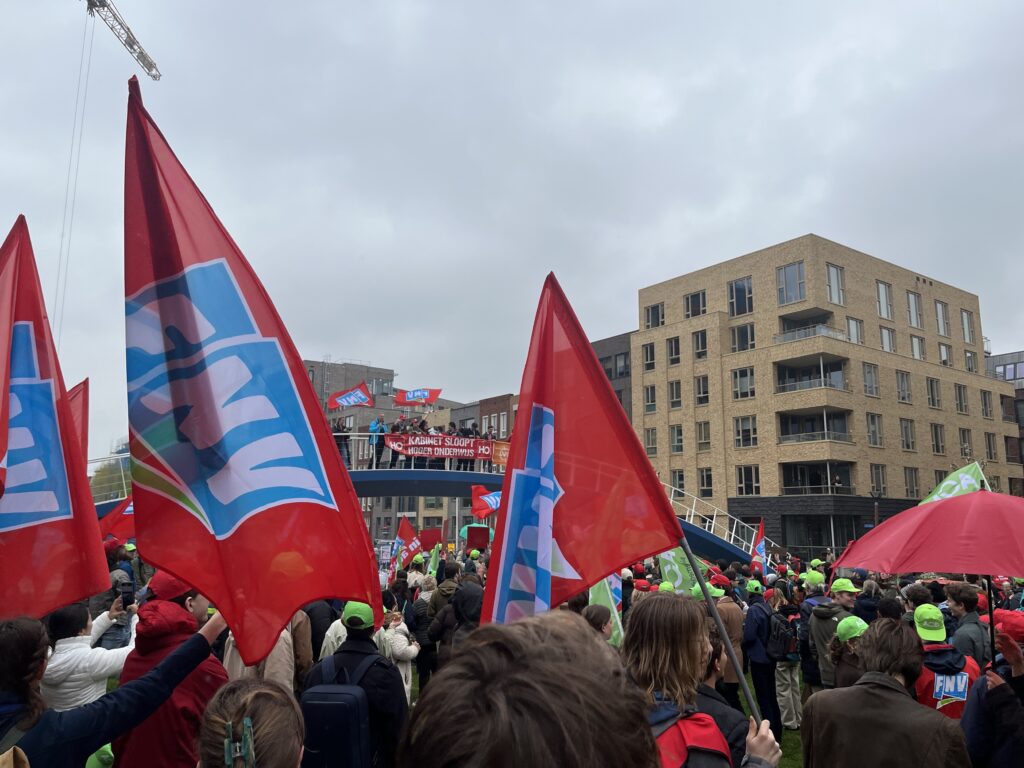
End of the march during the 24 April 2025 strike in Delft.

Panels: Over the past months, I was a panelist at several events. On 22 October 2024, at the Design & AI Symposium as part of the panel “Evolving Perspectives on AI and Design,” together with Iohanna Nicenboim and Jesse Benjamin, moderated by Mathias Funk (blog post). On 13 December 2024 at TH/NGS as part of the panel “Rethink Design: Book Launch and Panel Discussion on Designing With AI” chaired by Roy Bendor (video). On 12 March 2025, at the panel “Inclusive AI: Approaches to Digital Inclusion,” chaired by Nazli Cila and Taylor Stone.
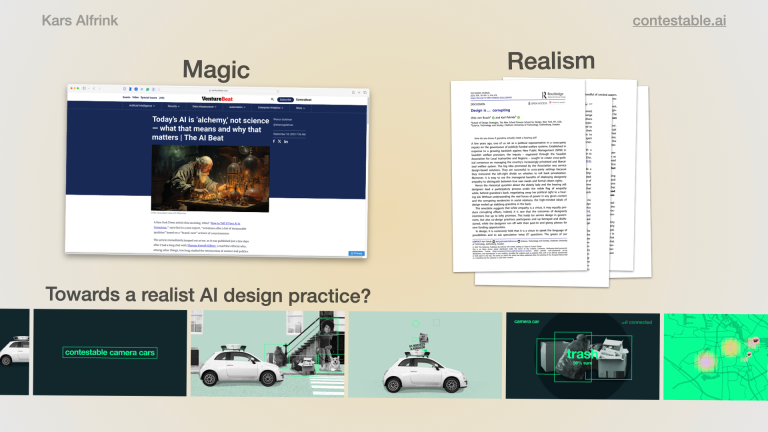
Slide I used during my panel contribution at the Design & AI symposium.

Design for Human Autonomy: I was part of several activities organized by the Delft Design for Values institute related to their annual theme of autonomy (led by Michael Klenk). I was a panelist on 15 October 2024 during the kick-off event (blog post). I wrote the section on designing AI for autonomy for the white paper edited by Udo Pesch (preprint). And during the closing symposium, master’s graduation student Ameya Sawant, whom I am coaching (with Fernando Secomandi acting as chair), was honored as a finalist in the thesis competition.

Master Graduation Students: Four master students that I coached during their thesis projects graduated, which between them explored technology’s role in society through AI-mediated civic engagement, generative AI implementation in public services, experimental approaches to AI trustworthiness, and urban environmental sensing—Nina te Groen (with Achilleas Psyilidis as chair), Romée Postma (with Roy Bendor), Eline Oei (with Giulia Calabretta), and Jim Blom (with Tomasz Jaskiewicz).

Architecting for Contestability: On 22 November 2025, I ran a single-day workshop about contestability for government-employed ICT architects participating in the Digital Design & Architecture course offered by the University of Twente, on invitation from Marijn Janssen (slides).

Qualitative Design Research: On 17 December 2024, I delivered a lecture on qualitative design research for the course Empirical Design Research, on invitation from my colleague Himanshu Verma (slides). Later, on 22 April 2025, I delivered a follow-up in the form of a lecture on reflexive thematic analysis for the course Product Futures Studio, coordinated by Holly McQuillan (slides).

Democratic Generative Things: On 6 June 2025 I joined the ThingsCon unconference to discuss my contribution to the RIOT report, “Embodied AI and collective power: Designing democratic generative things” (preprint). The report was edited by edited by Andrea Krajewski and Iskander Smit.
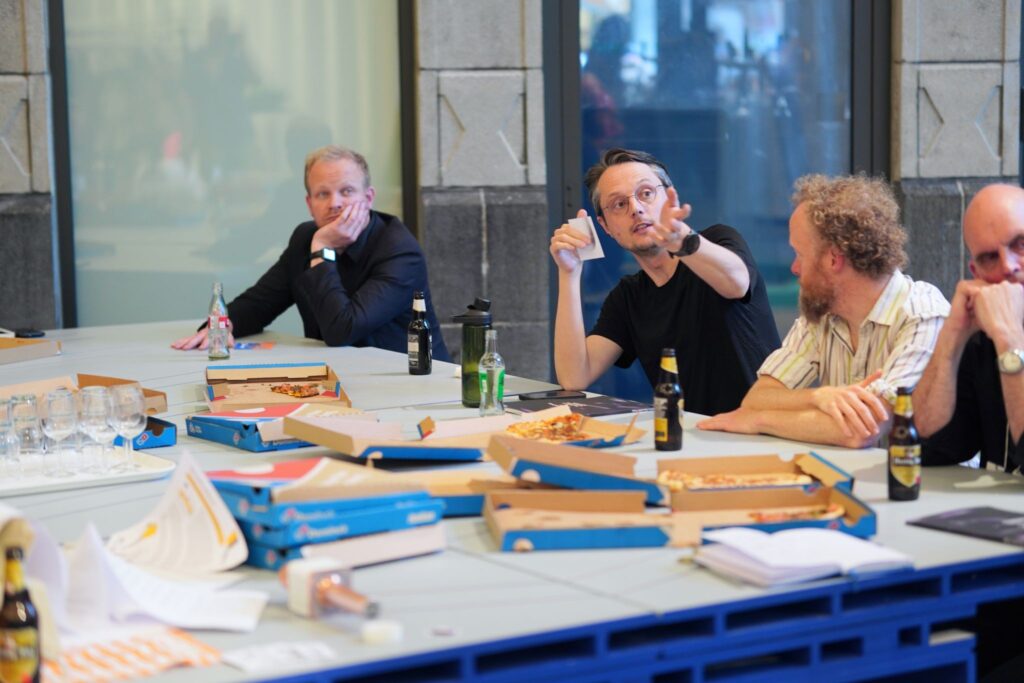
Me, holding forth during the ThingsCon RIOT unconference.

Learning Experience Design: I delivered the closing invited talk at LXDCON on 12 June 2025, reflecting on the impact of GenAI on the fields of education and design for learning (slides). Many thanks to Niels Floor for the invitation.

People’s Compute: I published a preprint of my position paper “People’s Compute: Design and the Politics of AI Infrastructures” over at OSF on 14 April 2025. I emailed it to peers and received over a dozen encouraging responses. It was also somehow picked up by Evgeny Morozov’s The Syllabus with some nice commentary attached.

On deck

So what am I up to at the moment? Keeping nice and busy.

  • I am co-authoring several articles, papers, and book chapters on topics including workplace automation, AI transparency, contestability in engineering, AI design and regulation, computational argumentation, explainable and participatory AI, and AI infrastructure politics. I do hope at least some of these will see the light of day in the coming months.
  • I am preparing a personal grant application that builds on the vision laid out in People’s Compute.
  • I will be delivering an invited talk at Enterprise UX on 21 November 2025.
  • I am acting as a scientific advisor to a center that is currently being established, which focuses on increasing digital autonomy within Dutch government institutions.
  • I will be co-teaching Designing Responsible AI again in Q1 of the next academic year.
  • I’ll serve as an associate chair on the CHI 2026 design subcommittee.
  • And I have signed up to begin our university’s teaching qualification certification.

Whew. That’s it. Thanks for reading (skimming?) if you’ve made it all the way to the end. I will try to circle back and do another update, maybe a little sooner than this one, say in six months’ time.

“Contestable Infrastructures” at Beyond Smart Cities Today

I’ll be at Beyond Smart Cities Today the next couple of days (18-19 September). Below is the abstract I submitted, plus a bibliography of some of the stuff that went into my thinking for this and related matters that I won’t have the time to get into.

In the actually existing smart city, algorithmic systems are increasingly used for the purposes of automated decision-making, including as part of public infrastructure. Algorithmic systems raise a range of ethical concerns, many of which stem from their opacity. As a result, prescriptions for improving the accountability, trustworthiness and legitimacy of algorithmic systems are often based on a transparency ideal. The thinking goes that if the functioning and ownership of an algorithmic system is made perceivable, people understand them and are in turn able to supervise them. However, there are limits to this approach. Algorithmic systems are complex and ever-changing socio-technical assemblages. Rendering them visible is not a straightforward design and engineering task. Furthermore such transparency does not necessarily lead to understanding or, crucially, the ability to act on this understanding. We believe legitimate smart public infrastructure needs to include the possibility for subjects to articulate objections to procedures and outcomes. The resulting “contestable infrastructure” would create spaces that open up the possibility for expressing conflicting views on the smart city. Our project is to explore the design implications of this line of reasoning for the physical assets that citizens encounter in the city. Because after all, these are the perceivable elements of the larger infrastructural systems that recede from view.

  • Alkhatib, A., & Bernstein, M. (2019). Street-Level Algorithms. 1–13. https://doi.org/10.1145/3290605.3300760
  • Ananny, M., & Crawford, K. (2018). Seeing without knowing: Limitations of the transparency ideal and its application to algorithmic accountability. New Media and Society, 20(3), 973–989. https://doi.org/10.1177/1461444816676645
  • Centivany, A., & Glushko, B. (2016). “Popcorn tastes good”: Participatory policymaking and Reddit’s “AMAgeddon.” Conference on Human Factors in Computing Systems – Proceedings, 1126–1137. https://doi.org/10.1145/2858036.2858516
  • Crawford, K. (2016). Can an Algorithm be Agonistic? Ten Scenes from Life in Calculated Publics. Science Technology and Human Values, 41(1), 77–92. https://doi.org/10.1177/0162243915589635
  • DiSalvo, C. (2010). Design, Democracy and Agonistic Pluralism. Proceedings of the Design Research Society Conference, 366–371.
  • Hildebrandt, M. (2017). Privacy As Protection of the Incomputable Self: Agonistic Machine Learning. SSRN Electronic Journal, 1–33. https://doi.org/10.2139/ssrn.3081776
  • Jackson, S. J., Gillespie, T., & Payette, S. (2014). The Policy Knot: Re-integrating Policy, Practice and Design. CSCW Studies of Social Computing, 588–602. https://doi.org/10.1145/2531602.2531674
  • Jewell, M. (2018). Contesting the decision: living in (and living with) the smart city. International Review of Law, Computers and Technology. https://doi.org/10.1080/13600869.2018.1457000
  • Lindblom, L. (2019). Consent, Contestability, and Unions. Business Ethics Quarterly. https://doi.org/10.1017/beq.2018.25
  • Mittelstadt, B. D., Allo, P., Taddeo, M., Wachter, S., & Floridi, L. (2016). The ethics of algorithms: Mapping the debate. Big Data & Society, 3(2), 205395171667967. https://doi.org/10.1177/2053951716679679
  • Van de Poel, I. (2016). An ethical framework for evaluating experimental technology. Science and Engineering Ethics, 22(3), 667–686. https://doi.org/10.1007/s11948-015-9724-3

“Contestable Infrastructures: Designing for Dissent in Smart Public Objects” at We Make the City 2019

Thijs Turèl of AMS Institute and myself presented a version of the talk below at the Cities for Digital Rights conference on June 19 in Amsterdam during the We Make the City festival. The talk is an attempt to articulate some of the ideas we both have been developing for some time around contestability in smart public infrastructure. As always with this sort of thing, this is intended as a conversation piece so I welcome any thoughts you may have.


The basic message of the talk is that when we start to do automated decision-making in public infrastructure using algorithmic systems, we need to design for the inevitable disagreements that may arise and furthermore, we suggest there is an opportunity to focus on designing for such disagreements in the physical objects that people encounter in urban space as they make use of infrastructure.

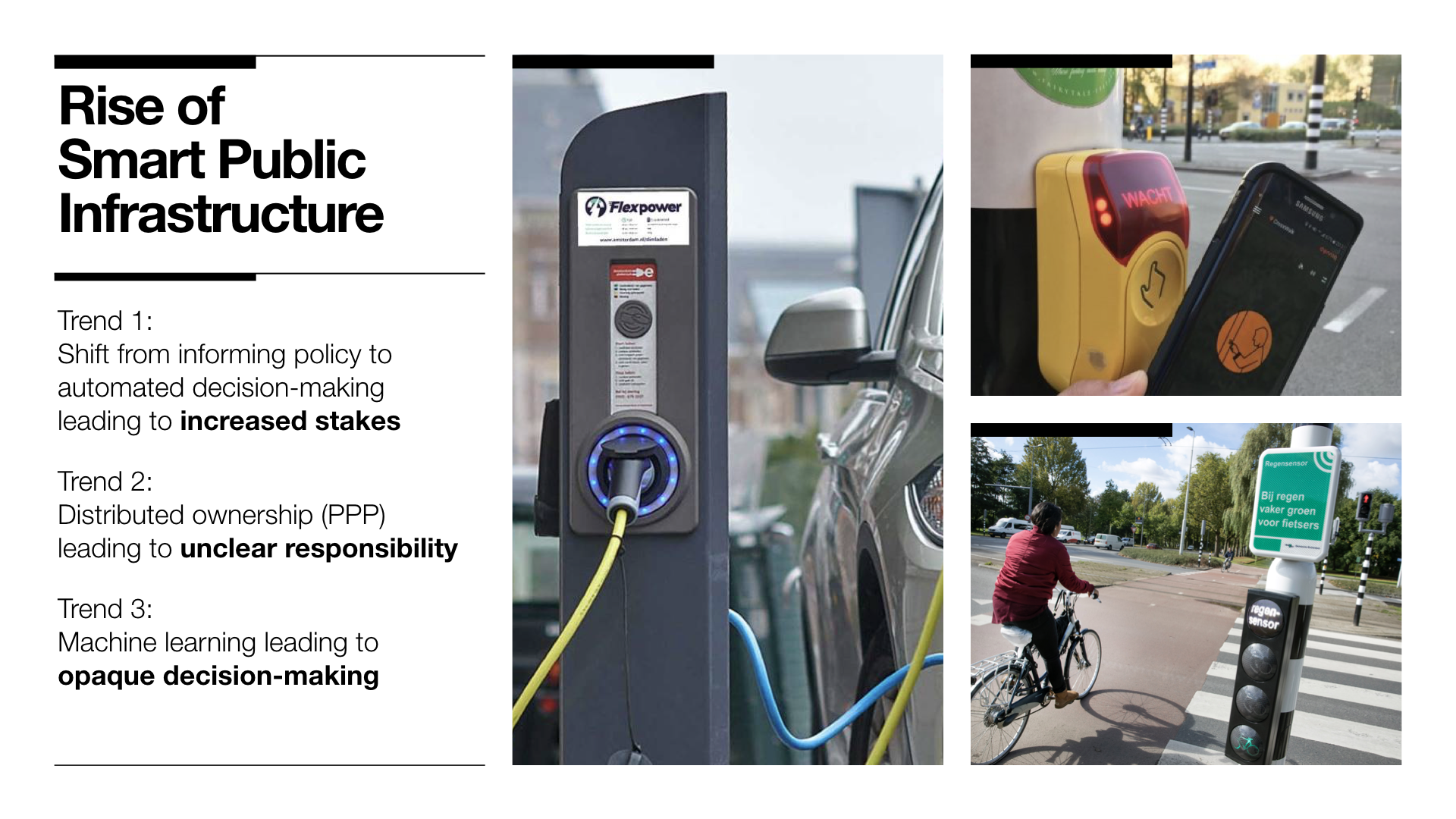
We set the scene by showing a number of examples of smart public infrastructure. A cyclist crossing that adapts to weather conditions. If it’s raining cyclists more frequently get a green light. A pedestrian crossing in Tilburg where elderly can use their mobile to get more time to cross. And finally, the case we are involved with ourselves: smart EV charging in the city of Amsterdam, about which more later.

Image credits: Vattenfall, Fietsfan010, De Nieuwe Draai

We identify three trends in smart public infrastructure: (1) where previously algorithms were used to inform policy, now they are employed to perform automated decision-making on an individual case basis. This raises the stakes; (2) distributed ownership of these systems as the result of public-private partnerships and other complex collaboration schemes leads to unclear responsibility; and finally (3) the increasing use of machine learning leads to opaque decision-making.

These trends, and algorithmic systems more generally, raise a number of ethical concerns. They include but are not limited to: the use of inductive correlations (for example in the case of machine learning) leads to unjustified results; lack of access to and comprehension of a system’s inner workings produces opacity, which in turn leads to a lack of trust in the systems themselves and the organisations that use them; bias is introduced by a number of factors, including development team prejudices, technical flaws, bad data and unforeseen interactions with other systems; and finally the use of profiling, nudging and personalisation leads to diminished human agency. (We highly recommend the article by Mittelstadt et al. for a comprehensive overview of ethical concerns raised by algorithms.)

So for us, the question that emerges from all this is: How do we organise the supervision of smart public infrastructure in a democratic and lawful way?

There are a number of existing approaches to this question. These include legal and regulatory (e.g. the right to explanation in the GDPR); auditing (e.g. KPMG’s “AI in Control” method, BKZ’s transparantielab); procurement (e.g. open source clauses); insourcing (e.g. GOV.UK) and design and engineering (e.g. our own work on the transparent charging station).

We feel there are two important limitations with these existing approaches. The first is a focus on professionals and the second is a focus on prediction. We’ll discuss each in turn.

Image credits: Cities Today

First of all, many solutions target a professional class, be it accountants, civil servants, supervisory boards, as well as technologists, designers and so on. But we feel there is a role for the citizen as well, because the supervision of these systems is simply too important to be left to a privileged few. This role would include identifying wrongdoing, and suggesting alternatives.

There is a tension here, which is that from the perspective of the public sector one should only ask citizens for their opinion when you have the intention and the resources to actually act on their suggestions. It can also be a challenge to identify legitimate concerns in the flood of feedback that can sometimes occur. From our point of view though, such concerns should not be used as an excuse to not engage the public. If citizen participation is considered necessary, the focus should be on freeing up resources and setting up structures that make it feasible and effective.

The second limitation is prediction. This is best illustrated with the Collinridge dilemma: in the early phases of new technology, when a technology and its social embedding are still malleable, there is uncertainty about the social effects of that technology. In later phases, social effects may be clear but then often the technology has become so well entrenched in society that it is hard to overcome negative social effects. (This summary is taken from an excellent van de Poel article on the ethics of experimental technology.)

Many solutions disregard the Collingridge dilemma and try to predict and prevent adverse effects of new systems at design-time. One example of this approach would be value-sensitive design. Our focus in stead is on use-time. Considering the fact that smart public infrastructure tends to be developed on an ongoing basis, the question becomes how to make citizens a partner in this process. And even more specifically we are interested in how this can be made part of the design of the “touchpoints” people actually encounter in the streets, as well as their backstage processes.

Why do we focus on these physical objects? Because this is where people actually meet the infrastructural systems, of which large parts recede from view. These are the places where they become aware of their presence. They are the proverbial tip of the iceberg.

Image credits: Sagar Dani

The use of automated decision-making in infrastructure reduces people’s agency. For this reason, resources for agency need to be designed back into these systems. Frequently the answer to this question is premised on a transparency ideal. This may be a prerequisite for agency, but it is not sufficient. Transparency may help you become aware of what is going on, but it will not necessarily help you to act on that knowledge. This is why we propose a shift from transparency to contestability. (We can highly recommend Ananny and Crawford’s article for more on why transparency is insufficient.)

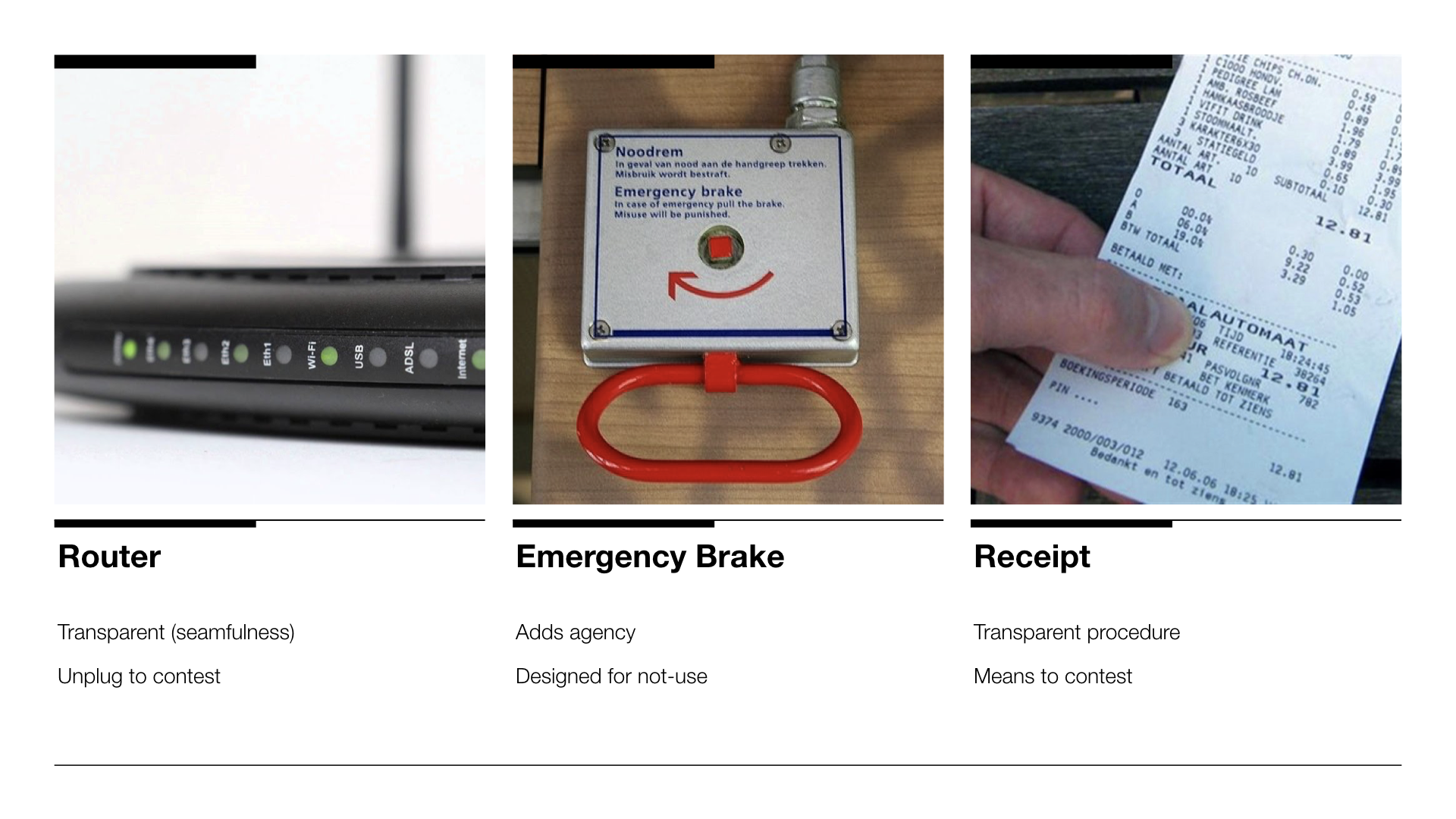
To clarify what we mean by contestability, consider the following three examples: When you see the lights on your router blink in the middle of the night when no-one in your household is using the internet you can act on this knowledge by yanking out the device’s power cord. You may never use the emergency brake in a train but its presence does give you a sense of control. And finally, the cash register receipt provides you with a view into both the procedure and the outcome of the supermarket checkout procedure and it offers a resource with which you can dispute them if something appears to be wrong.

Image credits: Aangiftedoen, source unknown for remainder

None of these examples is a perfect illustration of contestability but they hint at something more than transparency, or perhaps even something wholly separate from it. We’ve been investigating what their equivalents would be in the context of smart public infrastructure.

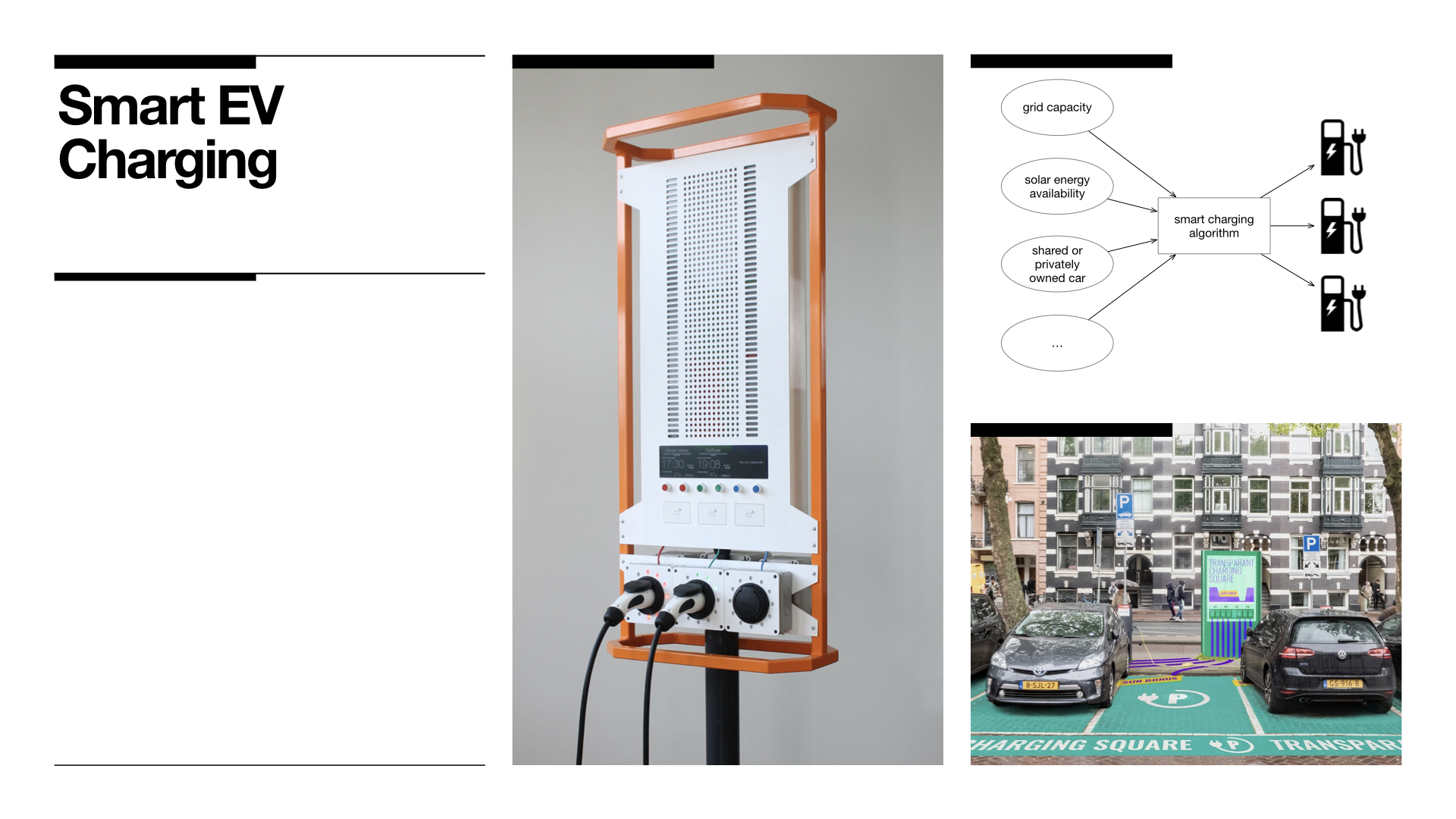
To illustrate this point further let us come back to the smart EV charging project we mentioned earlier. In Amsterdam, public EV charging stations are becoming “smart” which in this case means they automatically adapt the speed of charging to a number of factors. These include grid capacity, and the availability of solar energy. Additional factors can be added in future, one of which under consideration is to give priority to shared cars over privately owned cars. We are involved with an ongoing effort to consider how such charging stations can be redesigned so that people understand what’s going on behind the scenes and can act on this understanding. The motivation for this is that if not designed carefully, the opacity of smart EV charging infrastructure may be detrimental to social acceptance of the technology. (A first outcome of these efforts is the Transparent Charging Station designed by The Incredible Machine. A follow-up project is ongoing.)

Image credits: The Incredible Machine, Kars Alfrink

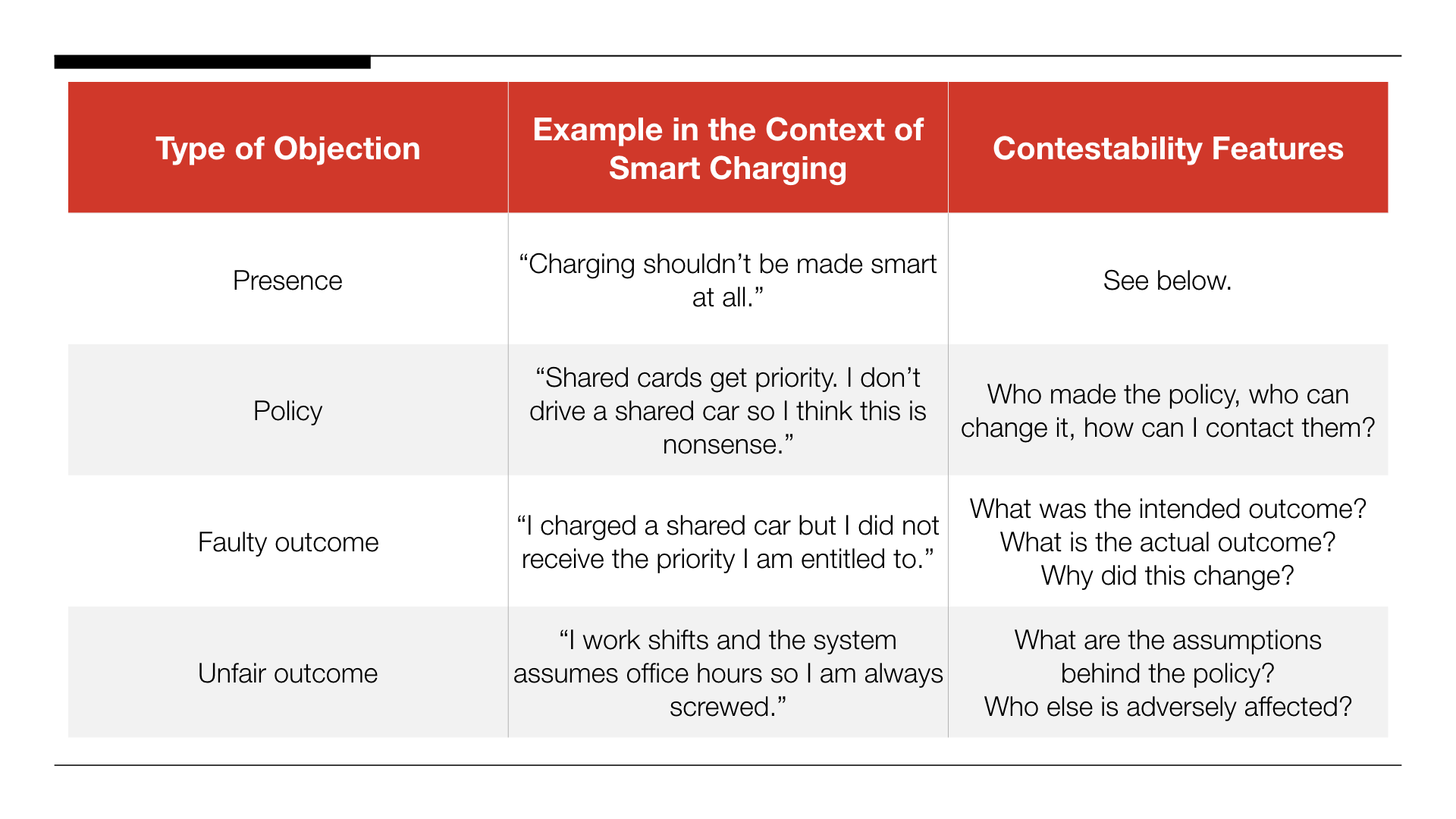
We have identified a number of different ways in which people may object to smart EV charging. They are listed in the table below. These types of objections can lead us to feature requirements for making the system contestable.

Because the list is preliminary, we asked the audience if they could imagine additional objections, if those examples represented new categories, and if they would require additional features for people to be able to act on them. One particularly interesting suggestion that emerged was to give local communities control over the policies enacted by the charge points in their vicinity. That’s something to further consider the implications of.

And that’s where we left it. So to summarise:

  1. Algorithmic systems are becoming part of public infrastructure.
  2. Smart public infrastructure raises new ethical concerns.
  3. Many solutions to ethical concerns are premised on a transparency ideal, but do not address the issue of diminished agency.
  4. There are different categories of objections people may have to an algorithmic system’s workings.
  5. Making a system contestable means creating resources for people to object, opening up a space for the exploration of meaningful alternatives to its current implementation.

PhD update – January 2019

Thought I’d post a quick update on my PhD. Since my previous post almost five months have passed. I’ve been developing my plan further, for which you’ll find an updated description below. I’ve also put together my very first conference paper, co-authored with my supervisor Gerd Kortuem. It’s a case study of the MX3D smart bridge for Designing Interactive Systems 2019. We’ll see if it gets accepted. But in any case, writing something has been hugely educational. And once I finally figured out what the hell I was doing, it was sort of fun as well. Still kind of a trip to be paid to do this kind of work. Looking ahead, I am setting goals for this year and the nearer term as well. It’s all very rough still but it will likely involve research through design as a method and maybe object oriented ontology as a theory. All of which will serve to operationalise and evaluate the usefulness of the “contestability” concept in the context of smart city infrastructure. To be continued—and I welcome all your thoughts!


Designing Smart City Infrastructure for Contestability

The use of information technology in cities increasingly subjects citizens to automated data collection, algorithmic decision making and remote control of physical space. Citizens tend to find these systems and their outcomes hard to understand and predict [1]. Moreover, the opacity of smart urban systems precludes full citizenship and obstructs people’s ‘right to the city’ [2].

A commonly proposed solution is to improve citizens understanding of systems by making them more open and transparent [3]. For example, GDPR prescribes people’s right to explanation of automated decisions they have been subjected to. For another example, the city of Amsterdam offers a publicly accessible register of urban sensors, and is committed to opening up all the data they collect.

However, it is not clear that openness and transparency in and of itself will yield the desired improvements in understanding and governing of smart city infrastructures [4]. We would like to suggest that for a system to perceived as accountable, people must be able to contest its workings—from the data it collects, to the decisions it makes, all the way through to how those decisions are acted on in the world.

The leading research question for this PhD therefore is how to design smart city infrastructure—urban systems augmented with internet-connected sensing, processing and actuating capabilities—for contestability [5]: the extent to which a system supports the ability of those subjected to it to oppose its workings as wrong or mistaken.

References

  1. Burrell, Jenna. “How the machine ‘thinks’: Understanding opacity in machine learning algorithms.” Big Data & Society 3.1 (2016): 2053951715622512.
  2. Kitchin, Rob, Paolo Cardullo, and Cesare Di Feliciantonio. “Citizenship, Justice and the Right to the Smart City.” (2018).
  3. Abdul, Ashraf, et al. “Trends and trajectories for explainable, accountable and intelligible systems: An hci research agenda.” Proceedings of the 2018 CHI Conference on Human Factors in Computing Systems. ACM, 2018.
  4. Ananny, Mike, and Kate Crawford. “Seeing without knowing: Limitations of the transparency ideal and its application to algorithmic accountability.” New Media & Society 20.3 (2018): 973-989.
  5. Hirsch, Tad, et al. “Designing contestability: Interaction design, machine learning, and mental health.” Proceedings of the 2017 Conference on Designing Interactive Systems. ACM, 2017.