Surprises in Animal Crossing: Wild World

20070112T155404

So I’ve been playing AC: WW for over a weeks now and I must say it has lived up to my expectations. It’s a cute and quirky game that does not follow conventional game design rules. There is no way to die, no (real) way to loose or even win. In a sense it’s more like a toy than a game; you can play with it endlessly, there is no goal to reach (apart from discovering all it’s little secrets).

Cockroaches

One of those secrets was particularly fun to discover. After a few days of play I convinced my girlfriend to give it a try. So she put the cartridge in her pink DS Lite. While I was cooking dinner, she went through the beginning stages (driving to the town in a taxi, getting a job with Tom Nook). A bit later, I picked it up again and went about my business (I think it was fishing, I still have a large loan to pay off after the first house expansion).

After a while I went back into the house and found (shock! horror!) a bunch of cockroaches running around my carefully kempt interior. “We have cockroaches!” I shouted to my girlfriend while running around the house trying to squash them. The apparent source was some apples lying around. “Didn’t the animals tell you don’t leave stuff lying around the house?” I asked her. They had, but where should she put them (the apples) otherwise? Good point.

We had a good laugh after that episode. Be careful who you play this game with; it might be a challenge living together in the real world – Animal Crossing is no different! But the real genius of the game is in these things. It’s a rules based world for sure (leave apples around the house, get cockroaches) but the mini-narratives that it allows you to build in this way is crazy.

Letters

Another example is the letters I find myself writing to the animals. I’m sure they’d be happy with any kind of letter, as long as I mention some specific words maybe (like ‘happy’ and ‘friend’). In stead, I’m writing fully formed sentences, and include little details that would be appreciated by real people. In that way, it’s allowing for subtle role-playing.

Charity

On the subject of role-playing (and there not being a ‘good’ or ‘bad’ way to play the game); I know I should be hard at work paying off the aforementioned loan (to progress to the next ‘level’). But in stead I find myself spending a lot of time and money on present for the animals, and donations to the museum. That might be role-playing (or that might be my real personality influencing what I find pleasurable in the game) but the coolest bit is that it doesn’t matter; any way of playing is valid.

Have any other people had similar experiences with the game? Are there ways to apply this logic (the patterns inherent in the game) to other domains?

Some closing links:

My Mobile Game Directions Pecha Kucha

Yesterday I presented my talk on mobile gaming at the 6th Pecha Kucha Night in Rotterdam’s Off_Corso. I was programmed as the first speaker, which was exciting (and also allowed me to benefit from the primacy effect, as my girlfriend pointed out). Colleague Iskander was kind enough to record the whole thing on his N70 (fittingly) and I present it here for your enjoyment or aggravation, whichever you prefer (please take note that the talk is in Dutch). The slides I used are over at SlideShare.

I’m still not sure the subject matter was appropriate for the event, considering the majority of speakers were either graphic designers, autonomous artists or architects. The crowd might’ve been a bit underwhelmed by my commercial and pop cultural references. Oh well, I had fun, I guess that’s the most important thing.

Many thanks to Nadine and Bart of Hunk Design for letting me loose on stage. ‘Nuff respect to all the presenters for taking the trouble of preparing a presentation. There were plenty of cool and inspiring ideas on show. Finally, thanks to the creators of all the images I used, you can find the credits in the SlideShare show.

Update: I’ve deleted my YouTube account so here’s an embed of the video on Vimeo:

See me Pecha Kucha on mobile gaming

Mobile Vader

Next Wednesday, see me do a presentation on mobile game design at the 6th Pecha Kucha Night in Off_Corso, Rotterdam. Pecha Kucha are super short presentations consisting of 20 slides. Speakers have exactly 20 seconds per slide to do their thing. Quite a challenge! I’ve finished my slides and a first draft of the talk, now to practice the hell out of my lines… Here’s an Upcoming.org entry I made for the event, here’s the Dutch and international site and finally, here’s some cool Pecha Kucha tips by Yongfook.

Mobile gaming directions

Yesterday we had another fun and interesting IA Cocktail Hour. Thanks to the kind folk at Media Catalyst for the hospitality and Olly and Boyd for their presentations. I thought I’d put up the slides of my short talk on where I think (non-console) mobile gaming is or should be headed. I’ve added some notes, so there’s more than just pretty pictures to look at. If you have any thoughts to share, don’t hesitate to do so!

Shadow of the Colossus mini-review

A screenshot of Shadow of the Colossus, courtesy of IGN.com.

One of the most rewarding gaming experience I’ve had in quite some time, Shadow of the Colossus is an exercise in restraint (something rarely found with game designers). Large parts of the game are spent riding a horse through a lavishly rich landscape, looking for a giant monster to battle. Felling one of the title colossi always involves solving a logical puzzle (real-world logic, as opposed to the so often found in-game logic) and is very satisfying. One of the best looking games I’ve ever seen on the PS2, riding, fighting and climbing cliff-faces are always esthetically pleasing and quite cinematic. Highly recommended!

Rough notes for T.L. Taylor – Play

MMOGs have roots in RPGs and MUDs.

Software and service.

Ultima, EverQuest, Wow…

Social contexts

MMOGs isn’t anti-social. Social isn’t icing on the cake. Social is the substance of the game. It’s key.

On- and offline connections mix.

Emergent social activity. E.g.: “guilds”; trust, responsibility, reputation.

Game devs aren’t giving players the tools to be social. Focus is on artefact first.

Rough map of guild – connections between players are offline

Transcript of in game chat. Lots of offline connections.

“Friends are the Ultimate Exploit”

EULA: sharing accounts is not allowed (in EQ).

Collaboration and teams:

Complex coordinated actions.

Co-creative culture

Players also produce and design. Emergent culture and technologies that change the game…

Players change the product in deep ways.

Game in box is just part of larger game space.

WoW opens up UI for players to change. Big differences between players.

Cheating – modification of game is debated.

IP – who should be the designer, what’s play?

Selling avatars on eBay. Game companies own the avatar so it’s not allowed. Embodiment – you don’t own your body!

In EQ there was a lot to do about fanfic.

WoW in game protests. “Protesting in game is not a valid way to give us feedback.”

Are game worlds public space? Or not because they’re corp. owned?

Commodification of culture. Designers want control over players / users. Let go!

Things that are happening in game are examples of bigger issues such as: UX, IP, mash-ups, P2P, etc.

Book: Play Between Worlds, T.L. Taylor.

Questions:

What about scale? Do these thoughts apply to smaller games? We need smaller games to experiment with governance and such.

Is there an end to the game? “End” is player-defined… Games should be better at helping people leave.

Can these games become the new platforms for productivity? There’s a lot of mumbling, but no-one knows. You pick up valuable skills while playing.

Does this apply to alternate reality games? E.g. ILoveBees… She did a piece on Majestic. Beta during 9/11. It was mixed with reality.

How can we use traditional ethnographic thinking? The work isn’t comparative enough to make any strong statements.

http://reboot.dk/wiki/Play

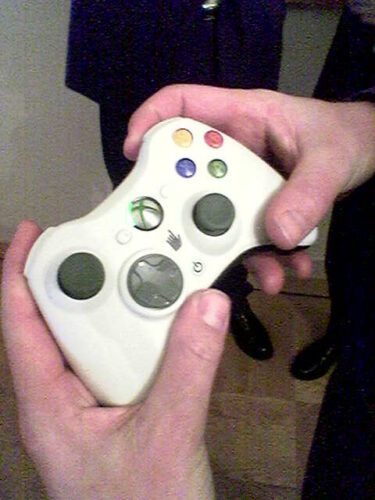
Xbox 360

Xbox 360 Originally uploaded by Kaeru.

Last thursday I got to try out the new Xbox 360 before it launched in the Netherlands. The wireless controller was nice, the graphics of both games I tried were as good as was to be expected. But sadly – no innovations in gameplay. I would’ve loved to see some massive online games in action. That had to wait to after the launch of course. Some more shots over at Flickr.