Play, story and recombination

A bunch of Lego bricks

“Dominant models in IA: space + story” was one of the notes I took while at this year’s Euro IA Summit. I’ll get into space some other time. Concerning story: Basically it strikes me that for a discipline involved with an interactive medium, so often designing is likened to storytelling. I’m not sure this is always the most productive way to approach design, I actually think it is very limiting. If you approach design not as embedding your story in the environment, but as creating an environment wherein users can create their own stories, then I’d say you’re on the right track. An example I tend to use is a game of poker: The design of the game poker was certainly not an act of storytelling, but a play session of poker is experienced as (and can be retold as) a story. Furthermore, the components of the game can be recombined to create different variations of the basic game, each creating different potentials for stories to arise. I’d like to see more designers approach interactive media (digital, physical or whatever) like this: Don’t tell a story to your user, enable them to create their own.1 Realize users will want to recombine your stuff with other stuff you might not know about (the notion of seamful design comes into play here). When you’ve done a proper job, you’ll find them retelling those stories to others, which I would say is the biggest compliment you can get.

1. Or to put this in Marc LeBlanc‘s terms: Don’t embed narrative, let it emerge through play.

Summary of my Playful IAs argument

I thought I’d post a short summary of the argument I made in my Euro IA Summit 2007 talk, for those who weren’t there and/or are too lazy to actually go through the notes in the slides. The presentation is basically broken up into three parts:

  1. Future web environments are becoming so complex, they start to show emergent properties. In this context a lot of traditional IA practice doesn’t make sense anymore. Instead of directly designing an information space, you’re better off designing the rules that underly the generative construction of such spaces. In other words, IA is becoming a second order design problem.
  2. IAs tend to argue for the value of their designs based solely on how well they support users in achieving their end goals. I propose supporting experience goals is just as important. From there I try to make the case that any powerful experience is a playful one, where the user’s fun follows from the feeling that he or she is learning new stuff, is kicking ass, is in flow.
  3. Game design is not black magic (anymore). In recent years a lot has become understood about how games work. They are built up out of game mechanics that each follow a pattern of action, simulation, feedback and modelling. Designing playful IAs means taking care that you encourage discovery, support exploration and provide feedback on mastery.

Get the the slides, and a list of sources for the talk in this earlier post.

Notables in the overlapping area of interaction and game design

With the Euro IA Summit soon approaching and my presentation more or less done, I think it might be a good time to post a list of people I’ve found inspiring while working on it. These are all persons who one way or the other are working in the overlapping area of interaction and game design (at least as far as I’m concerned.)

Katie Salen and Eric Zimmerman are the authors of the excellent book Rules of Play. This is arguably the foundational text on game design theory. It is so good even that much of it is readily applicable to the broader domain of interactive media.

Daniel Cook has written some thought-provoking pieces on his blog regarding the application of game design to interaction design. I admire the way he combines an analytical mind with considerable skill in visual arts, allowing him to communicate his ideas in a very engaging way.

Raph Koster is the author of A Theory of Fun for Game Design, a book I have yet to read. He’s the designer of the early MMOG Ultima Online and has since gone on to found his own company that is apparently focussed on delivering games everywhere. He’s recently presented some worthwhile talks on the area where the games and internet industry meet.

There are more, but I’d just like to highlight these three because they’ve all provided their own framework for thinking about games in such a way that it can be understood and used by relative outsiders like me. Take a look at their work, and let me know what you think.

Finding playful patterns at dConstruct 2007

Fortune cookie with design wisdom and dConstruct 2007 bag

I didn’t announce it on this blog, but if you’re following me on Twitter or Jaiku, took a look at the Upcoming event page or share trips with me on Dopplr you’re probably aware that I attended dConstruct 2007 in Brighton.

By way of a short conference report I’d like to list some of the references to games and play that jumped out at me during the day. It might be that I’m slowly but surely going a little crazy or that have really discovered the secret order of the universe, but either way I was pleasantly surprised that most talks suggested that successful experience design benefits from an understanding of the dynamics of play. Here goes:

  1. Game design is a second order design problem, meaning you cannot directly design the experience of play but only the ‘stuff’ that facilitates it. Jared Spool pointed out that successful experience design is invisible, it’s only when it’s done wrong that we notice it. This makes good experience design hard to sell, and I would say the same goes for great game design.
  2. The practice of game design is very much a multidisciplinary one, with a lot of specialties on board. Similarly, there is no way you’ll be able to do good experience design when you use a relay-race-like proces. You need to have people from a lot of different backgrounds solving problems collaboratively (or a few people who can do a lot of different stuff really well.) Jared Spool briefly pointed this out, Leisa Reichelt gave a lot of good suggestions on how to facilitate this with washing-machine methodologies and Tom Coates finished his talk encouraging cross-disciplinary collaboration too.
  3. Because good experience design (like game design) is a second order design problem, and it can only be done multidisciplinary, you can only do it in an iterative and incremental way. Good games get play-tested to death to ensure they’re fun, good experiences (on the web or wherever) need the same treatment. Leisa Reichelt had some interesting ideas on how to actually pull this off: Introducing UX to Agile, by having design and development teams both working in the same rhythm, but handling different stuff in their own iterations, with a lot of hand-over and communication back and forth. Well worth trying out I think.
  4. More thoughts on the invisible nature of experience was provided by Peter Merholz, who used a quote from Tim O’Reilly: “Designing from the outside in”. Start with the UI and then figure out the data and logic. I wouldn’t equate user experience with user interface (because – again – the experience cannot be directly designed) but I think it’s a good quote nonetheless. I liked Merholz’s emphasis on the importance of an experience vision most of all.
  5. I was great to hear Denise Wilton and George Oates talk about B3ta and Flickr. A lot of people are probably aware of the gamey origins of Flickr but it was enlightening to finally see some of it on the big screen. It came as no surprise to hear that Ludicorp‘s process in making Flickr was very much washing-machine style (although they did 0 user testing for a long time!)
  6. Matt Webb was perhaps the speaker who most explicitly drew parallels between game design and experience design. (He mentioned Raph Koster’s A Theory of Fun, for instance.) He also pointed out that customisation is vital to any experience, that a product should be able to recombine with others in its ecosystem, as well as allow for personalisation. Both customisation and personalisation encourage play. Tom Coates later mentioned something very similar – that your product (which as he was eager to point out is more than just your website) should be re-combinable and extendable with and by others.
  7. One of the major themes in interaction and game design for me is behaviour, the way products encourage behaviour in their users and the kinds of behaviours they have embedded in themselves. Matt Webb also mentioned that people love to tell stories about the experiences they’ve had. This is very true of gaming, which is all about verbs, actions, doing stuff. Game design is not storytelling, the storytelling happens after the game.
  8. I had completely forgotten about Disco, the CD burning app with simulated smoke effects that serve no purpose besides play. So thanks to Matt Webb I now have an example to complement the Wii Help Cat! (Come to think of it, the discussions surrounding Stamen Design‘s Twitter Blocks might be another good one.)

In conclusion, I think it’s great that Clearleft used this year’s edition to introduce the web development community to the wonderful world of experience design. I was also very happy to see a few people on stage I had not seen present before, but knew had a lot of good stuff to say. The pre- and after-party were both a lot of fun (thanks to Media Temple, Yahoo! Developer Network and the BBC for sponsoring those with free drink and food.) And if you’re curious, I understand there will be podcasts of all the sessions online soon, so keep an eye on the site.

The toy-like nature of social media

I’ve been meaning to write about this for quite a while: I think a lot of social media are like toys. I think what we see with people (adults!) using them is a lot like the open-ended play we know from playground games in school. A lot of these games are about exploring (the possibilities of) social relationships in a ‘safe’ context. Social media offer this same potential. In playground games there is a natural understanding that what happens within the magic circle of the game is not really real (but the notion is blurred.) A lot of discussion about the virtuality of relationships in social media does not acknowledge the existence of such a thing: Either the relationship you have with someone is real (he’s a real friend, or even real family) or not, in which case the relationship is often seen as value-less. I’d argue that a lot of people use social media to explore the potential of a relationship in a more or less safe way, to later either transition it into realness or not (note that I do not mean it needs to be taken offline into meat-space to make it real!)

I think social media are so compelling to so many people for this reason. They allow them to play with the very stuff social relations are made of. I think this fascination is universal and virtually timeless. At the same time I think the notion of using social play as the stuff of entertainment has seen a tremendous rise over the past decade. (I tend to illustrate this point with the rise of reality TV.)

If you think of the design of social software as the design of a toy (in contrast to thinking of it as a game) you can design for open-ended play. Meaning there is no need for a quantifiable end-state where one person (or a number of people) are said to be the winner. You can however create multiple feedback mechanisms that communicate potential goals to be pursued to the player. Amy Jo Kim has a worthwhile presentation on the kind of game mechanics to use in such a case (and also in the more game-like case.)

Finally, two things to think about and design for:

  1. Play in social media happens according to rules encoded in the software, but also very much following external rules that players agree upon amongst themselves.
  2. You will have people gaming te game. Meaning, there will be players who are interested in creating new external rules for social interactions. Think of the alternative rules players enforce in games of street soccer, for instance.

Update: Just thought this small quote of Michal Migurski defending the recent Twitter Blocks nicely complements my argument:

“There are plenty of but-useless things in the world that serve as emotional bonding points, amusements, attractions, and macguffins. Practically all of social media falls under this category for me, a form of mediated play that requires a suspension of disbelief in rational purpose to succeed.”

Design challenges for short-session gaming

Screenshot of a particularly funny Elite Beat Agents sequence

I’ve just finished reading an excellent series of post by two video game journalists on the apparent revival of short-session games. (What’s not to love about an article that finishes by asserting that Desktop Tower Defense beats BioShock at its own mechanic?) It’ll be in tomorrow’s link post but here’s the link anyway. Being involved with a casual gaming project myself lately, I’ve spent a some time thinking about what the design challenges for this sub-genre are. In other words: what make short-session games hard to pull off? I think it breaks down to these things:

  1. You need to get the player in flow as soon as possible. This means you can’t bother him with lengthy intros (or even menus). It also means the game’s mechanics should be as self-explanatory as possible. I’m reminded of the first time I started up Elite Beat Agents the other day and was given a super-short tutorial on how to play the game, then was dumped into the action right away (this is good).
  2. No stories please. Short-session gaming forces you to design for play, not for narrative (as it should be, in my opinion). It’s about giving the player an engaging activity and interesting choices, nothing more.
  3. Traditional distribution models make no sense for small games. Luckily, we now have network connectivity on virtually all gaming devices (not to mention PCs and mobile phones). The wait is for an open platform for game developers to experiment on while at the same time being able to make a buck. But even now, networked marketplaces on consoles have encouraged experimentation.
  4. The visual layer does not have to be retro. Although most short-session game experiences remind us of the good old games from the beginning days of electronic gaming, there’s no reason why these games should look retro.
  5. Throw some of that processing at the rules, not the visuals. Short-session, small and simple don’t necessarily mean crude. Don’t go all-out on my 4th point’s visuals without forgetting about all the cool complex behaviours you can create with today’s processors.

There’s much more to think and talk about, but I think these are the highlights. Particularly getting people into flow ASAP and coupling this with interesting distribution mechanisms is I think worth some more discussion.

Mirroring mental models — games modelling players

Will Wright demoing Spore at TED 2007

Today I sent in the slides of my Euro IA Summit presentation for the proceedings. The rough outline of my talk is done, the most important thing now is to find the proper examples to illustrate all the fuzzy theoretical thinking. That means (at least for me) doing a lot of Flickr photo searches. This time I’ll also be experimenting with using some short video-clips. Games are better seen in motion after all (and best experienced through play of course). Chronicling my thinking on the subject of playful IAs on this blog has been very helpful in organising my thoughts by the way, I’ll definitely try it again the next time I need to do a talk.

On mental models

One idea I managed to squeeze into the presentation in addition to the stuff I’ve been blogging about so far is about mental models. I think it was Ben Cerveny who mentioned in his Reboot 7.0 talk (MP3) that some of the pleasure of playing games is derived from the gradual mental model building a player goes through. The player uses the visual layer of a game to learn about the underlying structures. When a player masters a game, the visual layer more or less fades away and becomes a symbolic landscape through which he manipulates a far richer model of the game in his mind.

From a UX perspective because usually when designing web sites and apps we try to adhere to existing mental models as much as possible to prevent confusion and frustration. This is a very valid approach of course. However, regardless of how well done the UX design, there will always be some mental modelling on the user’s part. Best make this as engaging as possible I guess. This, again, is where games come in.

Will Wright acknowledges the fact that players build models of a game but he proposes to take it one step further. In an old(ish) talk at Accelerating Change 2004 he proposed the idea that a game can construct a model of the player as well. Parallels with online recommendation engines are apparent here. As Wright points out, in games (as in web environments) everything can be measured. This way, the experience can be tailored to a player/user. He’s applying this principle in the upcoming Spore, where game content (created by other players) is dynamically included based on inferred player preferences.

It can be argued that certain web professionals are way ahead of the games industry in this field. Perhaps there are some interesting opportunities for collaboration or career moves here?

The experience of playful IAs

Solving a Rubik's Cube

It’s time for a short update on my thinking about Playful IAs (the topic of my Euro IA Summit talk). One of the under-served aspects so far is the actual user experience of an architecture that is playful.

Brian Sutton-Smith describes a model describing the ways in which games are experienced in his book Toys as Culture. I first came across this book in (not surprisingly) Rules of Play. He lists five aspects:

  1. Visual scanning
  2. Auditory discrimination
  3. Motor responses
  4. Concentration
  5. Perceptual patterns of learning

Of most importance to my subject is the 5th one.

Game design, like the design of emergent IAs is a 2nd order design problem. You can only shape the user’s experience indirectly. One of the most important sources of pleasure for the user is the way you offer feedback on the ways he or she has explored and discovered the information space.

Obviously, I’m not saying you should make the use of your service deliberately hard. However, what I am saying is that if you’re interested in offering a playful experience on the level of IA, then Sutton-Smith’s perceptual patterns of learning is the best suited experiential dimension.

Learning about emergence from games

I’m still trying to get a grip on why I think games are such a good reference point for IAs and IxDs. I’ll try to take another stab at it in this post. Previously I wrote about how games might be a good way to ‘sell’ algorithmic architectures to your client. Even if you’re not actively pushing your clients to adopt ideas such as on-the-fly creation of site navigation, sooner or later I’m convinced you’ll find yourself confronted with a project where you’re not asked to develop a definitive information architecture. Instead you’ll be charged with the task to come up with mechanisms to generate these procedurally. When this is this case, you’re truly facing a second-order design problem. How can games help here?

One of the defining characteristics of games are their complexity. A few years ago Ben Cerveny gave a brilliant talk on play (MP3) at Reboot 7.0 and mentioned this specifically — that much of the pleasure derived from game-play is the result of the player coming to terms with complex patterns. This complexity is something different from pure randomness and most certainly different from a ‘mere’ state machine. In other words, games show emergence.

There are many examples of emergent systems. The Game of Life springs to mind. This system isn’t really a game but shows a remarkable richness in patterns, despite (or maybe because of) the fact that it is based on a set of deceptively simple rules (which apparently took its creator, John Conway, over 2 years to perfect!) The thing is though, The Game of Life is not interactive.

A wonderful example of a complex emergent system that is interactive is the real game Go. It has a set of very simple rules, but playing it well takes a huge amount of practice. The joy of playing Go for me (an absolute beginner) is largely due to discovering the many different permutations play can go through.

So getting back to my earlier remark: If you’re convinced you’ll need to get a better handle on solving the second-order design problems presented by the design of complex emergent systems, games are an excellent place to start learning. They are emergent first and interactive second, the perfect twin to the web environments we’ll be shaping in the future.

UX and the aesthetics of interactivity

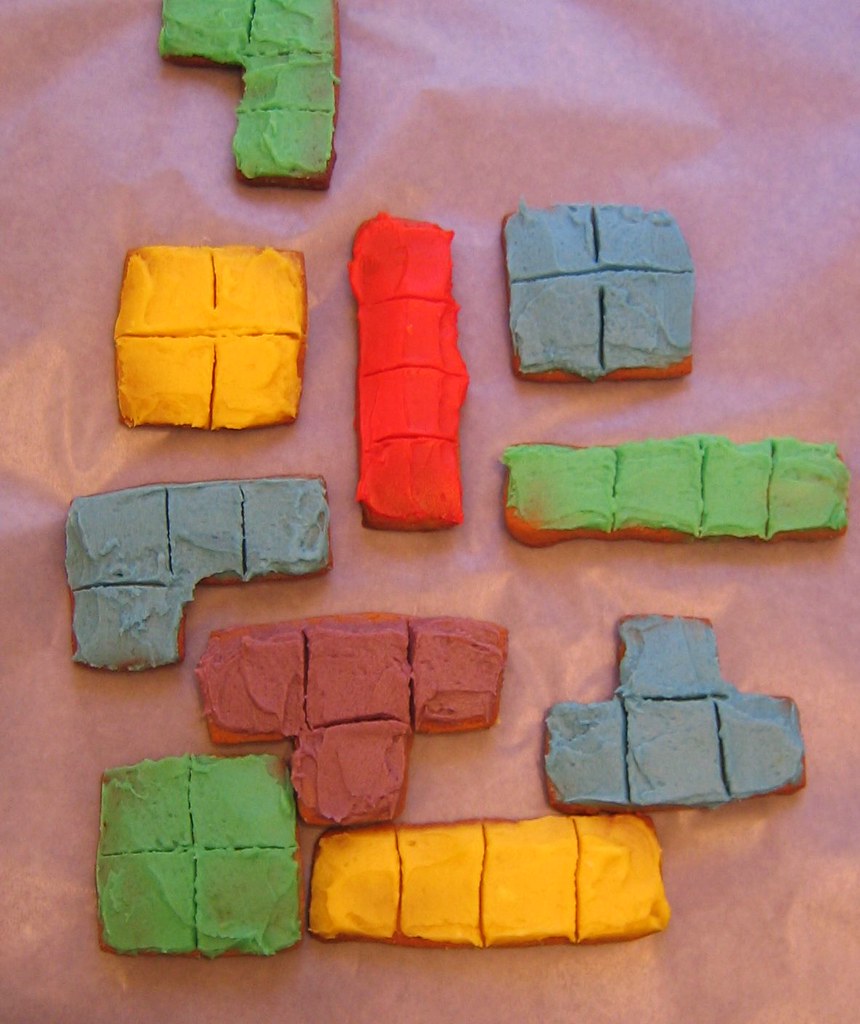
Tetris cookies

I’ve been trying to regularly post some thoughts on the topic of playful IA here. Previously I blogged about how games could be a useful frame for thinking about complex algorithmic architectures. Last week I posted some thoughts on the application of game mechanics in web apps. There, Rahul was kind enough to point me to the fascinating blog of ‘Danc’ Daniel Cook, titled Lost Garden, where there is one post in particular that resonates with my own pre-occupations lately.

In ‘Short thoughts on games and interaction design‘ (which honestly isn’t that short) Danc Cook looks at some of the ways game design techniques can be applied to the interaction design of web apps. In summary, according to Danc Cook game design techniques allow you to:

  1. Create an engaging experience that goes beyond simply completing a task efficiently.
  2. Support free and deep exploration and introduce and teach new interactions that violate conventions.

Some things you shouldn’t borrow from games without giving it a lot of thought are:

  1. Spatial metaphors
  2. Visual themes

These are some of the things most people think of first as characteristic of games but really, they are only surface, superficial, not determinant of the actual interactivity of the system.

I think one of the greatest arguments for a deeper understanding of games by interaction designers, information architects and other user experience specialists is that they are the medium that is all about the aesthetics of interactivity. It is true that they have no utilitarian character, they aim to create a pleasurable experience through systems of risks and rewards, restraints and freedoms, nested feedback loops and on and on. As a UX practitioner, it can never hurt to have a deep appreciation of the aesthetics of the medium you work in daily (beyond simply supporting user goals, or selling product, or whatever).