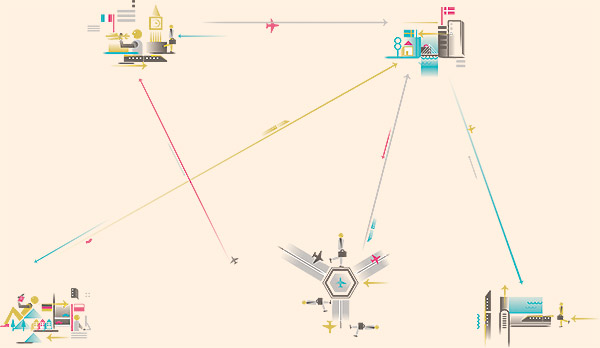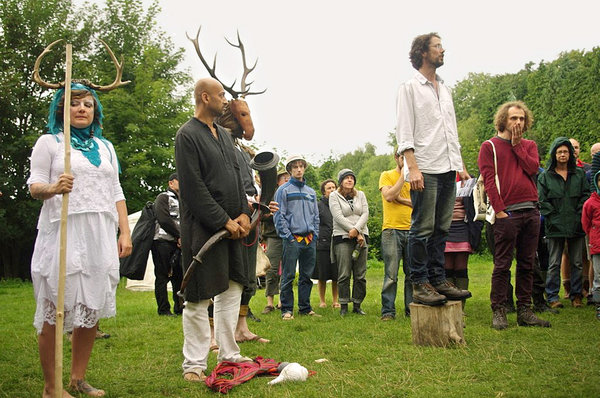
He enthusiastically cites Bernie Dekoven’s definition of that illuminating moment in cooperative play, where a “you and I” is visibly transformed into a “we.” When Bounden’s dancers have finished fumbling around their shared purpose, when, hand-in-phone-in-hand, they begin those first halting steps toward physical fluency together.

Bounden is de Jongh’s most collaborative and expressive game yet. In contrast to previous Game Oven games it does not use awkwardness as a crutch.

(via Gamasutra – You and me become we: Dancing with Bounden)

And this is where sports technology begins to illuminate larger issues around human and technological agency.

Like sport itself, these debates are endless. No technology will ever be infallible, but it may certainly be more accurate than human referees, umpires, commentators and armchair critics. What’s really interesting about having this debate at the TMS level is that it’s fundamentally and visibly embedded in a larger system: that of the game and history of cricket, a rule-based structure which leaves plenty of wiggle room for human fallibility, and human passions. This means the debate is not about the technology itself, but about its wider implications for the system it’s embedded in. The graphics are pretty but we care about the outcome a lot more.

But when such debates happen in wider society – another rule-based structure with a degree of wiggle room – this isn’t always the case. The same arguments around human and technological agency are occurring all around us, but we don’t seem to be debating them in the same way.

There’s an idea for an interesting game—a physical game with a digital arbiter, where players get to adjust the level of technological interference. This could possibly be a very educational experience about technology and human agency.

(via Test Match Special and Technological Agency | booktwo.org)

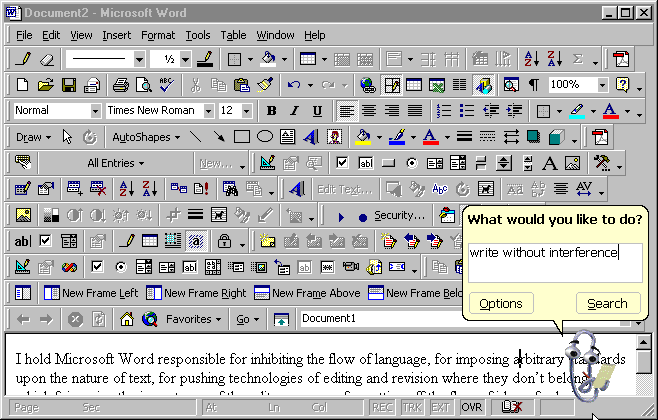
“People who do work with symbols and language to make a living organize their thoughts into the containers and systems that Office provides. Office is not so much a software product as a dialect that we all speak as we proceed about our labors.”

An enjoyable overview of some classic pieces of software and their influence on culture.

(via The Great Works of Software — The Message — Medium)

“The European dream appears quite stable. China may be heading for a bump in the road if its population ever demands democracy. Russia had a period of fast growth (with precious little benefit for most Russians) but what happens if Vladimir Putin is becoming a military adventurer? Europe looks to have those traumas behind it. Nor has it become an American-style plutocracy.”

“Europe still has lots to learn. A French friend recently attended a Californian reception packed with brilliant French engineers working in Silicon Valley. He came home thinking: “What would it take to bring those people back to France?” That’s the sort of question Europeans need to ask: how to convert their wonderful idea networks into Apples and Googles? London, Europe’s de facto business capital, with its budding tech sector, may be finding an answer. If it does, the rest of the continent will try to copy it, because nonstop cross-border learning is still the secret of Europe’s success.”

The first paragraph and the second here are oddly dissonant to me. Isn’t the financialisation of Silicon Valley (and for that matter, London’s Tech City) a sure sign plutocracy comes riding in on the back of “Apples and Googles”?

(via Why Europe works – FT.com)

Nobody does thoroughly argued presentations quite like Sebastian. This is good stuff on ethics and design.

I decided to share some thoughts it sparked via Twitter and ended up ranting a bit:

I recently talked about ethics to a bunch of “behavior designers” and found myself concluding that any designed system that does not allow for user appropriation is fundamentally unethical because as you rightly point out what is the good life is a personal matter. Imposing it is an inherently violent act. A lot of design is a form of technologically mediated violence. Getting people to do your bidding, however well intended. Which given my own vocation and work in the past is a kind of troubling thought to arrive at… Help?

Sebastian makes his best point on slides 113-114. Ethical design isn’t about doing the least harm, but about doing the most good. And, to come back to my Twitter rant, for me the ultimate good is for others to be free. Hence non-prescriptive design.

(via Designing the Good Life: Ethics and User Experience Design)

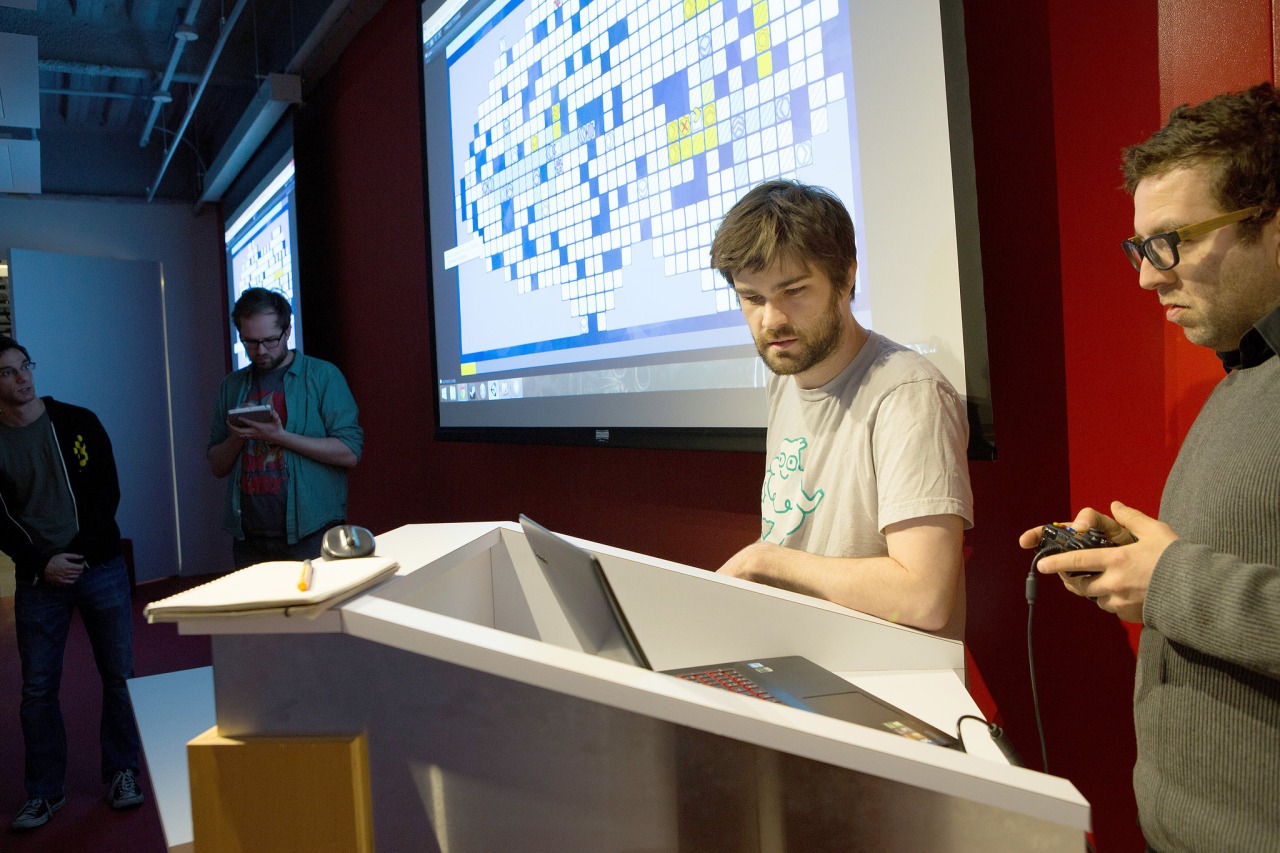
“Making a game combines everything that’s hard about building a bridge with everything that’s hard about composing an opera,” he said. “Games are basically operas made out of bridges.”

“Part of the problem with this urge to elevate games is that they also become domesticated,” Mr. Lantz said. “Now that we’ve gotten them in the museum and the university, keeping games weird and scary is maybe the next problem to solve.”

I got to visit NYU Game Center during Practice last year, and I am convinced it is basically the best games program in the world today because it is (1) explicitly focused on making, and (2) does not pander to whatever is “hot” in the industry at any moment, but tries to actively shape it in stead.

With regards to weirdness (or illegibility), this is a concern if mine too for some time and I tried to talk about how I see this working at Hide & Seek back in 2012.

(via Talented Designers Stream Into M.F.A. Video Game Programs – NYTimes.com)

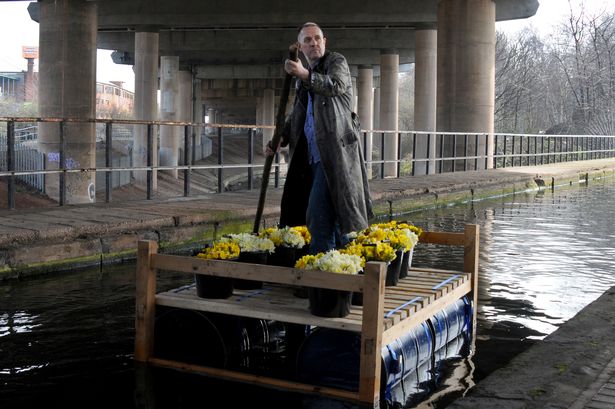
“One of the paintings just has the two words BAKE CAKE on it, no further explanation. But what I will be doing is baking 40 cakes at Eastside Projects (Victoria sponge or chocolate).

I will then draw a large circle on a map of Birmingham that is pinned to the gallery wall. The centre of the circle is the gallery where I have baked the cakes.

Then I will drive out to the edge of the circle with a cake, knock on a random front door. If anyone answers I will say, ‘I have baked you a cake, here it is.’

If they don’t want it for whatever reason, I will go next door and do the same. I will repeat this process 40 times until all the cakes have been delivered to and received by complete strangers who had no idea what this was about or the fact that their home was on the Birmingham Cake Circle.”

It’s been a while since I’ve read about art that is this playful. It puts a smile on my face.

(via Birmingham is first stop for Bill Drummond on 12-year world tour – Birmingham Post)

For Kingsnorth, the notion that technology will stave off the most catastrophic effects of global warming is not just wrong, it’s repellent — a distortion of the proper relationship between humans and the natural world and evidence that in the throes of crisis, many environmentalists have abandoned the principle that “nature has some intrinsic, inherent value beyond the instrumental.” If we lose sight of that ideal in the name of saving civilization, he argues, if we allow ourselves to erect wind farms on every mountain and solar arrays in every desert, we will be accepting a Faustian bargain.

The core of the demonstrators’ complaints was not that the new highways would worsen air pollution, cause car accidents or fracture communities; it was that some things, like wilderness and beauty, were — despite, or perhaps because of, their “uselessness” — more important than getting to work on time.

“People think that abandoning belief in progress, abandoning the belief that if we try hard enough we can fix this mess, is a nihilistic position,” Hine said. “They think we’re saying: ‘Screw it. Nothing matters.’ But in fact all we’re saying is: ‘Let’s not pretend we’re not feeling despair. Let’s sit with it for a while. Let’s be honest with ourselves and with each other. And then as our eyes adjust to the darkness, what do we start to notice?’ ”

This was an intense read, but I’m pretty sure anyone who has given some serious thought to climate change has at some points entertained some of these ideas. And between the lines, there are some interesting perspectives on instrumental rationality, playfulness and (dare I say it) mindfulness.

(via It’s the End of the World as We Know It … and He Feels Fine – NYTimes.com)

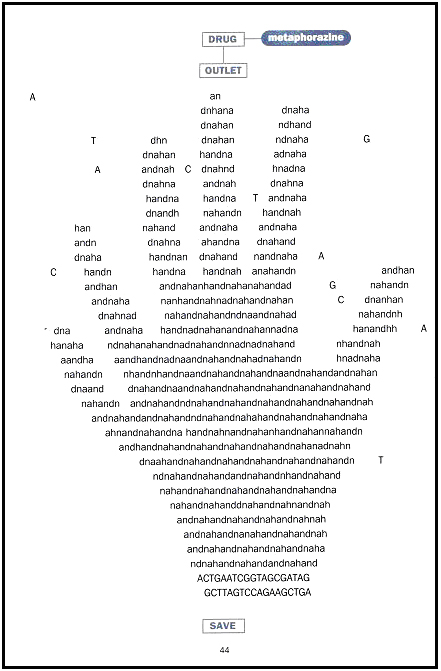
“Indeed, Noon seems to take the “play” from literary play and the “game” from writing game and whorl the words into uniquely distilled forms. This strategy is not only compelled by the desire to experiment; that is, Noon asks in the “Post Futurism Manifesto,” “can’t we writers have some fun as well?””

Noon’s writing games are metaphorical exercises that give him license to play with text and surprise himself. The approach has led to some of the most memorable weird fiction I’ve ever read.

(via “You are cordially invited to a / CHEMICAL WEDDING”: Metamorphiction and Experimentation in Jeff Noon’s Cobralingus | Electronic Book Review)

“In this film I wanted to look beyond the childish myth of ‘the cloud’, to investigate what the infrastructures of the internet actually look like. It felt important to be able to see and hear the energy that goes into powering these machines, and the associated systems for securing, cooling and maintaining them.”

Rarely has a datacenter looked this pretty.

(via Internet machine – Timo Arnall)