-
Joe McCarthy on the Microsoft Research Social Computing Symposium. He summarizes some interesting talks and then goes on to talk about permeability or cross-over effects between online and offline worlds.
Author: Kars Alfrink
links for 2006-06-22
-
“Mashups have no clear rules on what they can and can’t do with people’s details”
-
Danah makes a good argument for supporting as many browsers as you can when building social network apps.
-
Ben reviews We Media 2006: “Perhaps the biggest disappointment of the conference was the missed opportunity the conference had to move the debate forward into new territory.”
-
Metcalfe on web 2.0 in the enterprise: “if you want to add a bit of “Web2.0″, my quick and straight-to-the-point suggestion is to do your “Web2.0 stuff” in a satellite operation at arms length from the rest of your operation.”
-
Hilarious satirical children’s book on file sharing.
Back
Back by dope demand. Yesterday I returned from my lovely trip to Italy. Dirty clothes are in the laundromat, I’ve caught up on paperwork and e-mail, now it’s time to start going through the huge amounts of photos. Me and my girlfriend have managed to knock off the first few days, but I’ve got literally thousands lying around (I know shouldn’t have bought a new camera…) So it’ll take a while before we’ve gone through ’em all. In the mean time the first few are up. Here’s my favourite of the batch.
Off to Italy
After a slight delay I’m off to Italy in a few hours. I’ll be visiting Rome, Florence and Venice. Expect plenty of photos when I return. Back in less than two weeks!
Shadow of the Colossus mini-review
One of the most rewarding gaming experience I’ve had in quite some time, Shadow of the Colossus is an exercise in restraint (something rarely found with game designers). Large parts of the game are spent riding a horse through a lavishly rich landscape, looking for a giant monster to battle. Felling one of the title colossi always involves solving a logical puzzle (real-world logic, as opposed to the so often found in-game logic) and is very satisfying. One of the best looking games I’ve ever seen on the PS2, riding, fighting and climbing cliff-faces are always esthetically pleasing and quite cinematic. Highly recommended!
Broken Flowers mini-review
This film provided what I expected of it: a typical apathetic looking Bill Murray who finds himself in various bizarre situations. The film seems to be about nothing, and lead nowhere, but in the end you find it under your skin, some of its images lingering. I particularly like the way in which the setup (Murray as Johnston receives a letter from an unknown ex-partner) has you constantly looking for clues as to who of the four women is the mother of Johnston’s alleged son. It plays on and portrays the way the human brain desperately looks for patterns in random phenomena – anything pink is loaded with significance, just because the initial letter is pink. Recommended.
(Also, the jazzy, “Ethiopian” music is very nice as well.)
Reboot 8.0 photos are up
I spend the morning going through my photos of Reboot 8.0. I had near 800 of them, so that was quite the exercise. Now there’s 147 in a set over at my Flickr account. It was nice to relive the whole experience while going through the shots, made me realize I saw and did a hell of a lot in two days. No wonder I was so tired when I got home.
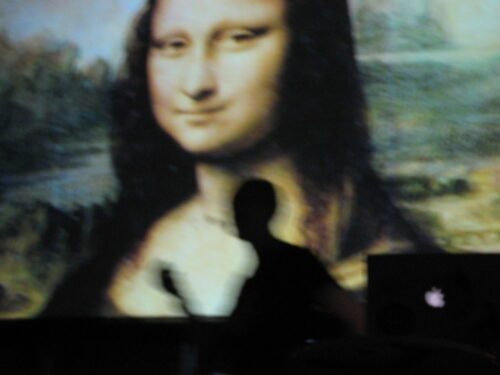
Here’s my favorite shot of the set, aptly summarizing the theme of this year’s event, “renaissance?” with Ben Hammersley dancing around the stage flanked by Mona Lisa and a battered PowerBook.
Reboot 8.0 post mortem
I’m back in Utrecht after a few great days in Copenhagen. Reboot 8.0 was surprisingly good this year. I was afraid it wouldn’t measure up to the awesome quality of last year, but I was wrong. Perhaps this year was even better. I’ll have to digest everything a little more before I can say for sure.
I’ll get back later with some thoughts on important issues that were brought up during the event. But first I’m off to Italy for two weeks of vacation and some much needed rest.
So photos and in depth analysis will have to wait a little longer. Back in a few weeks!
Rough notes from Euan Semple – There’s something going on here that is bigger than any of us
What does it all mean?
Printing press analogy. Press changed the way we saw the world. We’ll have similar shift in the future (long term). But: they used to burn heretics as well. Not everyone will want to adopt this.
7 years since Cluetrain: lots of stuff is still the same
Change will not happen thanks to tech.
Three myths
- Hierarchy is the only way to organize stuff, from church through military, etc. but: hyperlinks subvert hierarchy. Once people start employing them it has a disruptive effect, breaking though hierarchies.
- If we take certain steps we’ll be successful. But success got scrambled.
- Cartesian anxiety: stress due to separation of individual and rest of the world (perspective). Misunderstanding of evolution, it should be about passing around what works (faster), not killing off the weak.
“It’s easier to do good than to do bad” — Jimmy Wales
LOVE: that’s what makes the internet hang together (and it’s not about the huge amounts of porn). Tolerance, the need to connect. Reboot is very much about this.
Internet creates opportunities for better understanding of shared meaning.
Everything is motivated by love or fear and fear is just absence of love.
He didn’t get where he was today… by using fear.
Collusion: people don’t want to admit to what they’re doing is wrong.
Anarchy actually means the ultimate in democracy. Is it so bad to fragment huge institutions.
Every society has people that see themselves as maintainers of order (although they don’t know what that order is).
The web cuts out the middle men (maintainers of order).
The idea that the online world is immature and dangerous is wrong. Google never forgets. Think about the stuff you say.
Don’t complain, don’t say no.
Do the right thing.
Stating the obvious, say the way you think the world should be and it’ll turn out that way.
Seeing something interesting, then judging yourself if it’s valuable enough and publishing it. Other people doing the same as an effect and on and on.
It’s not about tech. but it isn’t utopia either. You should take responsibility for what you do.
Dalai Lama quote: it’s about relationships and being social.
http://reboot.dk/wiki/There%27s_something_going_on_here_that_is_bigger_than_any_of_us

Rough notes for Chris Heathcote – A mobile Internet manifesto
It isn’t Nokia policy, he’s trying to be provocative.
1b internet 2b mobile user 5b unconnected
many networks, you’ll be connected to the internet
100% voice, 50% java, 10% native apps
these are not barriers:
display device speed text entry network speed
1000 bln. text messages in 2005
we might be the last gen. that uses querty
fixed 1000M wireless 100M fixed internet 10M wireless internet 1M
people want terabyte speed, we need to think what’s good enough now
we’re there already
barriers: data cost, battery life, 2 hour problem, smart networks
a picture used to cost 15 euros to upload
fixed price is really important in data
battery hasn’t seen innovation like the rest of mobile tech.
in the west we’re always less than 2 hours away from a “real” computer
David S. Isenberg: fat pipe, always on, get out of the way
assumption is that mobile phones can’t work in a dumb network, rich client sutuation
they are
mobile internet does not exist!
good mobile browsers, they’re here
other important stuff: smart clients – easy to develop: Flash Lite, Python
browser is like swiss army knife
E.g.: Backpack. Nice web app. He’s been trying to make a mobile version of Backpack.
Why is that different?
He can’t release it publicly yet, but he will soon.
PC + mobile: home + away
They’re far more useful together than seperate
What’s useful? 10 x easier 10 x cheaper 10 x a day
Mind like water (GTD) mobile is excellent for this, you can action them
Mobile is social
Timekilling? Competition: books, iPods, etc.
Social is more interesting, you want to take those elements from web apps to mobile
Internet is push + pull
Demo time!
Mobile web browser: access to all kinds of phone stuff.
He loves it, he wants to see people build stuff with it.
Out of sight message: because he wanted a domain he’s going through a proxy.
Not being online all the time is interesting from a presence point of view.
no need for separate mobile sites
basic accessibility and web standards still rule
lots of websites are assuming users have lots of bandwidth – that’s bad on both the web and mobile
data is very important (useful data)
APIs are great, XML is great, as long as they work
we’re not special: Google tries to be helpful by forcing you into the mobile version
Don’t repurpose content for mobile.
People are people… they’re the same. They have the same needs. Make sure they have access.
Create mobile sites. Aim at the 2b, not the 1b.
Mobile is going to be the main way to access the internet in the future.
Voice is interesting as well.
Q One thing you mentioned is flat rates. We can’t solve it as devs. Any ideas to force carriers to do it? A Carriers aren’t as uncanny as you think. They realize that money can be made from flat rate.
Sites can be built for mobile using web standards easily. That’s key.
Q What do you need for the mobile Backpack? A The series 60 phones running Python. We want to open source it so people can port it.