Postdoc update – July 2025

I am over one year into my postdoc at TU Delft. Where did the time go? By way of an annual report, here’s a rundown of my most notable outputs and activities since the previous update from June 2024. And also, some notes on what I am up to now.

Happenings

Participatory AI and ML Engineering: On 13 February 2024 at a Human Values for Smarter Cities meeting and on 11 June 2024 at a Cities Coalition for Digital Rights meeting, I presented a talk on participatory AI and ML engineering (blogged here). This has since evolved into a study I am currently running with the working title “Vision Model Macroscope.” We are designing, building, and evaluating an interface that allows municipal workers to understand and debate value-laden technical decisions made by machine learning engineers in the construction of camera vehicles. For the design, I am collaborating with CLEVER°FRANKE. The study is part of the Human Values for Smarter Cities projected headed up by the Civic Interaction Design group at AUAS.

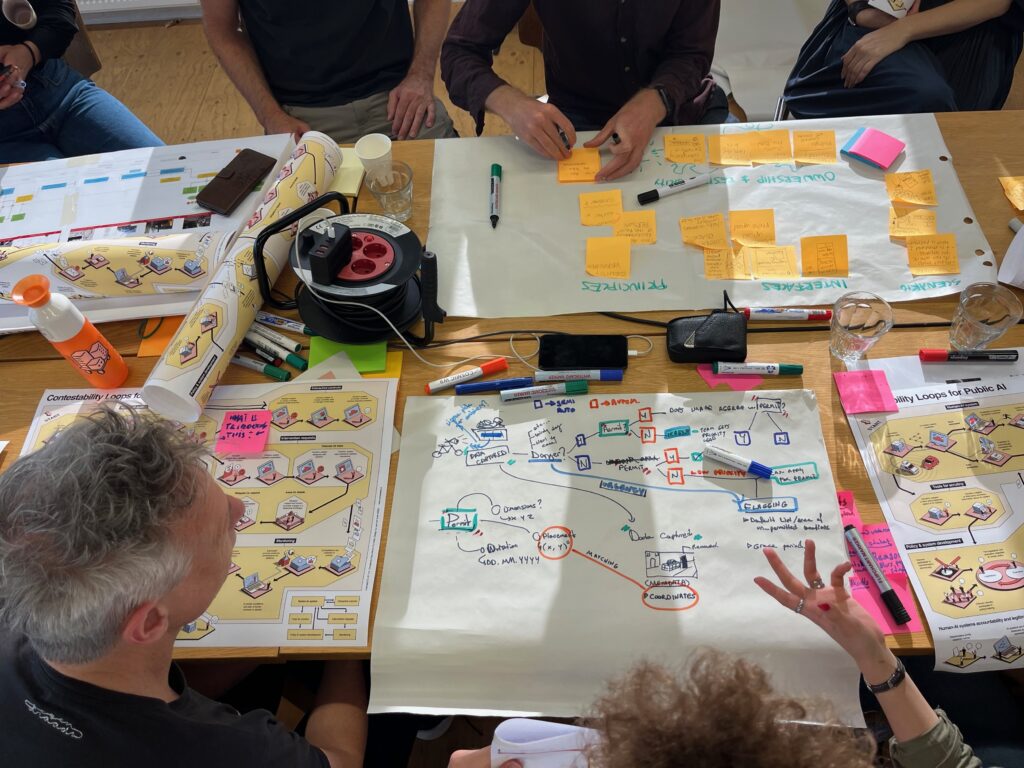
Envisioning Contestability Loops: My article “Envisioning Contestability Loops: Evaluating the Agonistic Arena as a Generative Metaphor for Public AI” (with Ianus Keller, Mireia Yurrita Semperena, Denis Bulygin, Gerd Kortuem, and Neelke Doorn) was published in She Ji on 17 June 2024. (I had already published the infographic “Contestability Loops for Public AI,” which the article revolves around, on 17 April 2024.) Later in the year, on 5 September 2024, I ran the workshop that the study builds on as a ThingsCon Salon. And on 27 September 2024, I presented the article at Lawtomation Days in Madrid, Spain, as part of the panel “Methods in law and technology research: inter- and cross-disciplinary challenges and opportunities,” chaired by Kostina Prifti (slides). (Also, John Thackara said nice things about the article online.)
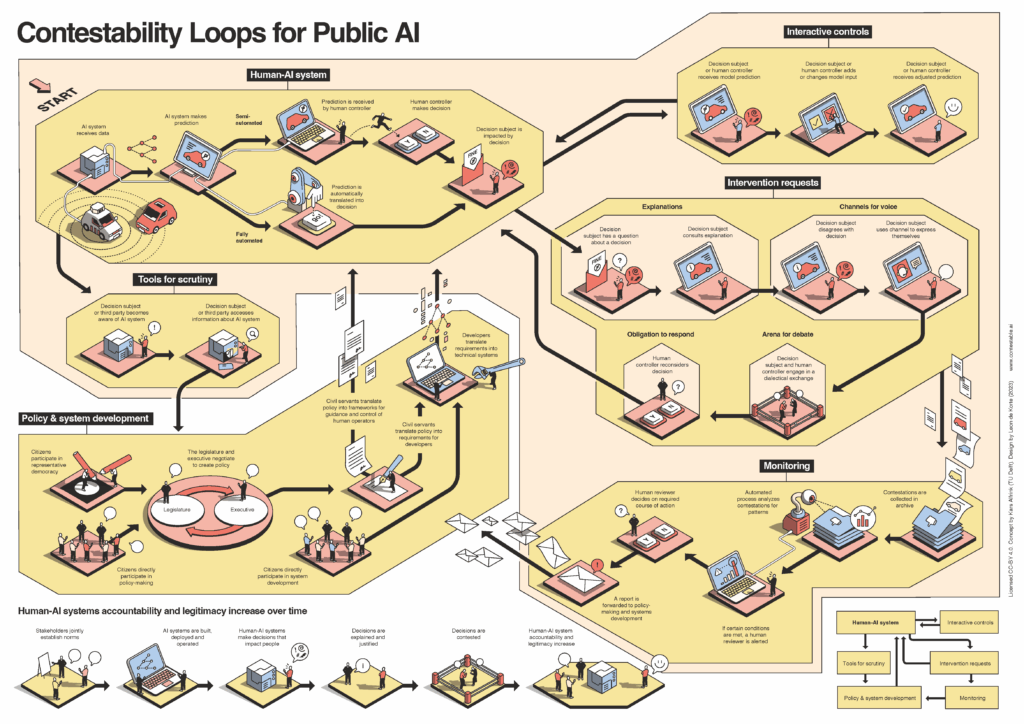
Contestability Loops for Public AI infographic
Envisioning Contestability Loops workshop at ThingsCon Salon in progress.

Democratizing AI Through Continuous Adaptability: I presented on “Democratizing AI Through Continuous Adaptability: The Role of DevOps” at the TILTing Perspectives 2024 panel “The mutual shaping of democratic practices & AI,” which was chaired and moderated by Merel Noorman on 14 July 2024. I later reprised this talk at NWO ICT.OPEN on 16 April 2025 as part of the track “Human-Computer Interaction and Societal Impact in the Netherlands,” chaired by Armağan Karahanoğlu and Max Birk (PDF of slides).

From Stem to Stern: I was part of the organizing team of the CSCW 2024 workshop “From Stem to Stern: Contestability Along AI Value Chains,” which took place as a hybrid one-day session on 9 November 2024. I blogged a summary and some takeaways of the workshop here. Shoutout to Agathe Balayn and Yulu Pi for leading this endeavor.

Contestable AI Talks: I was invited to speak on my PhD research at various meetings and events organized by studios, agencies, consultancies, schools, and public sector organizations. On 3 September 2024, at the data design agency CLEVER°FRANKE (slides). On 10 January 2025, at the University of Utrecht Computational Sociology group. On 19 February 2025, at digital ethics consultancy The Green Land (slides). On 6 March 2024, at Communication and Multimedia Design Amsterdam (slides). And on 17 March 2025, at the Advisory Board on Open Government and Information Management.

Designing Responsible AI: Over the course of 2024, Sara Colombo, Francesca Mauri, and I developed and taught for the first time a new Integrated Product Design master’s elective, “Designing Responsible AI” (course description). Later, on 28 March 2025, I was invited by my colleagues Alessandro Bozzon and Carlo van der Valk to give a single-morning interactive lecture on part of the same content at the course AI Products and Services (slides).
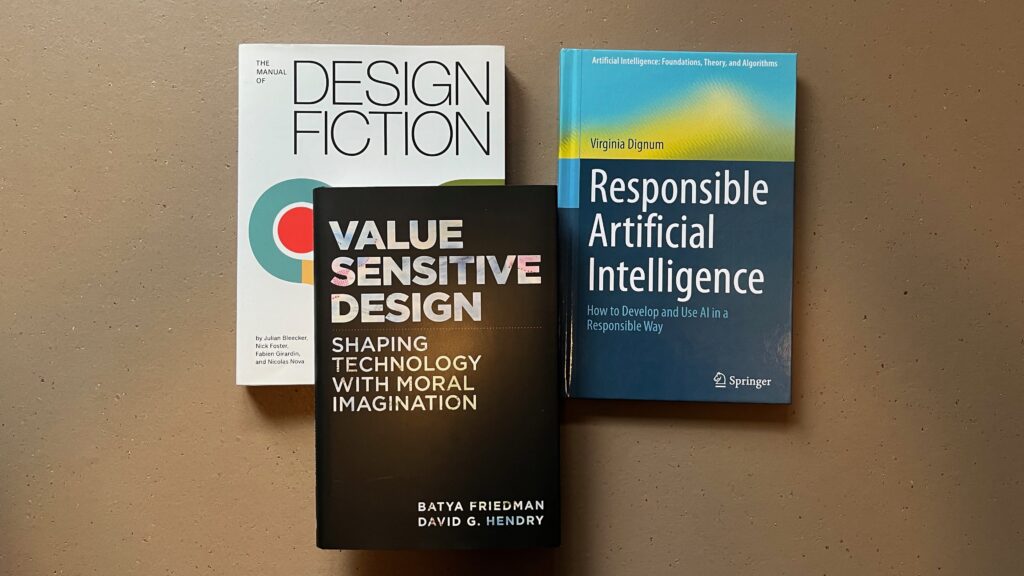
Books that represent the range of theory covered in the course “Designing Responsible AI.”

Stop the Cuts: On 2 July 2024, a far-right government was sworn in in the Netherlands (it has since fallen). They intended to cut funding to education by €2 billion. A coalition of researchers, teachers, students, and others organized to protest and strike in response. I was present at several of these actions: The alternative opening of the academic year in Utrecht on 2 September 2024. Local walkouts on 14 November 2024 (I participated in Utrecht). Mass demonstration in The Hague on 25 November 2024. Local actions on 11 December 2024 (I participated in Delft). And finally, for now at least, on 24 April 2025, at the Delft edition of the nationwide relay strike. If you read this, work in academia, and want to act, join a union (I am a member of the AOb), and sign up for the WOinActie newsletter.
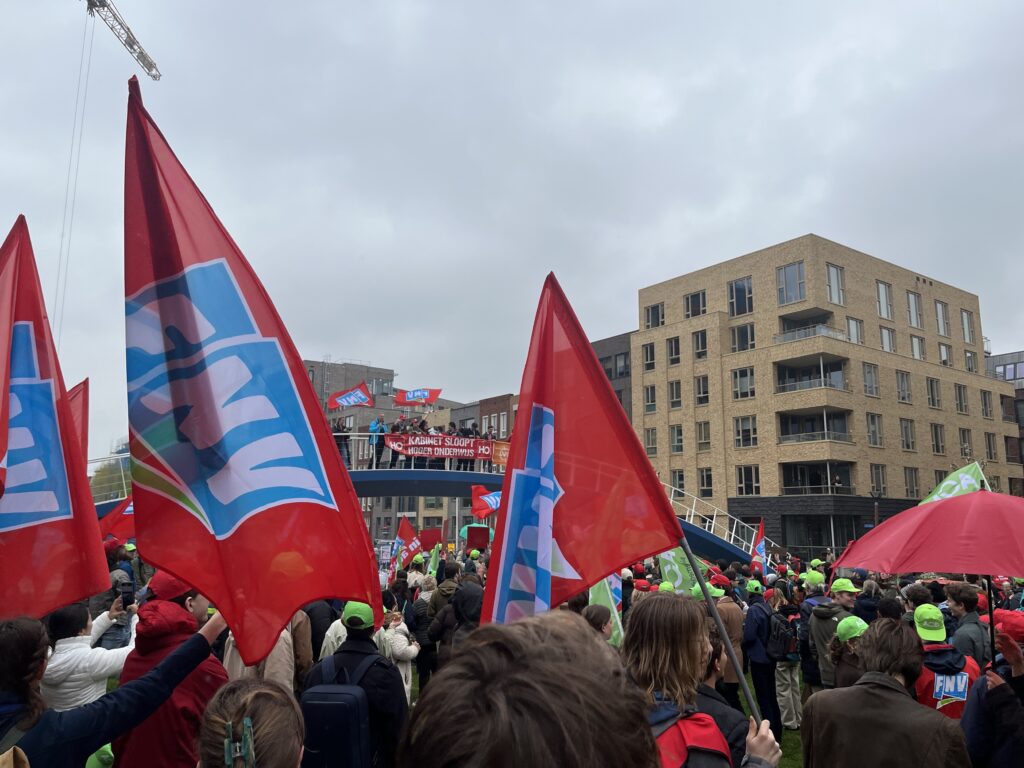
End of the march during the 24 April 2025 strike in Delft.

Panels: Over the past months, I was a panelist at several events. On 22 October 2024, at the Design & AI Symposium as part of the panel “Evolving Perspectives on AI and Design,” together with Iohanna Nicenboim and Jesse Benjamin, moderated by Mathias Funk (blog post). On 13 December 2024 at TH/NGS as part of the panel “Rethink Design: Book Launch and Panel Discussion on Designing With AI” chaired by Roy Bendor (video). On 12 March 2025, at the panel “Inclusive AI: Approaches to Digital Inclusion,” chaired by Nazli Cila and Taylor Stone.
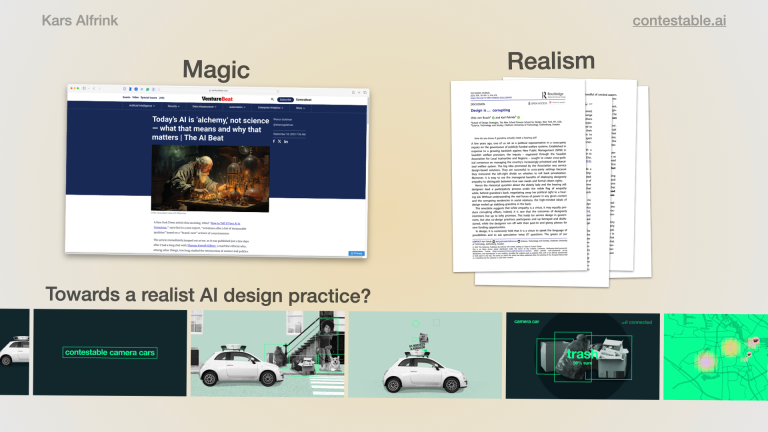
Slide I used during my panel contribution at the Design & AI symposium.

Design for Human Autonomy: I was part of several activities organized by the Delft Design for Values institute related to their annual theme of autonomy (led by Michael Klenk). I was a panelist on 15 October 2024 during the kick-off event (blog post). I wrote the section on designing AI for autonomy for the white paper edited by Udo Pesch (preprint). And during the closing symposium, master’s graduation student Ameya Sawant, whom I am coaching (with Fernando Secomandi acting as chair), was honored as a finalist in the thesis competition.

Master Graduation Students: Four master students that I coached during their thesis projects graduated, which between them explored technology’s role in society through AI-mediated civic engagement, generative AI implementation in public services, experimental approaches to AI trustworthiness, and urban environmental sensing—Nina te Groen (with Achilleas Psyilidis as chair), Romée Postma (with Roy Bendor), Eline Oei (with Giulia Calabretta), and Jim Blom (with Tomasz Jaskiewicz).

Architecting for Contestability: On 22 November 2025, I ran a single-day workshop about contestability for government-employed ICT architects participating in the Digital Design & Architecture course offered by the University of Twente, on invitation from Marijn Janssen (slides).

Qualitative Design Research: On 17 December 2024, I delivered a lecture on qualitative design research for the course Empirical Design Research, on invitation from my colleague Himanshu Verma (slides). Later, on 22 April 2025, I delivered a follow-up in the form of a lecture on reflexive thematic analysis for the course Product Futures Studio, coordinated by Holly McQuillan (slides).

Democratic Generative Things: On 6 June 2025 I joined the ThingsCon unconference to discuss my contribution to the RIOT report, “Embodied AI and collective power: Designing democratic generative things” (preprint). The report was edited by edited by Andrea Krajewski and Iskander Smit.
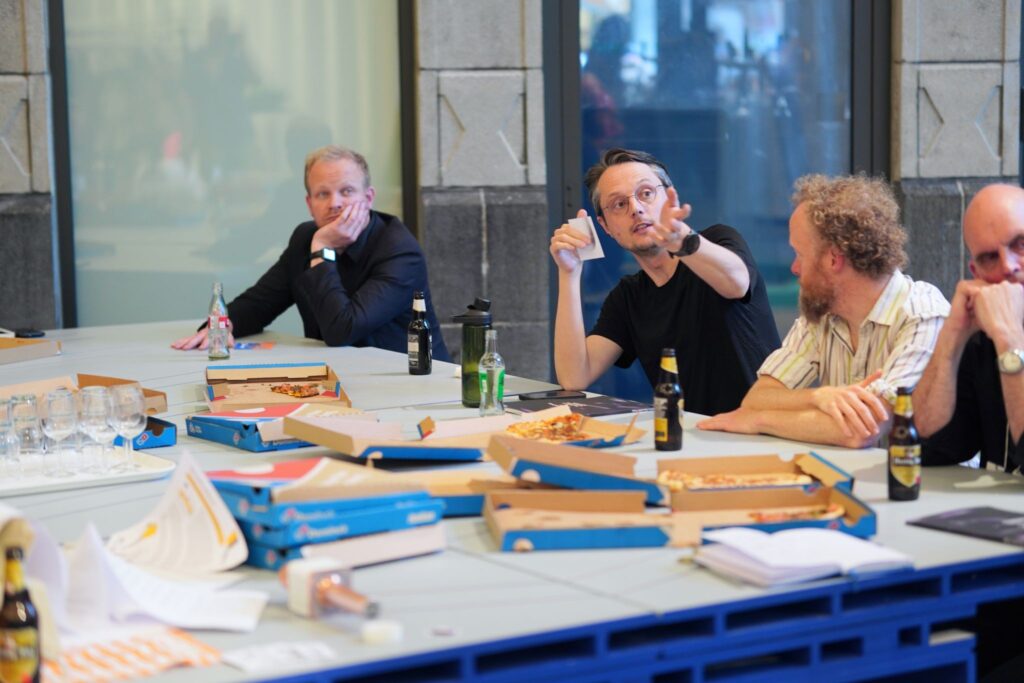
Me, holding forth during the ThingsCon RIOT unconference.

Learning Experience Design: I delivered the closing invited talk at LXDCON on 12 June 2025, reflecting on the impact of GenAI on the fields of education and design for learning (slides). Many thanks to Niels Floor for the invitation.

People’s Compute: I published a preprint of my position paper “People’s Compute: Design and the Politics of AI Infrastructures” over at OSF on 14 April 2025. I emailed it to peers and received over a dozen encouraging responses. It was also somehow picked up by Evgeny Morozov’s The Syllabus with some nice commentary attached.

On deck

So what am I up to at the moment? Keeping nice and busy.

  • I am co-authoring several articles, papers, and book chapters on topics including workplace automation, AI transparency, contestability in engineering, AI design and regulation, computational argumentation, explainable and participatory AI, and AI infrastructure politics. I do hope at least some of these will see the light of day in the coming months.
  • I am preparing a personal grant application that builds on the vision laid out in People’s Compute.
  • I will be delivering an invited talk at Enterprise UX on 21 November 2025.
  • I am acting as a scientific advisor to a center that is currently being established, which focuses on increasing digital autonomy within Dutch government institutions.
  • I will be co-teaching Designing Responsible AI again in Q1 of the next academic year.
  • I’ll serve as an associate chair on the CHI 2026 design subcommittee.
  • And I have signed up to begin our university’s teaching qualification certification.

Whew. That’s it. Thanks for reading (skimming?) if you’ve made it all the way to the end. I will try to circle back and do another update, maybe a little sooner than this one, say in six months’ time.

Research Through Design Reading List

After posting the list of engineering ethics readings it occurred to me I also have a really nice collection of things to read from a course on research through design taught by Pieter Jan Stappers, which I took earlier this year. I figured some might get some use out of it and I like having it for my own reference here as well.

The backbone for this course is the chapter on research through design by Stappers and Giaccardi in the encyclopedia of human-computer interaction, which I highly recommend.

All of the readings below are referenced in that chapter. I’ve read some, quickly gutted others for meaning and the remainder is still on my to-read list. For me personally, the things on annotated portfolios and intermediate-level knowledge by Gaver and Löwgren were the most immediately useful and applicable. I’d read the Zimmerman paper earlier and although it’s pretty concrete in its prescriptions I did not really latch on to it.

  1. Brandt, Eva, and Thomas Binder. “Experimental design research: genealogy, intervention, argument.” International Association of Societies of Design Research, Hong Kong 10 (2007).
  2. Gaver, Bill, and John Bowers. “Annotated portfolios.” interactions 19.4 (2012): 40-49.
  3. Gaver, William. “What should we expect from research through design?.” Proceedings of the SIGCHI conference on human factors in computing systems. ACM, 2012.
  4. Löwgren, Jonas. “Annotated portfolios and other forms of intermediate-level knowledge.” Interactions 20.1 (2013): 30-34.
  5. Stappers, Pieter Jan, F. Sleeswijk Visser, and A. I. Keller. “The role of prototypes and frameworks for structuring explorations by research through design.” The Routledge Companion to Design Research (2014): 163-174.
  6. Stappers, Pieter Jan. “Meta-levels in Design Research.”
  7. Stappers, Pieter Jan. “Prototypes as central vein for knowledge development.” Prototype: Design and craft in the 21st century (2013): 85-97.
  8. Wensveen, Stephan, and Ben Matthews. “Prototypes and prototyping in design research.” The Routledge Companion to Design Research. Taylor & Francis (2015).
  9. Zimmerman, John, Jodi Forlizzi, and Shelley Evenson. “Research through design as a method for interaction design research in HCI.” Proceedings of the SIGCHI conference on Human factors in computing systems. ACM, 2007.

Bonus level: several items related to “muddling through”…

  1. Flach, John M., and Fred Voorhorst. “What matters?: Putting common sense to work.” (2016).
  2. Lindblom, Charles E. “Still Muddling, Not Yet Through.” Public Administration Review 39.6 (1979): 517-26.
  3. Lindblom, Charles E. “The science of muddling through.” Public Administration Review 19.2 (1959): 79-88.

Engineering Ethics Reading List

I recently followed an excellent three-day course on engineering ethics. It was offered by the TU Delft graduate school and taught by Behnam Taibi with guest lectures from several of our faculty.

I found it particularly helpful to get some suggestions for further reading that represent some of the foundational ideas in the field. I figured it would be useful to others as well to have a pointer to them.

So here they are. I’ve quickly gutted these for their meaning. The one by Van de Poel I did read entirely and can highly recommend for anyone who’s doing design of emerging technologies and wants to escape from the informed consent conundrum.

I intend to dig into the Doorn one, not just because she’s one of my promoters but also because resilience is a concept that is closely related to my own interests. I’ll also get into the Floridi one in detail but the concept of information quality and the care ethics perspective on the problem of information abundance and attention scarcity I found immediately applicable in interaction design.

  1. Stilgoe, Jack, Richard Owen, and Phil Macnaghten. “Developing a framework for responsible innovation.” Research Policy 42.9 (2013): 1568-1580.
  2. Van den Hoven, Jeroen. “Value sensitive design and responsible innovation.” Responsible innovation (2013): 75-83.
  3. Hansson, Sven Ove. “Ethical criteria of risk acceptance.” Erkenntnis 59.3 (2003): 291-309.
  4. Van de Poel, Ibo. “An ethical framework for evaluating experimental technology.” Science and engineering ethics22.3 (2016): 667-686.
  5. Hansson, Sven Ove. “Philosophical problems in cost–benefit analysis.” Economics & Philosophy 23.2 (2007): 163-183.
  6. Floridi, Luciano. “Big Data and information quality.” The philosophy of information quality. Springer, Cham, 2014. 303-315.
  7. Doorn, Neelke, Paolo Gardoni, and Colleen Murphy. “A multidisciplinary definition and evaluation of resilience: The role of social justice in defining resilience.” Sustainable and Resilient Infrastructure (2018): 1-12.

We also got a draft of the intro chapter to a book on engineering and ethics that Behnam is writing. That looks very promising as well but I can’t share yet for obvious reasons.

Starting a PhD

Today is the first official work day of my new doctoral researcher position at Delft University of Technology. After more than two years of laying the ground work, I’m starting out on a new challenge.

I remember sitting outside a Jewel coffee bar in Singapore1 and going over the various options for whatever would be next after shutting down Hubbub. I knew I wanted to delve into the impact of machine learning and data science on interaction design. And largely through process of elimination I felt the best place for me to do so would be inside of academia.

Back in the Netherlands, with help from Ianus Keller, I started making inroads at TU Delft, my first choice for this kind of work. I had visited it on and off over the years, coaching students and doing guest lectures. I’d felt at home right away.

There were quite a few twists and turns along the way but now here we are. Starting this month I am a doctoral candidate at Delft University of Technology’s faculty of Industrial Design Engineering.

My research is provisionally titled ‘Intelligibility and Transparency of Smart Public Infrastructures: A Design Oriented Approach’. Its main object of study is the MX3D smart bridge. My supervisors are Gerd Kortuem and Neelke Doorn. And it’s all part of the NWO-funded project ‘BRIdging Data in the built Environment (BRIDE)’.

Below is a first rough abstract of the research. But in the months to come this is likely to change substantially as I start hammering out a proper research plan. I plan to post the occasional update on my work here, so if you’re interested your best bet is probably to do the old RSS thing. There’s social media too, of course. And I might set up a newsletter at some point. We’ll see.

If any of this resonates, do get in touch. I’d love to start a conversation with as many people as possible about this stuff.

Intelligibility and Transparency of Smart Public Infrastructures: A Design Oriented Approach

This phd will explore how designers, technologists, and citizens can utilize rapid urban manufacturing and IoT technologies for designing urban space that expresses its intelligence from the intersection of people, places, activities and technology, not merely from the presence of cutting-edge technology. The key question is how smart public infrastructure, i.e. data-driven and algorithm-rich public infrastructures, can be understood by lay-people.

The design-oriented research will utilize a ‘research through design’ approach to develop a digital experience around the bridge and the surrounding urban space. During this extended design and making process the phd student will conduct empirical research to investigate design choices and their implications on (1) new forms of participatory data-informed design processes, (2) the technology-mediated experience of urban space, (3) the emerging relationship between residents and “their” bridge, and (4) new forms of data-informed, citizen led governance of public space.

  1. My Foursquare history and 750 Words archive tell me this was on Saturday, January 16, 2016. []

Status update

This is not exactly a now page, but I thought I would write up what I am doing at the moment since last reporting on my status in my end-of-year report.

The majority of my workdays are spent doing freelance design consulting. My primary gig has been through Eend at the Dutch Victim Support Foundation, where until very recently I was part of a team building online services. I helped out with product strategy, setting up a lean UX design process, and getting an integrated agile design and development team up and running. The first services are now shipping so it is time for me to move on, after 10 months of very gratifying work. I really enjoy working in the public sector and I hope to be doing more of it in future.

So yes, this means I am available and you can hire me to do strategy and design for software products and services. Just send me an email.

Shortly before the Dutch national elections of this year, Iskander and I gathered a group of fellow tech workers under the banner of “Tech Solidarity NL” to discuss the concerning lurch to the right in national politics and what our field can do about it. This has developed into a small but active community who gather monthly to educate ourselves and develop plans for collective action. I am getting a huge boost out of this. Figuring out how to be a leftist in this day and age is not easy. The only way to do it is to practice and for that reflection with peers is invaluable. Building and facilitating a group like this is hugely educational too. I have learned a lot about how a community is boot-strapped and nurtured.

If you are in the Netherlands, your politics are left of center, and you work in technology, consider yourself invited to join.

And finally, the last major thing on my plate is a continuing effort to secure a PhD position for myself. I am getting great support from people at Delft University of Technology, in particular Gerd Kortuem. I am focusing on internet of things products that have features driven by machine learning. My ultimate aim is to develop prototyping tools for design and development teams that will help them create more innovative and more ethical solutions. The first step for this will be to conduct field research inside companies who are creating such products right now. So I am reaching out to people to see if I can secure a reasonable amount of potential collaborators for this, which will go a long way in proving the feasibility of my whole plan.

If you know of any companies that develop consumer-facing products that have a connected hardware component and make use of machine learning to drive features, do let me know.

That’s about it. Freelance UX consulting, leftist tech-worker organising and design-for-machine-learning research. Quite happy with that mix, really.