Postdoc update – July 2025

I am over one year into my postdoc at TU Delft. Where did the time go? By way of an annual report, here’s a rundown of my most notable outputs and activities since the previous update from June 2024. And also, some notes on what I am up to now.

Happenings

Participatory AI and ML Engineering: On 13 February 2024 at a Human Values for Smarter Cities meeting and on 11 June 2024 at a Cities Coalition for Digital Rights meeting, I presented a talk on participatory AI and ML engineering (blogged here). This has since evolved into a study I am currently running with the working title “Vision Model Macroscope.” We are designing, building, and evaluating an interface that allows municipal workers to understand and debate value-laden technical decisions made by machine learning engineers in the construction of camera vehicles. For the design, I am collaborating with CLEVER°FRANKE. The study is part of the Human Values for Smarter Cities projected headed up by the Civic Interaction Design group at AUAS.

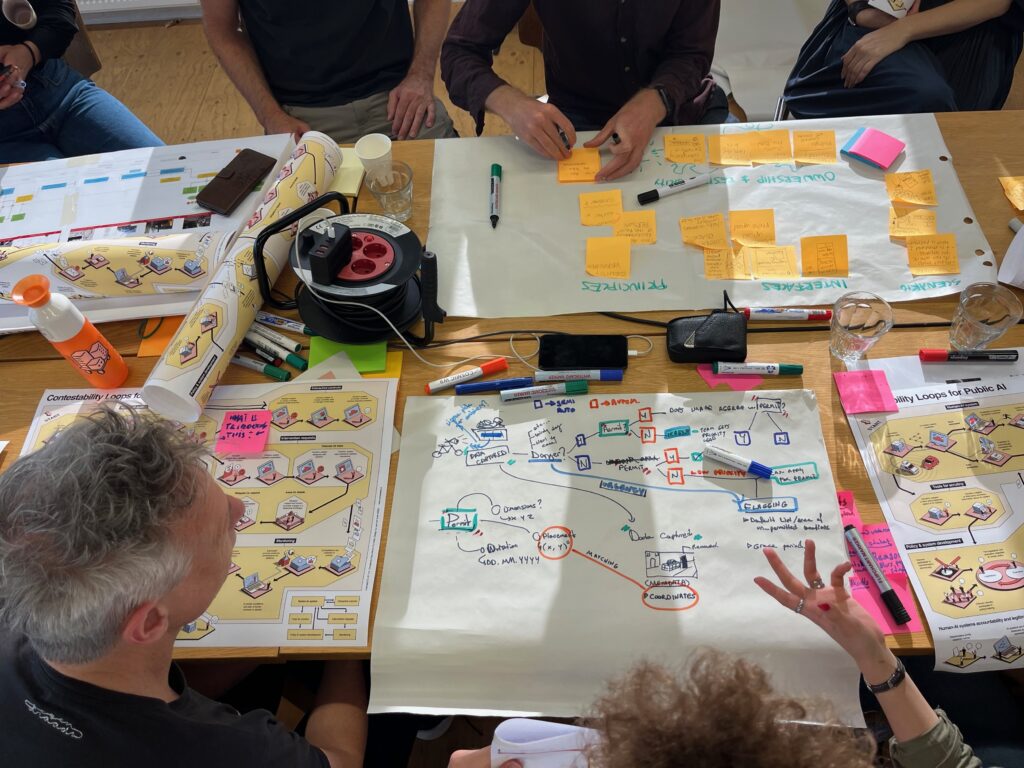
Envisioning Contestability Loops: My article “Envisioning Contestability Loops: Evaluating the Agonistic Arena as a Generative Metaphor for Public AI” (with Ianus Keller, Mireia Yurrita Semperena, Denis Bulygin, Gerd Kortuem, and Neelke Doorn) was published in She Ji on 17 June 2024. (I had already published the infographic “Contestability Loops for Public AI,” which the article revolves around, on 17 April 2024.) Later in the year, on 5 September 2024, I ran the workshop that the study builds on as a ThingsCon Salon. And on 27 September 2024, I presented the article at Lawtomation Days in Madrid, Spain, as part of the panel “Methods in law and technology research: inter- and cross-disciplinary challenges and opportunities,” chaired by Kostina Prifti (slides). (Also, John Thackara said nice things about the article online.)
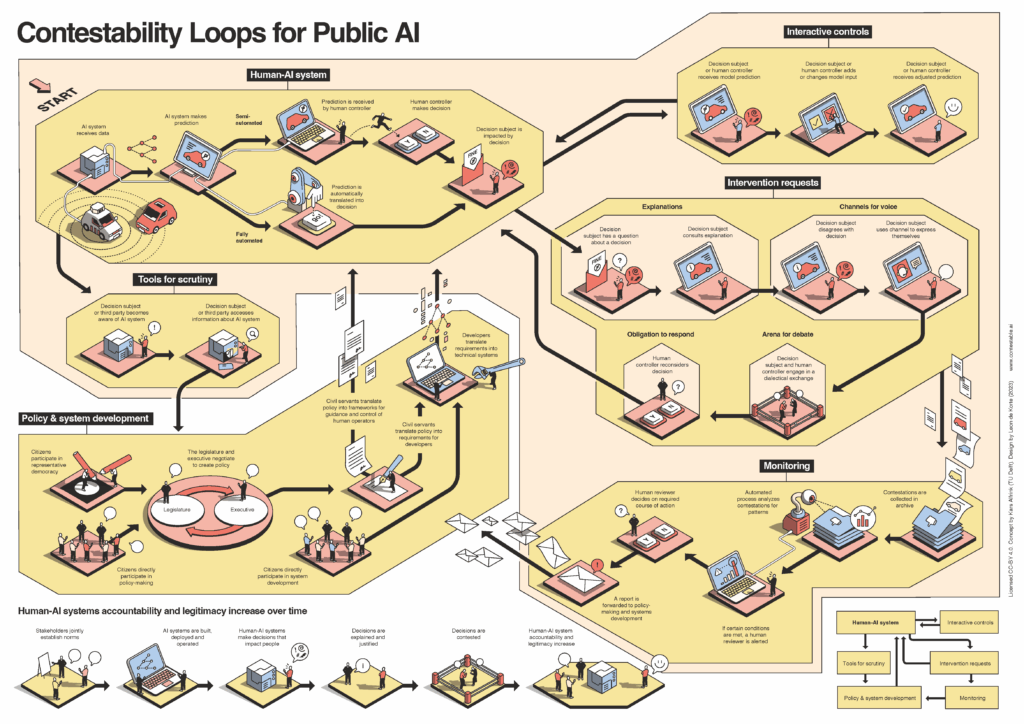
Contestability Loops for Public AI infographic
Envisioning Contestability Loops workshop at ThingsCon Salon in progress.

Democratizing AI Through Continuous Adaptability: I presented on “Democratizing AI Through Continuous Adaptability: The Role of DevOps” at the TILTing Perspectives 2024 panel “The mutual shaping of democratic practices & AI,” which was chaired and moderated by Merel Noorman on 14 July 2024. I later reprised this talk at NWO ICT.OPEN on 16 April 2025 as part of the track “Human-Computer Interaction and Societal Impact in the Netherlands,” chaired by Armağan Karahanoğlu and Max Birk (PDF of slides).

From Stem to Stern: I was part of the organizing team of the CSCW 2024 workshop “From Stem to Stern: Contestability Along AI Value Chains,” which took place as a hybrid one-day session on 9 November 2024. I blogged a summary and some takeaways of the workshop here. Shoutout to Agathe Balayn and Yulu Pi for leading this endeavor.

Contestable AI Talks: I was invited to speak on my PhD research at various meetings and events organized by studios, agencies, consultancies, schools, and public sector organizations. On 3 September 2024, at the data design agency CLEVER°FRANKE (slides). On 10 January 2025, at the University of Utrecht Computational Sociology group. On 19 February 2025, at digital ethics consultancy The Green Land (slides). On 6 March 2024, at Communication and Multimedia Design Amsterdam (slides). And on 17 March 2025, at the Advisory Board on Open Government and Information Management.

Designing Responsible AI: Over the course of 2024, Sara Colombo, Francesca Mauri, and I developed and taught for the first time a new Integrated Product Design master’s elective, “Designing Responsible AI” (course description). Later, on 28 March 2025, I was invited by my colleagues Alessandro Bozzon and Carlo van der Valk to give a single-morning interactive lecture on part of the same content at the course AI Products and Services (slides).
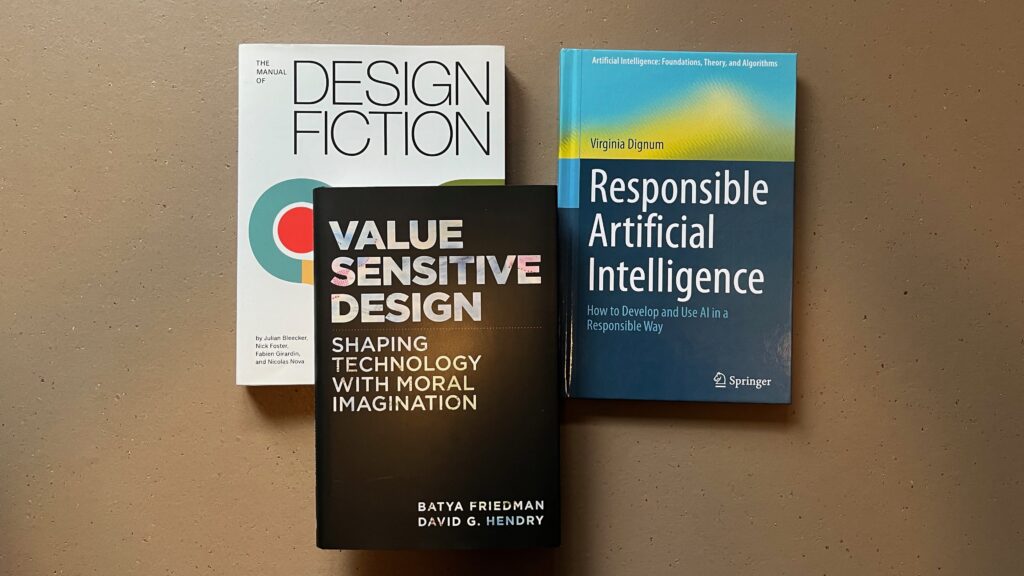
Books that represent the range of theory covered in the course “Designing Responsible AI.”

Stop the Cuts: On 2 July 2024, a far-right government was sworn in in the Netherlands (it has since fallen). They intended to cut funding to education by €2 billion. A coalition of researchers, teachers, students, and others organized to protest and strike in response. I was present at several of these actions: The alternative opening of the academic year in Utrecht on 2 September 2024. Local walkouts on 14 November 2024 (I participated in Utrecht). Mass demonstration in The Hague on 25 November 2024. Local actions on 11 December 2024 (I participated in Delft). And finally, for now at least, on 24 April 2025, at the Delft edition of the nationwide relay strike. If you read this, work in academia, and want to act, join a union (I am a member of the AOb), and sign up for the WOinActie newsletter.
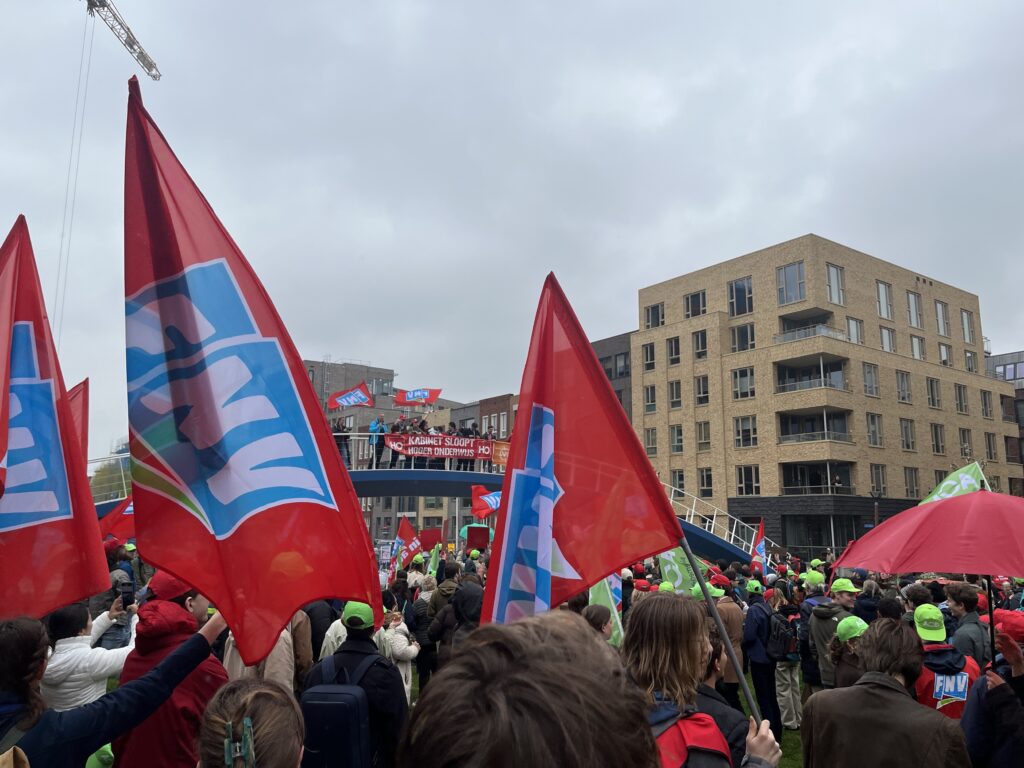
End of the march during the 24 April 2025 strike in Delft.

Panels: Over the past months, I was a panelist at several events. On 22 October 2024, at the Design & AI Symposium as part of the panel “Evolving Perspectives on AI and Design,” together with Iohanna Nicenboim and Jesse Benjamin, moderated by Mathias Funk (blog post). On 13 December 2024 at TH/NGS as part of the panel “Rethink Design: Book Launch and Panel Discussion on Designing With AI” chaired by Roy Bendor (video). On 12 March 2025, at the panel “Inclusive AI: Approaches to Digital Inclusion,” chaired by Nazli Cila and Taylor Stone.
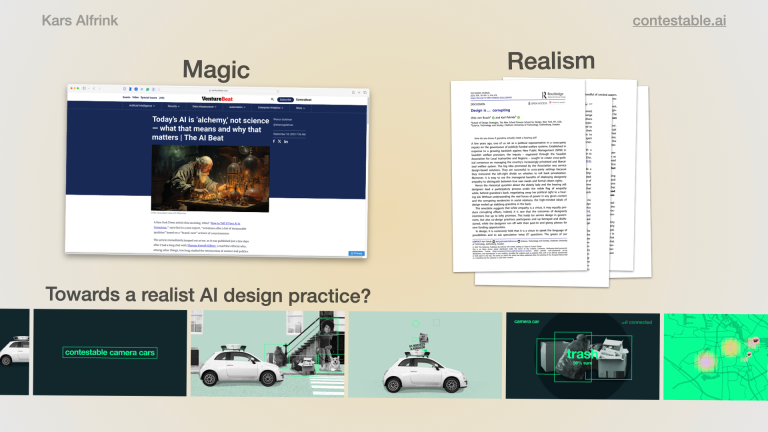
Slide I used during my panel contribution at the Design & AI symposium.

Design for Human Autonomy: I was part of several activities organized by the Delft Design for Values institute related to their annual theme of autonomy (led by Michael Klenk). I was a panelist on 15 October 2024 during the kick-off event (blog post). I wrote the section on designing AI for autonomy for the white paper edited by Udo Pesch (preprint). And during the closing symposium, master’s graduation student Ameya Sawant, whom I am coaching (with Fernando Secomandi acting as chair), was honored as a finalist in the thesis competition.

Master Graduation Students: Four master students that I coached during their thesis projects graduated, which between them explored technology’s role in society through AI-mediated civic engagement, generative AI implementation in public services, experimental approaches to AI trustworthiness, and urban environmental sensing—Nina te Groen (with Achilleas Psyilidis as chair), Romée Postma (with Roy Bendor), Eline Oei (with Giulia Calabretta), and Jim Blom (with Tomasz Jaskiewicz).

Architecting for Contestability: On 22 November 2025, I ran a single-day workshop about contestability for government-employed ICT architects participating in the Digital Design & Architecture course offered by the University of Twente, on invitation from Marijn Janssen (slides).

Qualitative Design Research: On 17 December 2024, I delivered a lecture on qualitative design research for the course Empirical Design Research, on invitation from my colleague Himanshu Verma (slides). Later, on 22 April 2025, I delivered a follow-up in the form of a lecture on reflexive thematic analysis for the course Product Futures Studio, coordinated by Holly McQuillan (slides).

Democratic Generative Things: On 6 June 2025 I joined the ThingsCon unconference to discuss my contribution to the RIOT report, “Embodied AI and collective power: Designing democratic generative things” (preprint). The report was edited by edited by Andrea Krajewski and Iskander Smit.

Me, holding forth during the ThingsCon RIOT unconference.

Learning Experience Design: I delivered the closing invited talk at LXDCON on 12 June 2025, reflecting on the impact of GenAI on the fields of education and design for learning (slides). Many thanks to Niels Floor for the invitation.

People’s Compute: I published a preprint of my position paper “People’s Compute: Design and the Politics of AI Infrastructures” over at OSF on 14 April 2025. I emailed it to peers and received over a dozen encouraging responses. It was also somehow picked up by Evgeny Morozov’s The Syllabus with some nice commentary attached.

On deck

So what am I up to at the moment? Keeping nice and busy.

  • I am co-authoring several articles, papers, and book chapters on topics including workplace automation, AI transparency, contestability in engineering, AI design and regulation, computational argumentation, explainable and participatory AI, and AI infrastructure politics. I do hope at least some of these will see the light of day in the coming months.
  • I am preparing a personal grant application that builds on the vision laid out in People’s Compute.
  • I will be delivering an invited talk at Enterprise UX on 21 November 2025.
  • I am acting as a scientific advisor to a center that is currently being established, which focuses on increasing digital autonomy within Dutch government institutions.
  • I will be co-teaching Designing Responsible AI again in Q1 of the next academic year.
  • I’ll serve as an associate chair on the CHI 2026 design subcommittee.
  • And I have signed up to begin our university’s teaching qualification certification.

Whew. That’s it. Thanks for reading (skimming?) if you’ve made it all the way to the end. I will try to circle back and do another update, maybe a little sooner than this one, say in six months’ time.

Democratizing AI Through Continuous Adaptability: The Role of DevOps

Below are the abstract and slides for my contribution to the TILTing Perspectives 2024 panel “The mutual shaping of democratic practices & AI,” moderated by Merel Noorman.

Slides

Abstract

Contestability

This presentation delves into democratizing artificial intelligence (AI) systems through contestability. Contestability refers to the ability of AI systems to remain open and responsive to disputes throughout their lifecycle. It approaches AI systems as arenas where groups compete for power over designs and outcomes.

Autonomy, democratic agency, legitimation

We identify contestability as a critical system quality for respecting people’s autonomy. This includes their democratic agency: their ability to legitimate policies. This includes policies enacted by AI systems.

For a decision to be legitimate, it must be democratically willed or rely on “normative authority.” The democratic pathway should be constrained by normative bounds to avoid arbitrariness. The appeal to authority should meet the “access constraint,” which ensures citizens can form beliefs about policies with a sufficient degree of agency (Peter, 2020 in Rubel et al., 2021).

Contestability is the quality that ensures mechanisms are in place for subjects to exercise their democratic agency. In the case of an appeal to normative authority, contestability mechanisms are how subjects and their representatives gain access to the information that will enable them to evaluate its justifiability. In this way, contestability satisfies the access constraint. In the case of democratic will, contestability-by-design practices are how system development is democratized. The autonomy account of legitimation adds the normative constraints that should bind this democratic pathway.

Himmelreich (2022) similarly argues that only a “thick” conception of democracy will address some of the current shortcomings of AI development. This is a pathway that not only allows for participation but also includes deliberation over justifications.

The agonistic arena

Elsewhere, we have proposed the Agonistic Arena as a metaphor for thinking about the democratization of AI systems (Alfrink et al., 2024). Contestable AI embodies the generative metaphor of the Arena. This metaphor characterizes public AI as a space where interlocutors embrace conflict as productive. Seen through the lens of the Arena, public AI problems stem from a need for opportunities for adversarial interaction between stakeholders.

This metaphorical framing suggests prescriptions to make more contentious and open to dispute the norms and procedures that shape:

  1. AI system design decisions on a global level, and
  2. human-AI system output decisions on a local level (i.e., individual decision outcomes), establishing new dialogical feedback loops between stakeholders that ensure continuous monitoring.

The Arena metaphor encourages a design ethos of revisability and reversibility so that AI systems embody the agonistic ideal of contingency.

Post-deployment malleability, feedback-ladenness

Unlike physical systems, AI technologies exhibit a unique malleability post-deployment.

For example, LLM chatbots optimize their performance based on a variety of feedback sources, including interactions with users, as well as feedback collected through crowd-sourced data work.

Because of this open-endedness, democratic control and oversight in the operations phase of the system’s lifecycle become a particular concern.

This is a concern because while AI systems are dynamic and feedback-laden (Gilbert et al., 2023), many of the existing oversight and control measures are static, one-off exercises that struggle to track systems as they evolve over time.

DevOps

The field of DevOps is pivotal in this context. DevOps focuses on system instrumentation for enhanced monitoring and control for continuous improvement. Typically, metrics for DevOps and their machine learning-specific MLOps offshoot emphasize technical performance and business objectives.

However, there is scope to expand these to include matters of public concern. The matters-of-concern perspective shifts the focus on issues such as fairness or discrimination, viewing them as challenges that cannot be resolved through universal methods with absolute certainty. Rather, it highlights how standards are locally negotiated within specific institutional contexts, emphasizing that such standards are never guaranteed (Lampland & Star, 2009, Geiger et al., 2023).

MLOps Metrics

In the context of machine learning systems, technical metrics focus on model accuracy. For example, a financial services company might use Area Under The Curve Receiver Operating Characteristics (AUC-ROC) to continuously monitor and maintain the performance of their fraud detection model in production.

Business metrics focus on cost-benefit analyses. For example, a bank might use a cost-benefit matrix to balance the potential revenue from approving a loan against the risk of default, ensuring that the overall profitability of their loan portfolio is optimized.

Drift

These metrics can be monitored over time to detect “drift” between a model and the world. Training sets are static. Reality is dynamic. It changes over time. Drift occurs when the nature of new input data diverges from the data a model was trained on. A change in performance metrics may be used to alert system operators, who can then investigate and decide on a course of action, e.g., retraining a model on updated data. This, in effect, creates a feedback loop between the system in use and its ongoing development.

An expansion of these practices in the interest of contestability would require:

  1. setting different metrics,
  2. exposing these metrics to additional audiences, and
  3. establishing feedback loops with the processes that govern models and the systems they are embedded in.

Example 1: Camera Cars

Let’s say a city government uses a camera-equipped vehicle and a computer vision model to detect potholes in public roads. In addition to accuracy and a favorable cost-benefit ratio, citizens, and road users in particular, may care about the time between a detected pothole and its fixing. Or, they may care about the distribution of potholes across the city. Furthermore, when road maintenance appears to be degrading, this should be taken up with department leadership, the responsible alderperson, and council members.

Example 2: EV Charching

Or, let’s say the same city government uses an algorithmic system to optimize public electric vehicle (EV) charging stations for green energy use by adapting charging speeds to expected sun and wind. EV drivers may want to know how much energy has been shifted to greener time windows and its trends. Without such visibility on a system’s actual goal achievement, citizens’ ability to legitimate its use suffers. As I have already mentioned, democratic agency, when enacted via the appeal to authority, depends on access to “normative facts” that underpin policies. And finally, professed system functionality must be demonstrated as well (Raji et al., 2022).

DevOps as sociotechnical leverage point for democratizing AI

These brief examples show that the DevOps approach is a potential sociotechnical leverage point. It offers pathways for democratizing AI system design, development, and operations.

DevOps can be adapted to further contestability. It creates new channels between human and machine actors. One of DevOps’s essential activities is monitoring (Smith, 2020), which presupposes fallibility, a necessary precondition for contestability. Finally, it requires and provides infrastructure for technical flexibility so that recovery from error is low-cost and continuous improvement becomes practically feasible.

The mutual shaping of democratic practices & AI

Zooming out further, let’s reflect on this panel’s overall theme, picking out three elements: legitimation, representation of marginalized groups, and dealing with conflict and contestation after implementation and during use.

Contestability is a lever for demanding justifications from operators, which is a necessary input for legitimation by subjects (Henin & Le Métayer, 2022). Contestability frames different actors’ stances as adversarial positions on a political field rather than “equally valid” perspectives (Scott, 2023). And finally, relations, monitoring, and revisability are all ways to give voice to and enable responsiveness to contestations (Genus & Stirling, 2018).

And again, all of these things can be furthered in the post-deployment phase by adapting the DevOps lens.

Bibliography

  • Alfrink, K., Keller, I., Kortuem, G., & Doorn, N. (2022). Contestable AI by Design: Towards a Framework. Minds and Machines33(4), 613–639. https://doi.org/10/gqnjcs
  • Alfrink, K., Keller, I., Yurrita Semperena, M., Bulygin, D., Kortuem, G., & Doorn, N. (2024). Envisioning Contestability Loops: Evaluating the Agonistic Arena as a Generative Metaphor for Public AI. She Ji: The Journal of Design, Economics, and Innovation10(1), 53–93. https://doi.org/10/gtzwft
  • Geiger, R. S., Tandon, U., Gakhokidze, A., Song, L., & Irani, L. (2023). Making Algorithms Public: Reimagining Auditing From Matters of Fact to Matters of Concern. International Journal of Communication18(0), Article 0.
  • Genus, A., & Stirling, A. (2018). Collingridge and the dilemma of control: Towards responsible and accountable innovation. Research Policy47(1), 61–69. https://doi.org/10/gcs7sn
  • Gilbert, T. K., Lambert, N., Dean, S., Zick, T., Snoswell, A., & Mehta, S. (2023). Reward Reports for Reinforcement Learning. Proceedings of the 2023 AAAI/ACM Conference on AI, Ethics, and Society, 84–130. https://doi.org/10/gs9cnh
  • Henin, C., & Le Métayer, D. (2022). Beyond explainability: Justifiability and contestability of algorithmic decision systems. AI & SOCIETY37(4), 1397–1410. https://doi.org/10/gmg8pf
  • Himmelreich, J. (2022). Against “Democratizing AI.” AI & SOCIETYhttps://doi.org/10/gr95d5
  • Lampland, M., & Star, S. L. (Eds.). (2008). Standards and Their Stories: How Quantifying, Classifying, and Formalizing Practices Shape Everyday Life (1st edition). Cornell University Press.
  • Peter, F. (2020). The Grounds of Political Legitimacy. Journal of the American Philosophical Association6(3), 372–390. https://doi.org/10/grqfhn
  • Raji, I. D., Kumar, I. E., Horowitz, A., & Selbst, A. (2022). The Fallacy of AI Functionality. 2022 ACM Conference on Fairness, Accountability, and Transparency, 959–972. https://doi.org/10/gqfvf5
  • Rubel, A., Castro, C., & Pham, A. K. (2021). Algorithms and autonomy: The ethics of automated decision systems. Cambridge University Press.
  • Scott, D. (2023). Diversifying the Deliberative Turn: Toward an Agonistic RRI. Science, Technology, & Human Values48(2), 295–318. https://doi.org/10/gpk2pr
  • Smith, J. D. (2020). Operations anti-patterns, DevOps solutions. Manning Publications.
  • Treveil, M. (2020). Introducing MLOps: How to scale machine learning in the enterprise (First edition). O’Reilly.