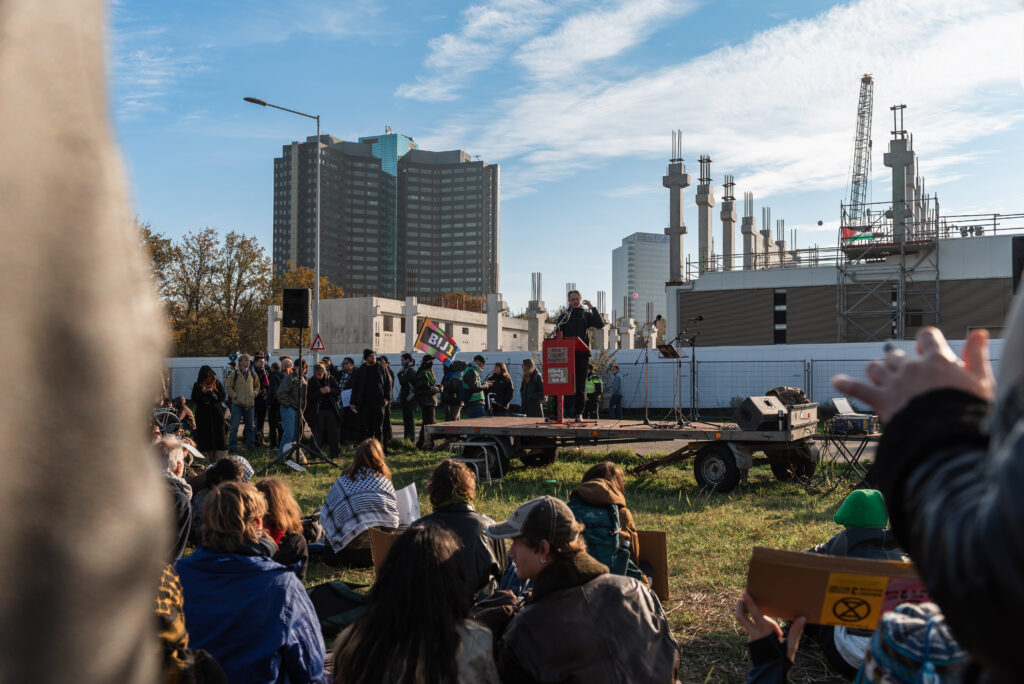
Today I gave a short talk at a teach-in on the politics of data centres. The teach-in was part of the Stop Dirty Data Centres European Days of Action on 6 and 7 November, when local groups across Europe protested and called for a moratorium on large data centres.
The teach-in took place during a support demonstration organised by Fossielvrij NL at the Plimsollweg in Amsterdam Sloterdijk. That’s the site where Pure DC is building a hyperscale data centre for Microsoft, despite the city’s ban on hyperscales. Fieke Jansen and Charis Papaevangelou organised a line-up of Dutch university teachers, each of whom had five minutes, outdoors and without slides, to explain one part of what is at stake. Thanks to them for inviting me, to Fossielvrij NL for organising the demo and to Geef Tegengas for their direct action.
A rough abstract of what I said:
I don’t need to convince anyone at a demo like this that we should resist the buildout of big corporate AI. The question I asked was: what could computing be instead? I shared three lessons from my research as a designer. First, look past the app to the infrastructure underneath it. To really be able to shape applications, people need a say in the stuff they are built on top of. Second, you can leave an app, but you can’t leave the infrastructure, so pushing back takes durable organisations with members, in addition to individual protest. I used De Digitale Stad from back in 1994 as an early example of community computing. Third, in addition to opposing big corporate AI, I am mainly interested in exploring alternative forms of computing. Like the Luddites, we can reject exploitative technological practices without rejecting all technology. One test is whether a system resists extraction or accelerates it. This brings me to design. In my view design is always political, so designers should join communities and communities should become designers, both to resist extractive computing and to build regenerative computing that meets social needs.
Update 9 November 2026: Delta interviewed me about the teach-in. Read it in English or Dutch.