Designing socially useful computing, together

Today I gave a short talk at a teach-in on the politics of data centres. The teach-in was part of the Stop Dirty Data Centres European Days of Action on 6 and 7 November, when local groups across Europe protested and called for a moratorium on large data centres.

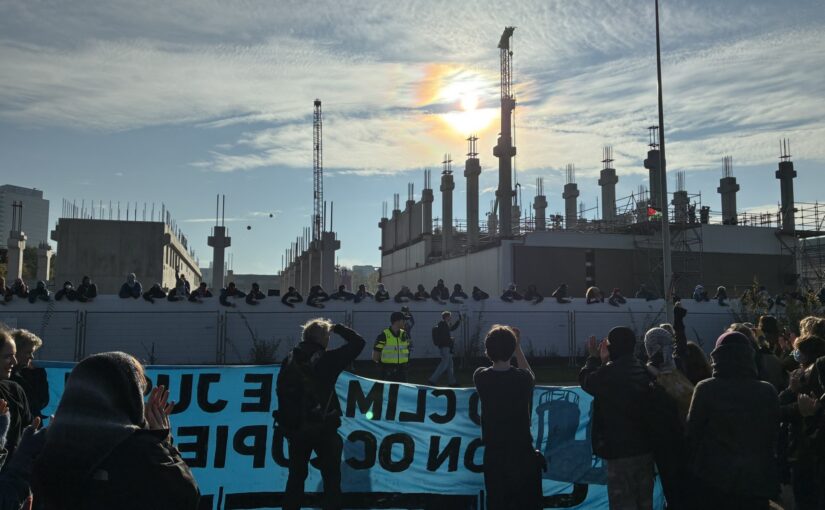
The teach-in took place during a support demonstration organised by Fossielvrij NL at the Plimsollweg in Amsterdam Sloterdijk. That’s the site where Pure DC is building a hyperscale data centre for Microsoft, despite the city’s ban on hyperscales. Fieke Jansen and Charis Papaevangelou organised a line-up of Dutch university teachers, each of whom had five minutes, outdoors and without slides, to explain one part of what is at stake. Thanks to them for inviting me, to Fossielvrij NL for organising the demo and to Geef Tegengas for their direct action.

A rough abstract of what I said:

I don’t need to convince anyone at a demo like this that we should resist the buildout of big corporate AI. The question I asked was: what could computing be instead? I shared three lessons from my research as a designer. First, look past the app to the infrastructure underneath it. To really be able to shape applications, people need a say in the stuff they are built on top of. Second, you can leave an app, but you can’t leave the infrastructure, so pushing back takes durable organisations with members, in addition to individual protest. I used De Digitale Stad from back in 1994 as an early example of community computing. Third, in addition to opposing big corporate AI, I am mainly interested in exploring alternative forms of computing. Like the Luddites, we can reject exploitative technological practices without rejecting all technology. One test is whether a system resists extraction or accelerates it. This brings me to design. In my view design is always political, so designers should join communities and communities should become designers, both to resist extractive computing and to build regenerative computing that meets social needs.

Update 9 November 2026: Delta interviewed me about the teach-in. Read it in English or Dutch.
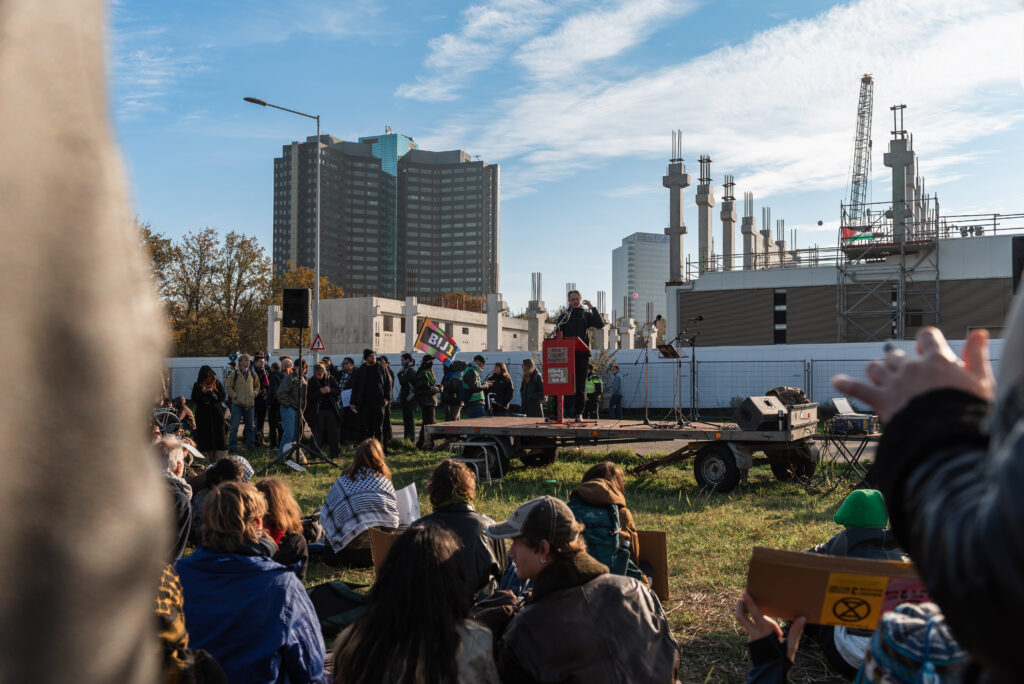
Kars speaks from a red lectern on a flatbed trailer in a grassy field, gesturing with one hand. A handwritten sign on the lectern reads "nobody asked for AI." People sit on the grass in the foreground, some in keffiyehs, and one holds up an Extinction Rebellion sign. Others stand behind them, and a BIJ1 flag flies in the crowd. Behind the trailer, a white construction fence surrounds the half-built Microsoft data centre: concrete pillars with rebar sticking out of the tops, scaffolding with a Palestinian flag, and a crane. Office towers rise against a blue sky.
Speaking at the teach-in at the Plimsollweg, Amsterdam, 6 November 2026. Photo: Dorotea Pace / Fossielvrij NL.

Week 140

Is it march already? Time flies.

I’m on my way to Amsterdam again. Around 10 hours earlier, I was in a train in the opposite direction, coming back from Visible Cities #02. This turned out to be an evening well spent. Some nice examples of AR projects were shown but in particular Ole Bouman of the NAi’s perspective on the changes architecture will go through under the pressure of new technologies was enlightening. He came across as both critical and knowledgeable, passionate about the field with a solid grounding in its history. Inspiring. Finally spending an evening in TrouwAmsterdam – eating a burger and drinking a beer in the space where printing presses used to run – was another plus.

I’m at Layar a lot this week again. Still can’t tell you too much about what’s going on there. But it continues to be both a challenging and fun engagement, so that’s good.

Apart from this, I spent a day brainstorming new game concepts for one of the Netherlands’s big lotteries, with which they’re hoping to reach a younger generation. It’s always a challenge to immerse oneself in a new context that fast, but it went well. Lots of nice ideas came up and the workshop was facilitated in a tight manner. Participating in these things always results in useful insights for when I run my own sessions.

I do feel slightly exhausted from all this, not in the least because what should have been a two hour review of proposals on monday morning with my students turned into a three-and-a-half hour marathon session. They’ve had to submit their graduation project proposals now, so I’ll soon sit down and do a final assessment of them. Then they’re good to go.

And so will I.