Blog All Kindle-clipped Locations: Destruction and Creation

I finished my previous post on why designers should be interested in John Boyd with the recommendation to read his essay “Destruction and Creation”. I thought I’d share the bits I highlighted in my copy. It is part of Osinga’s Science, Strategy and War, to which the locations below refer.

Location 3176 – Boyd introduces a very simple but fundamental reason for why we should care about decision making:

… a basic aim or goal, as individuals, is to improve our capacity for independent action

Location 3183 – the same applies to design and designers. We do not want to be controlled by our circumstances. Boyd was talking to a military audience, but the description below is true of any social situation, including the design practice:

In a real world of limited resources and skills, individuals and groups form, dissolve and reform their cooperative or competitive postures in a continuous struggle to remove or overcome physical and social environmental obstacles.

Location 3190

Against such a background, actions and decisions become critically important.

Location 3192

To make these timely decisions implies that we must be able to form mental concepts of observed reality, as we perceive it, and be able to change these concepts as reality itself appears to change.

Location 3195 – designers are asked to do nothing but the above. The succes of our designs hinges on our understanding of reality and our skill at intervening in it. So the question below is of vital importance to us:

How do we generate or create the mental concepts to support this decision-making activity?

Location 3196 – in the next section of the essay Boyd starts to provide answers:

There are two ways in which we can develop and manipulate mental concepts to represent observed reality: We can start from a comprehensive whole and break it down to its particulars or we can start with the particulars and build towards a comprehensive whole.

Location 3207

… general-to-specific is related to deduction, analysis, and differentiation, while, specific-to-general is related to induction, synthesis, and integration.

Location 3216

… such an unstructuring or destruction of many domains – to break the correspondence of each with its respective constituents – is related to deduction, analysis, and differentiation. We call this kind of unstructuring a destructive deduction.

Location 3225

… creativity is related to induction, synthesis, and integration since we proceeded from unstructured bits and pieces to a new general pattern or concept. We call such action a creative or constructive induction.

Location 3227 – here Boyd starts to connect the two ways of creating concepts. I have always found it gratifying to immerse myself in a design’s domain and to start teasing apart its constituent elements, before moving on to acts of creation:

It is important to note that the crucial or key step that permits this creative induction is the separation of the particulars from their previous domains by the destructive deduction.

Location 3230

… the unstructuring and restructuring just shown reveals a way of changing our perception of reality.

Location 3237 – so far so fairly straight-forward. But Boyd gets increasingly more sophisticated about this cycle of destruction and creation. For example, he suggests we should check for internal consistency of a new concept by tracing back its elements to the original sources:

… we check for reversibility as well as check to see which ideas and interactions match-up with our observations of reality.

Location 3240 – so this is not a two-step linear act, but a cyclical one, where we keep tuning parts and wholes of a concept (or design) and test them against reality:

Over and over again this cycle of Destruction and Creation is repeated until we demonstrate internal consistency and match-up with reality.

Location 3249 – in the next section, Boyd problematises the process he has proposed by showing that once we have formed a concept, its matchup to reality immediately starts to deteriorate:

… at some point, ambiguities, uncertainties, anomalies, or apparent inconsistencies may emerge to stifle a more general and precise match-up of concept with observed reality.

Location 3257 – the point below is one I can’t help but iterate often enough to clients and coworkers. We must work under the assumption of mismatches occurring sooner or later. It is an essential state of mind:

… we should anticipate a mismatch between phenomena observation and concept description of that observation.

Location 3266 – he brings in Gödel, Heisenberg and the second law of thermodynamics to explain why this is so:

Gödel’s Proof indirectly shows that in order to determine the consistency of any new system we must construct or uncover another system beyond it.

Location 3274

Back and forth, over and over again, we use observations to sharpen a concept and a concept to sharpen observations. Under these circumstances, a concept must be incomplete since we depend upon an ever-changing array of observations to shape or formulate it. Likewise, our observations of reality must be incomplete since we depend upon a changing concept to shape or formulate the nature of new inquiries and observations.

Location 3301 – so Gödel shows we need to continuously create new concepts to maintain the usefulness of prior ones due to the relationship between observed reality and mental concepts. Good news for designers! Our work is never done. It is also an interesting way to think about culture evolving by the building of increasingly complex networks of prior concepts into new ones. Next, Boyd brings in Heisenberg to explain why there is uncertainty involved when making observations of reality:

… the magnitude of the uncertainty values represent the degree of intrusion by the observer upon the observed.

Location 3304

… uncertainty values not only represent the degree of intrusion by the observer upon the observed but also the degree of confusion and disorder perceived by that observer.

Location 3308 – Heisenberg shows that the more we become intwined with observed reality the more uncertainty increases. This is of note because as we design new things and we introduce them into the environment, unexpected things start to happen. But also, we as designers ourselves are part of the environment. The more we are part of the same context we are designing for, the less able we will be to see things as they truly are. Finally, for the third move by which Boyd problematises the creation of new concepts, we arrive at the second law of thermodynamics:

High entropy implies a low potential for doing work, a low capacity for taking action or a high degree of confusion and disorder. Low entropy implies just the opposite.

Location 3312 – closed systems are those that don’t communicate with their environment. A successful design practice should be an open system, lest it succumb to entropy:

From this law it follows that entropy must increase in any closed system

… whenever we attempt to do work or take action inside such a system – a concept and its match-up with reality – we should anticipate an increase in entropy hence an increase in confusion and disorder.

Location 3317 – it’s important to note that Boyd’s ideas are equally applicable to design plans, design practices, design outcomes, any system involved in design, really. Confused? Not to worry, Boyd boils it down in the next and final section:

According to Gödel we cannot – in general – determine the consistency, hence the character or nature, of an abstract system within itself. According to Heisenberg and the Second Law of Thermodynamics any attempt to do so in the real world will expose uncertainty and generate disorder.

Location 3320 – the bit below is a pretty good summary of why “big design up front” does not work:

any inward-oriented and continued effort to improve the match-up of concept with observed reality will only increase the degree of mismatch.

Location 3329 – whenever we encounter chaos the instinct is to stick to our guns, but it is probably wiser to take a step back and reconsider our assumptions:

we find that the uncertainty and disorder generated by an inward-oriented system talking to itself can be offset by going outside and creating a new system.

Location 3330 – creativity or explorative design under pressure can seem like a waste of time but once we have gone through the exercise in hind sight we always find it more useful than thought before:

Simply stated, uncertainty and related disorder can be diminished by the direct artifice of creating a higher and broader more general concept to represent reality.

Location 3340

I believe we have uncovered a Dialectic Engine that permits the construction of decision models needed by individuals and societies for determining and monitoring actions in an effort to improve their capacity for independent action.

Location 3341

the goal seeking effort itself appears to be the other side of a control mechanism that seems also to drive and regulate the alternating cycle of destruction and creation toward higher and broader levels of elaboration.

Location 3347 – chaos is a fact of life, and as such we should welcome it because it is as much a source of vitality as it is a threat:

Paradoxically, then, an entropy increase permits both the destruction or unstructuring of a closed system and the creation of a new system to nullify the march toward randomness and death.

Location 3350 – one of Boyd’s final lines is a fine description of what I think design should aspire to:

The result is a changing and expanding universe of mental concepts matched to a changing and expanding universe of observed reality.
John Boyd for designers

The first time I came across military strategist John Boyd’s ideas was probably through Venkatesh Rao’s writing. For example, I remember enjoying Be Somebody or Do Something.

Boyd was clearly a contrarian person. I tend to have a soft spot for such figures so I read a highly entertaining biography by Roger Coram. Getting more interested in his theories I then read an application of Boyd’s ideas to business by Chet Richards. Still not satisfied, I decided to finally buckle down and read the comprehensive survey of his martial and scientific influences plus transcripts of all his briefings by Frans Osinga.

It’s been a hugely enjoyable and rewarding intellectual trip. I feel like Boyd has given me some pretty sharp new tools-to-think-with. From his background you might think these tools are limited to warfare. But in fact they can be applied much more broadly, to any field in which we need to make decisions under uncertain circumstances.

As we go about our daily lives we are actually always dealing with this dynamic. But the stakes are usually low, so we mostly don’t really care about having a thorough understanding of how to do what we want to do. In warfare the stakes are obviously unusually high, so it makes sense for some of the most articulate thinking on the subject to emerge from it.

As a designer I have always been interested in how my profession makes decisions. Designers usually deal with high levels of uncertainty too. Although lives are rarely at stake, the continued viability of businesses and quality of peoples lives usually are, at least in some way. Furthermore, there is always a leap of faith involved with any design decision. When we suggest a path forward with our sketches and prototypes, and we choose to proceed to development, we can never be entirely sure if our intended outcomes will pan out as we had hoped.

This uncertainty has always been present in any design act, but an argument could be made that technology has increased the amount of uncertainty in our world.

The way I see it, the methods of user centred design, interaction design, user experience, etc are all attempts to “deal with” uncertainty in various ways. The same can be said for the techniques of agile software development.

These methods can be divided into roughly two categories, which more or less correspond to the upper two quadrants of this two-by-two by Venkatesh. Borrowing the diagram’s labels, one is called Spore. It is risk-averse and focuses on sustainability. The other is called Hydra and it is risk-savvy and about anti-fragility. Spore tries to limit the negative consequences of unexpected events, and Hydra tries to maximise their positive consequences.

An example of a Spore-like design move would be to insist on thorough user research at the start of a project. We expend significant resources to diminish the amount of unknowns about our target audience. An example of a Hydra-like design move is the kind of playtesting employed by many game designers. We leave open the possibility of surprising acts from our target audience and hope to subsequently use those as the basis for new design directions.

It is interesting to note that these upper two quadrants are strategies for dealing with uncertainty based on synthesis. The other two rely on analysis. We typically associate synthesis with creativity and by extension with design. But as Boyd frequently points out, invention requires both analysis and synthesis, which he liked to call destruction and creation. When I reflect on my own way of working, particularly in the early stages of a project, the so-called fuzzy front end, I too rely on a cycle of destruction and creation to make progress.

I do not see one of the two approaches, Spore or Hydra, as inherently superior. But my personal preference is most definitely the Hydra approach. I think this is because a risk-savvy stance is most helpful when trying to invent new things, and when trying to design for play and playfulness.

The main thing I learned from Boyd for my own design practice is to be aware of uncertainty in the first place, and to know how to deal with it in an agile way. You might not be willing to do all the reading I did, but I would recommend to at least peruse the one long-form essay Boyd wrote, titled Destruction and Creation (PDF), about how to be creative and decisive in the face of uncertainty.

A Battlefield of Disorder

In the first post of this year I started out with a bit of video by Adam Curtis, which mentions Russia’s use of “nonlinear war” to create confusion in its enemies. I said it reminded me of the ideas of John Boyd, because he talks about mismatches a lot: The importance of minimising mismatches between your perception of external reality and its actual nature, and maximising same for your enemies.

After writing that post, Alper shared an article criticising Adam Curtis. In it, Dan Hancox says Curtis imposes his (overly simplistic) world view on us, while dressing it up as revealing journalism. Along the way he mentions this LRB article by James Meek on the British campaign in Afghanistan’s Helmand region. It makes for an intriguing read. To mention two things:

  1. Meek talks about how there was a mismatch (my words, not his) between the concepts that made up the British doctrine, and the nature of the reality they encountered. For example, they were unable to account for a large part of the population resisting them.
  2. Meek also talks about the British army’s inability to learn in peacetime. There seems to be a lack of interest for intellectual analysis and the development of new ideas.

The same day I finished reading Meek I watched Restrepo, a documentary about a US platoon in Afghanistan’s Korengal Valley. One of the things that stood out for me was the apparent mismatch (again, my words) between how the US forces we follow in the doc conceptualise their opponent, and what we know about their true nature. They often talk about Al-Qaeda as if it is some well-organised army mirroring their own, when as with British in the Helmand, we can see that more often than not they are being resisted (while sometimes simultaneously being exploited) by a local populace who does not consider them bringers of freedom and prosperity.

The feeling crept up on me that part of what is going on with those US soldiers may also be wilful ignorance, because for them that almost seems the only way to be able to keep fighting. (They go home broken men regardless though, it is terrible to see the change in them wrought by such violence.)

All the same, conceiving of your opponent as a well-ordered force which can at some point be decisively defeated, plays into the enemy’s hands. It also misunderstands the nature of contemporary warfare, which isn’t a contest of technology, but a war of ideas. This is also what is mentioned in Curtis’s film, when he talks about Surkov’s nonlinear war.

I later dug up a Foreign Policy article which delves even deeper into the nature of Russia’s approach to warfare. Reading it, a picture emerges that the Kremlin may very well understand nonwestern perspectives on the current world order better than the west does, which they leverage to their benefit. Or, if this understanding is present in the west, then the Russians are simply better able at acting in accordance with it.

Peter Pomerantsev, the article’s author, says we can compare the Kremlin’s view of globalisation as a sort of corporate raiding, “the ultra-violent, post-Soviet version of corporate takeovers.” Even if Russia is weak, technologically speaking, through nonlinear war it can leverage its relative weakness. And if we think Russia is isolated, we might be too eager to stick to our own view of globalisation as (again) a liberating influence which brings prosperity to less developed nations. According to Pomerantsev, BRIC countries see the “global village” as a rigged game (justifiably so, I would add), thus they have no issues with Russia not playing by the (that is to say the west’s) rules.

In short, Russia seems to have a more sophisticated grasp of contemporary warfare as a war of ideas than the west does.

Circling back to Boyd, in the final section of Osinga’s book on the Mad Major he refers to a 1989 article by Bill Lind, one of Boyd’s associates, which talks about idea-driven fourth-generation warfare. Its practitioners wage protracted asymmetric war. For these actors it is a political, not a military struggle.

Lind says the battlefield has shifted from one of order, to a battlefield of disorder. But western military organisations are still organised on first-generation principles, operating in an orderly fashion, in stead of being structured so that they can deal with and leverage disorder.

Osinga also talks about Van Creveld, who makes the point that for these 4GW practitioners, war is an end, not a means. Western rules do not apply to their conception of the struggle. War does not serve a policy, it is policy. In addition, war is not fought in the technological dimension but in the moral dimension.

All of this leaves me even more conflicted about contemporary warfare than I already was. (And let me say here that my interest in the subject comes not from bloodlust but an almost naive desire for world peace, or at least an ever-increasing diminishment of suffering. But I try to face reality regardless.) Perhaps one of the most troubling implications is that for us to have a chance at “winning”, we need to abandon our old rules of conduct.

This is the type of essentially illegal war being engaged in by the US, as documented in Dirty Wars. I was and still am appalled by the practices of remote warfare described therein. But having read all of the above it now also makes a perverse kind of sense. If you’re at war with non-state actors, you are at a severe disadvantage if you must adhere to international laws and the sovereignty of states.

The alternative—if we accept that for us war is a means towards an end but for our adversaries war is an end in itself—is to exercise a much larger amount of restraint as nations, even in the face of all manner of terrorism, than we ever have before. Sometimes Obama’s drone program is framed as this more restrained, controlled response to terror, but I can’t help but think that any kind of violent response plays into our enemy’s hands, as today’s drone strikes clearly do.

And anyway, remote warfare misses the point about the shift from technology to ideas: We’ll never “win” if we don’t start to make convincing arguments about the morality (but not moral supremacy) of our way of life to those populations effectively being held hostage by those actors benefiting from perpetual war.

Because, if we hope to win by abandoning things that made us who we are (the rule of law, democracy, economic and social justice) in many ways we are already defeated.

Adams Systems, an addendum

So after the previous post, Alper asked for a concrete example of the loop, and Boris asked for a drawing of it. I figured both would be useful exercises to see if the Adams Systems idea holds any water. (Yes, I’ve decided to name these intrinsically motivated systems of decision and action after Scott Adams, the creator of Dilbert.)

A Diagram…

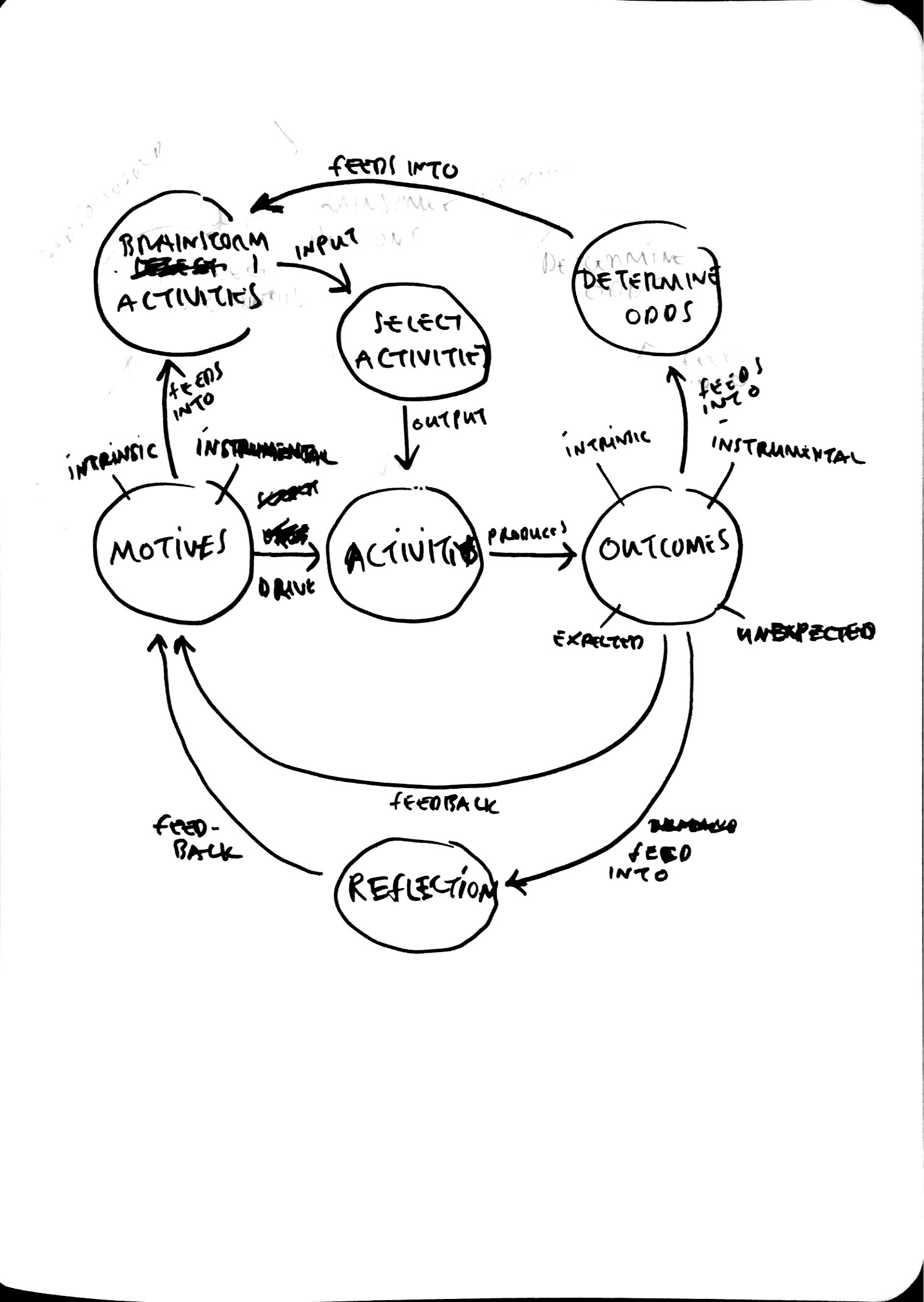
Adams System diagram

Yes it’s messy and maybe illegible in places but I do think this shows two important things: One is making a conscious effort to reflect on action outcomes and in particular to make intrinsic outcomes (more) apparent to yourself. The other is to adjust actions based on the perceived odds of expected and unexpected outcomes happening.

… And an Example.

OK. Let’s say we are interested in blogging. The intrinsic motivation for this is, we enjoy the process of articulating our thinking, and processing ideas that we’ve encountered elsewhere. An (arguably extrinsic) motivation might be that we get recognised by others for our ability to come up with new ideas.

One desired outcome of the blogging activity would be posts, which we produce at some frequency, and which make sense and are interesting to read, and which take ideas from others and recombine parts of them into interesting new ones. Such outcomes would satisfy our intrinsic motivation to blog.

An additional outcome might include questions, comments and encouraging words from readers, which would satisfy our extrinsic motivation for recognition. However, this particular outcome is much more out of our control than the previous one.

Increasing the odds of outcome number one could be done by ensuring there is time for the occasional blogging to happen. It would also help to keep track of things we read, and to record interesting quotes that we might want to use in future posts. We might in addition set a low bar for what qualifies as a blog post, and to force ourselves to write in one go. All of these things make it easier for the writing to happen in the first place. The appearance of a blog post satisfies our intrinsic motivation, and thus increases the likelihood of us settling down to write another one at a later point in time.

Outcome number two is harder to control. Increasing the odds of this happening might include deliberately picking subject matter which is popular or controversial. It might also include formatting our posts in such a way that they read easily and invite a response. The danger of doing these things is readily apparent, because they can easily conflict with the things we need to do to blog regularly, such as setting a low bar.

It would therefore be advisable to put more effort in making Outcome One apparent to ourselves, and to not obsess too much over Outcome Two. Sheer volume in posts also increases the odds of reader response, after all. But if we start obsessing over readers statistics and comment counts, we might lose sight of the things we wrote in the first place. However, by re-reading old posts we remind ourselves of our past thinking, which serves to bolster our confidence in staying the course.

So two addenda to the Adams System idea. I think I’ll leave it at this for now.

Towards intrinsically motivated systems of decision and action

I am going to talk about motivation, and I am going to talk about goal-setting. The two are related, of course. But when we abandon instrumental and deterministic approaches, it gets a little complicated.

(If this post’s title sounds kind of scary, don’t take it too seriously. I invented it while roleplaying an academic, after writing this in one pass.)

1.

Because of my work at Hubbub I read about motivation a lot. I remember during the original gamification debates, a lot was said about intrinsic motivation, and how artificial external incentives actually diminish motivation. The evidence in support of this keeps growing, as described for instance in this recent piece in the New York Times. Here’s a quote:

Helping people focus on the meaning and impact of their work, rather than on, say, the financial returns it will bring, may be the best way to improve not only the quality of their work but also — counterintuitive though it may seem — their financial success.

Self-Determination Theory (SDT) says that a basic human need is to feel autonomous. Extrinsic incentives diminish this sense of autonomy. In a workplace context, I can imagine that a diminished sense of autonomy will lead to diminished motivation to do good work.

I’ve been involved with quite a few workplace “gamification” projects (I continue to dislike the word but I’ll use it here for clarity’s sake). Our biggest challenge was to get clients to decrease the amount of controlling feedback already in place, in stead of adding even more under the guise of “fun”. This is the same thing that Kanaga talks about when he talks about “soft gamification“.

The NYT article also talks about the difference between “internal” versus “instrumental” motives. Internal motives are inherently related to the activity at hand. Instrumental ones are not. They later distinguish internal/instrumental motives from internal/instrumental consequences. If an activity has instrumental consequences, it does not automatically follow that the person engaged in the activity is motivated by them.

Going back to SDT, another need described is competence, the sense of which is increased by offering positive feedback. The study discussed in the NYT article makes the important point that we should be looking for the internal motives people have for engaging in a task, and helping them have a sense of internal consequences. It’s often easier to use instrumental consequences as the basis for our (digital, gamified) positive feedback systems, because they are ofte readily quantifiable, and computers like stuff you can count. But this would actually backfire.

In many ways, I am just rephrasing stuff that has been said much better and more elaborately by Sebastian, and probably also others. But it helps to hash these things out. It makes the concepts stick more.

Let’s shift.

2.

In the land of productivity, goal setting, particularly of the SMART kind, is king. Indeed, in my own practice at Hubbub, one of the things we did when Alper became partner was to adopt Google’s OKR approach to goal setting to help us focus on what we want to achieve, and to provide ourselves with feedback on how we are doing. It’s not perfect, but it works well enough and we continue to use it.

But there’s a danger to goal setting, or maybe a particular kind of goal setting, which is nicely articulated by Scott Adams, of all people, in a blog post titled “Goals vs. Systems“. A quote:

My problem with goals is that they are limiting. Granted, if you focus on one particular goal, your odds of achieving it are better than if you have no goal. But you also miss out on opportunities that might have been far better than your goal. Systems, however, simply move you from a game with low odds to a game with better odds. With a system you are less likely to miss one opportunity because you were too focused on another. With a system, you are always scanning for any opportunity.

Adams talks about setting yourself up to benefit from unexpected outcomes of the things you do. When we plan, and when we set goals, it can be tempting to be very deterministic in our approach. Adams suggests not focusing on goals but in stead creating systems that are generative. When he says systems, I sort of hear him say “habits”.

I think it’s more complicated than abandoning goals, though. Because the kind of systems Adams suggests embracing still serve goals, but like I said, in a less deterministic way. He talks about increasing odds. And I think when he’s thinking about those odds, he also has some potential consequences in mind.

This is basically a Talebian approach to goal-setting. It’s about making what Venkatesh Rao describes as “rich moves” (I can’t find the link to the particular article I had in mind, alas).

The way I think about it for my own practice of goal setting is to keep a loose coupling between the goals I want to achieve and the ways in which I expect to do so. I am basically looking for activities (systems) that get me closer to those goals, without decreasing the possibility of other good things happening too. It’s a game of trade-offs that starts from an acceptance of the unpredictability of reality.

But what about motivation?

3.

This is what I want to think about more. If we accept that motivation is best served by focusing on internal consequences. And if we believe that it is smarter (as in risk-savvy, not as in SMART) to focus on systems in stead of goals, then how do we stay motivated to diligently walk through our systems, in the absence of immediate payoffs, or trackable progress towards a measurable goal?

This is personally relevant for me, as I am trying to get back on the blogging horse (second post of 2015, but it’s already week 4). It is also relevant because I want the OKRs we set at Hubbub to be generative.

Maybe the motivation flowcharts Matt talked about way back when are helpful here. And maybe Sebastian’s engagement loops are also useful. For now, the recipe I will be following for setting up “Adams systems” that are intrinsically motivated looks a little like this:

  • Understand the intrinsic motives for engaging in the activity at hand
  • Determine desired outcomes, both intrinsic and instrumental
  • Brainstorm system-like activities (habits) which increase the chances of these outcomes happening
  • Select the activities which are most likely to have unexpected outcomes (or the least likely to have only expected outcomes)
  • Invent ways of making apparent intrinsic outcomes and reflecting on them
  • Loop back to your intrinsic motives and adjust systems accordingly

It’s a first stab, heavily inspired by Boyd’s OODA-loop, which like I said before I am deeply into at the moment.

Let’s see how it works out, and let me know if it makes sense.

“This game is rigged, man.”

I am going to try my hand at the occasional blogging again. And I have decided to do this not at my tumblr, but back here. It was fine to post things to Tumblr occasionally, but I have started to dislike not having these notes on my own server. And perhaps more importantly, I started to get really annoyed by Tumblr’s lack of a functioning search. So, I’ve imported all the things I posted to Tumblr over the past few years into this blog, and we’ll continue where we left off.

In this first post of the new year, some things related to inequality under late capitalism. To begin with a bit of video from Adam Curtis for Charlie Brooker’s enjoyable end-of-the-year review Wipe 2014.

I was pointed to this by Hans de Zwart and on Twitter I responded that the idea of non-linearity reminds me of the ideas on warfare developed by John Boyd, which I am currently knee-deep in. And Boyd’s ideas of winning by decreasing mismatches between your model of external reality and reality itself while increasing those mismatches for your opponent in turn connects with James C. Scott’s concept of legibility.

Meanhwile, James Bridle has been charting technological infrastructures of control for The Nor, a project commissioned by the Hayward Gallery. The essays James has written on his charting of surveillance cameras, radar and high-frequency trading infrastructure are hugely enjoyable reads because James has gone out there and done the legwork. This isn’t idle theorising, these are ideas grounded in lived experience of today’s reality on the ground. While recounting his experiences tracing these technological infrastructures, James makes many interesting connections to literature, as well as non-obvious observations about how these technologies relate to today’s social injustices. Long story short: you should go and read the lot of them.

Inequality is engineered, and deliberate. It is an arbitraging of social conditions, a perpetuation of the existing situation by those who seek to profit from its differences.

Low Latency, James Bridle

The reason I am blogging these things is that I continue to be interested in new forms of resistance against the non-linear warfare described by Curtis and Bridle’s technologies of control. The first step is to become aware of these strategies, but to return to Boyd, the question then is how to operate in such a way that you can survive on your own terms, by using tempo and agility and basically a better understanding of reality.

To close things off, a few recent things I read which are all about capitalism, and its instrumentalisation of everyday life. First off, Andres O’Hehir on the perceived death of adulthood, a phenomenon which I sort of recognise, and which he aptly describes not as some kind of conscious lifestyle choice or megatrend, but as a thing emerging from the demands put on us by the market and the cultural industry.

The suit-wearing, gin-drinking 35-year-old Organization Man of 1964 and the couch-bound, action-figure-collecting 35-year-old fanboy of 2014 are dialectical mirror images of each other, economic archetypes called forth by their respective eras.

The “death of adulthood” is really just capitalism at work, Andrew O’Hehir

It’s curious to think that “becoming an adult” is something the market does not want you to do.

And finally, two pieces on the sharing economy. One, by Avi Asher-Schapiro, clearly describing how Uber’s blueprint makes the livelihood of workers even more precarious, while at the same time forcing them to tell their customers they love their jobs. The other, by the infamous Evgeny Morozov, rightly points out the sharing economy alleviates some of the pains of living under late capitalism, while doing nothing to solve the root causes of those ails.

But under the guise of innovation and progress, companies are stripping away worker protections, pushing down wages, and flouting government regulations. At its core, the sharing economy is a scheme to shift risk from companies to workers, discourage labor organizing, and ensure that capitalists can reap huge profits with low fixed costs.

There’s nothing innovative or new about this business model. Uber is just capitalism, in its most naked form.

Against Sharing, Avi Asher-Schapiro

There’s no denying that the sharing economy can – and probably does – make the consequences of the current financial crisis more bearable. However, in tackling the consequences, it does nothing to address the causes. It’s true that, thanks to advances in the information technology, some of us can finally get by with less – chiefly, by relying on more effective distribution of existing resources. But there’s nothing to celebrate here: it’s like handing everybody earplugs to deal with intolerable street noise instead of doing something about the noise itself.

Don’t believe the hype, the ‘sharing economy’ masks a failing economy, Evgeny Morozov

I blog these things as a reminder to myself of some of the arguments against the current vogue of digitally mediated service delivery platforms. They can be so seductive and many clients and peers seem blinded by their promises. I am interested in salvaging the good bits of these services, they are after all potentially empowering, while coming up with solutions to the injustices they perpetrate and enlarge.

Too much of our impression of the world comes from a misleading formula of journalistic narration. Reporters give lavish coverage to gun bursts, explosions, and viral videos, oblivious to how representative they are and apparently innocent of the fact that many were contrived as journalist bait. Then come sound bites from “experts” with vested interests in maximizing the impression of mayhem: generals, politicians, security officials, moral activists. The talking heads on cable news filibuster about the event, desperately hoping to avoid dead air. Newspaper columnists instruct their readers on what emotions to feel.

— The world is not falling apart: The trend lines reveal an increasingly peaceful period in history.

Heading back from Big Brother Awards. Hans and his team at Bits of Freedom put on a good show. A few things of note: The lady from the primary education council using “game” as a metaphor to explain adaptive digital learning materials. The ridiculous faux cable response from the ministry of safety and justice to Opstelten winning an award, which I wish but don’t expect will backfire on them horrifically. Hans using the concept of “legibility” to shift the focus of the digital rights movement on to increased diversity. A high percentage of female speakers on stage. Snowden getting a standing ovation. It was a good night, if only to rally the troops.

Sources for my Creative Mornings Utrecht talk on education, games, and play

I was standing on the shoulders of giants for this one. Here’s a (probably incomplete) list of sources I referenced throughout the talk.

Comedians kill themselves. Talk to 100 comedians this week, everybody knows somebody who killed themselves. I mean, we always say ignorance is bliss. Well, if so, what’s the opposite? Some form of misery. Being a comedian, 80 percent of the job is just you notice shit, which is a trait of schizophrenics too. You notice things people don’t notice.