Urban procedural rhetorics — transcript of my TWAB 2008 talk

This is a transcript of my presentation at The Web and Beyond 2008: Mobility in Amsterdam on 22 May. Since the majority of paying attendees were local I presented in Dutch. However, English appears to be the lingua franca of the internet, so here I offer a translation. I have uploaded the slides to SlideShare and hope to be able to share a video recording of the whole thing soon.

Update: I have uploaded a video of the presentation to Vimeo. Many thanks to Almar van der Krogt for recording this.

In 1966 a number of members of Provo took to the streets of Amsterdam carrying blank banners. Provo was a nonviolent anarchist movement. They primarily occupied themselves with provoking the authorities in a “ludic” manner. Nothing was written on their banners because the mayor of Amsterdam had banned the slogans “freedom of speech”, “democracy” and “right to demonstrate”. Regardless, the members were arrested by police, showing that the authorities did not respect their right to demonstrate.1

Good afternoon everyone, my name is Kars Alfrink, I’m a freelance interaction designer. Today I’d like to talk about play in public space. I believe that with the arrival of ubiquitous computing in the city new forms of play will be made possible. The technologies we shape will be used for play wether we want to or not. As William Gibson writes in Burning Chrome:

“…the street finds its own uses for things”

For example: Skateboarding as we now know it — with its emphasis on aerial acrobatics — started in empty pools like this one. That was done without permission, of course…

Only later half-pipes, ramps, verts (which by the way is derived from ‘vertical’) and skateparks arrived — areas where skateboarding is tolerated. Skateboarding would not be what it is today without those first few empty pools.2

Continue reading Urban procedural rhetorics — transcript of my TWAB 2008 talk

  1. The website of Gramschap contains a chronology of the Provo movement in Dutch. [↩]
  2. For a vivid account of the emergence of the vertical style of skateboarding see the documentary film Dogtown and Z-Boys. [↩]
links for 2008-05-17

links for 2008-05-15

links for 2008-05-14

links for 2008-05-12

links for 2008-05-10

Sketching the experience of toys

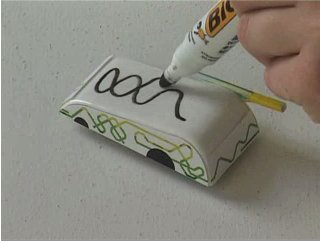
A frame from the Sketch-A-Move video

“Play is the highest form of research.”

—Albert Einstein1

That’s what I always say when I’m playing games, too.

I really liked Bill Buxton‘s book Sketching User Experiences. I like it because Buxton defends design as a legitimate profession separate from other disciplines—such as engineering—while at the same time showing that designers (no matter how brilliant) can only succeed in the right ecosystem. I also like the fact that he identifies sketching (in its many forms) as a defining activity of the design profession. The many examples he shows are very inspiring.

One in particular stood out for me, which is the project Sketch-A-Move by Anab Jain and Louise Klinker done in 2004 at the RCA in London. The image above is taken from the video they created to illustrate their concept. It’s about cars auto-magically driving along trajectories that you draw on their roof. You can watch the video over at the book’s companion website. It’s a very good example of visualizing an interactive product in a very compelling way without actually building it. This was all faked, if you want to find out how, buy the book.2

The great thing about the video is not only does it illustrate how the concept works, it also gives you a sense of what the experience of using it would be like. As Buxton writes:3

“You see, toys are not about toys. Toys are about play and the experience of fun that they help foster. And that is what this video really shows. That, and the power of video to go beyond simply documenting a concept to communicating something about experience in a very visceral way.”

Not only does it communicate the fun you would have playing with it, I think this way of sketching actually helped the designers get a sense themselves of wether what they had come up with was fun. You can tell they are actually playing, being surprised by unexpected outcomes, etc.

The role of play in design is discussed by Buxton as well, although he admits he needed to be prompted by a friend of his: Alex Manu, a teacher at OCAD in Toronto writes in an email to Buxton:4

“Without play imagination dies.”

“Challenges to imagination are the keys to creativity. The skill of retrieving imagination resides in the mastery of play. The ecology of play is the ecology of the possible. Possibility incubates creativity.”

Which Buxton rephrases in one of his own personal mantras:5

“These things are far too important to take seriously.”

All of which has made me realize that if I’m not having some sort of fun while designing, I’m doing something wrong. It might be worth considering switching from one sketching technique to another. It might help me get a different perspective on the problem, and yield new possible solutions. Buxton’s book is a treasure trove of sketching techniques. There is no excuse for being bored while designing anymore.

  1. Sketching User Experiences p.349 [↩]
  2. No, I’m not getting a commission to say that. [↩]
  3. Ibid. 1, at 325 [↩]
  4. Ibid., at 263 [↩]
  5. Ibid. [↩]

links for 2008-05-09