-
An elaborate overview of sign-up patterns by Alexa of Adaptive Path.
-
Tom wraps up his examination of an interesting little story-line in GTA IV.
-
A report of a panel discussion at the Games for Health conference. Some very different approaches to applying games outside of entertainment. I enjoyed the exercise games example the most.
-
Where did this come from? Apparently the Reboot folks have dug up a bunch of recordings I did not know about – including one of my presentation last year. Oh dear.
-
“Have you wanted an LED that can fade from deep red to bright purple? Flash like a police light? Turn on with the subtle fade of an incandescent bulb? Flicker like a candle? That’s BlinkM.”
Author: Kars Alfrink
Designer turned design researcher. Postdoc at TU Delft. Exploring contestable AI.
links for 2008-06-05
-
An upcoming book on urban informatics and the real-time city. Via Dan Hill.
-
This might be worth making the trip to fortress America for this year. Game design legend Chris Crawford is speaking.
-
A thorough review of several notebooks by someone who obviously takes this all very seriously.
-
Mr. Hinton got one of these. Do want too.
links for 2008-06-04
-
Saw this a few times in presentations over the past years: “Arukotch isn’t really a tamagotchi, it’s more of a pedometer. Not only does Arukotch count your steps, she will also meet new boys while you are walking.” (From Mr. Bleecker to Mr. Bogost to me.)
-
“I think in prototyping the most important I’ve learned is to choose the visual language that satisfies it, to capture the maturity of the idea. […] And that language should be apparent when you give it to people to look at.”
links for 2008-06-03
-
Just when I was planning to start playing with my WiiMote and Processing my friends at Tinker.it publish this tutorial (and a few others). Fun!
-
More DS goodness: “a FREE homebrew Cellular Automaton music sequencer for the Nintendo DS”. Via Tom (again).
Sketching in code — Twitter, Processing, dataviz
Sketching is the defining activity of design writes Buxton and I tend to agree. The genius of his book is that he shows sketching can take on many forms. It is not limited to working with pencils and paper. You can sketch in 3D using wood or clay. You can sketch in time using video, etc. Buxton does not include many examples of sketching in code, though.1 Programming in any language tends to be a hard earned skill, he writes, and once you have achieved sufficient mastery in it, you tend to try and solve all problems with this one tool. Good designers can draw on a broad range of sketching techniques and pick the right one for a given situation. This might include programming, but then it would need to conform to Buxton’s defining characteristics of sketching: quick, inexpensive, disposable, plentiful, offer minimal detail, and suggest and explore rather than confirm.
I have been spending some time broadening my sketching repertoire as a designer. Before I started interaction design I was mostly into visual arts (drawing, painting, comics) so I am quite comfortable sketching in 2D, using storyboards, etc.2 Sketching in code though, has always been a weak spot. I have started to remedy this by looking into Processing.
As an exercise I took some data from Twitter — one data set was the 20 most recent tweets and the other my friends list — and decided to see how quick I could create a few different visualizations of that data. The end results were:
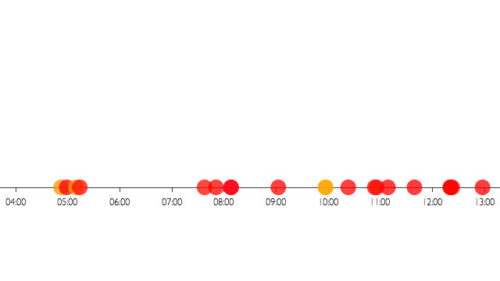
one: a timeline that spatially plots the latest tweets from my friends — showing density at certain points in time; or how ‘noisy’ it is on my Twitter stream,
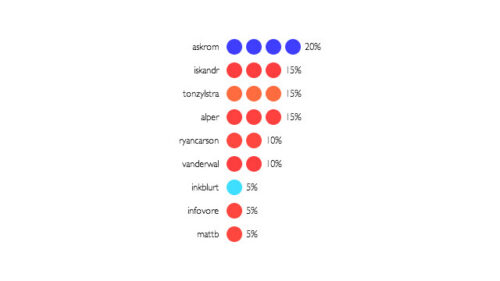
two: an ordering of friends based on the percentage of their tweets that take up my timeline — who’s the loudest of my friends?,
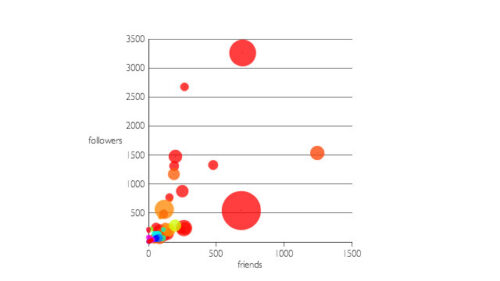
three: a graph of my friends list, with number of friends and followers on the axes and their total number of tweets mapped to the size of each point.
The aim was not to come up with groundbreaking solutions, or finished applications.3 The goal was to exercise this idea of sketching in code and use it to get a feel for a ‘complex’ data set, iterating on many different ways to show the data before committing to one solution. In a real-world project I could see myself as a designer do this and then collaborate with a ‘proper’ programmer to develop the final solution (which would most likely be interactive). I would choose different sketching techniques to design the interactive aspects of a data-visualization. For now I am content with Processing sketches that simply output a static image.
Tools & resources used were:
- Processing – a free and open source programming environment for visual folks
- The Twitter4J library for working with the Twitter API
- The wonderful Processing book by Ben Fry and Casey Reas
- Visualizing Data by Ben Fry, including some of the accompanying code
- The community that lives on the board of the Processing site
If as a designer you are confronted with a project that involves making a large amount of data understandable, sketching in code can help. You can use it to ‘talk’ to the data, and get a sense of its ‘shape’.
- There is one involving Phidgets and Max/MSP, a visual programming solution for physical computing. [↩]
- Some examples include a multi-touch project I did for InUse and a recent presentation at TWAB 2008. [↩]
- I don’t think any of these visualizations are very profound, they’re interesting at best. [↩]
links for 2008-06-02
-
Pretty video for the Radiohead song Weird Fishes made with Processing. Via Jacco.
links for 2008-05-31
-
My friend Annakaisa has published one of her game-like elicitation techniques: verbs, nouns and adjectives cards for rapid idea generation sessions (tailored to casual mobile games).
-
One designer takes a stab at what makes the WiiWare title lost winds so unique. “Changing the method of input can make a familiar genre feel like a unique experience”. I would say: of course it does! “It’s the interaction, silly.”
-
A short Dutch documentary film featuring Brian Sutton-Smith who makes some very interesting points about the *real* value of play. Also some footage of Fisher-Price’s play lab.
-
Another awesome G.R.L. project: laser controlled graffiti light display projected on the Renzo Piano KPN Telecom Building in Rotterdam (where I once had an animation running).
links for 2008-05-30
-
An ambitious new foundation that aims to give the Dutch games industry a real boost.
links for 2008-05-29
-
“Colors! is a simplistic digital painting application for Nintendo DS based on modern painting-techniques developed for drawing tablets in programs like Photoshop.” Via Tom.
-
Noone explains the virtues of casual gaming better than Yahtzee of Zero Punctuation fame.
-
Possibly the best presentation I’ve seen in a long time about the merging of social software and gaming. Hunicke explains things very clearly.
links for 2008-05-28
-
“Well then, explanations are now no longer causes but networks of mutual contingencies. We can look at explanations not as predictions, but as chords that have reached closure. Seeing an explanation, we can feel relief that the world is at one.”
-
Ton offers a topology of Twitter users based on their friends/followers ratio. And describes how he attempts to create conversational symmetry for himself.
-
I like this—an interactive light display controlled by dripping colored inks into glasses of water. Via Alexandra.
-
A digital version of Debord’s Kriegspiel, by RSG. Via Bernard.
-
“…letting ourselves explore the land of the senses is the only way to start to break the dominance of the greedy, visually-driven interfaces and deliver mobile experiences and interactions that – as Adam Greenfield says – dissolve into behavior.”
-
Slick ‘visual’ interface to the news. Spotted in James’ Flickr stream.