-
First in a thread about browser-based games engines. In the plug-in space, Unity is without a doubt the best option, but for those (like me) who want something that *only* requires a browser (think Weewar) there are few options if any.
-
Koster on Google’s entry into the virtual worlds space: “Not exactly the recipe one would expect from Google, barring the distributed nature of it, and in some ways, not the one you would expect for a move for the future of virtual worlds.”
Author: Kars Alfrink
Designer turned design researcher. Postdoc at TU Delft. Exploring contestable AI.
Playing With Complexity — slides and notes for my NLGD Festival of Games talk
When the NLGD Foundation invited me to speak at their anual Festival of Games I asked them what they would like me to discuss. “Anything you like,” was what they said, essentially. I decided to submit an abstract dealing with data visualization. I had been paying more and more attention to this field, but was unsuccessful in relating it the other themes running through my work, most notably play. So I thought I’d force myself to tackle this issue by promising to speak about it. Often a good strategy, I’ve found. If it worked out this time I leave for you to judge.
In brief, in the presentation I argue two things: one — that the more sophisticated applications of interactive data visualization resemble games and toys in many ways, and two — that game design can contribute to the solutions to several design issues I have detected in the field of data visualization.
Below are the notes for the talk, slightly edited, and with references included. The full deck of slides, which includes credits for all the images used, is up on SlideShare.
Hello everyone, my name is Kars Alfrink. I am a Dutch interaction designer and I work freelance. At the moment I work in Copenhagen, but pretty soon I will be back here in Utrecht, my lovely hometown.

In my work I focus on three areas: mobility, social interactions, and play. Here is an example of my work: These are storyboards that explore possible applications of multitouch technology in a gated community. Using these technologies I tried to compensate for the negative effects a gated community has on the build-up of social capital. I also tried to balance ‘being-in-the-screen’ with ‘being-in-the-world’ — multitouch technologies tend to be very attention-absorbing, but in built environments this is often not desirable.1
I am not going to talk about multitouch though. Today’s topic is data visualization and what opportunities there are for game designers in that field. My talk is roughly divided in three parts. First, I will briefly describe what I think data visualization is. Next, I will look at some applications beyond the very obvious. Third and last, I will discuss some design issues involved with data visualization. For each of these issues, I will show how game design can contribute.
Right, let’s get started.
Continue reading Playing With Complexity — slides and notes for my NLGD Festival of Games talk
- For more background on this project please see this older blog post. More examples of my recent work can be found in my portfolio. [↩]
links for 2008-07-08
-
Just finished an expert review. These heuristics would have come in handy as reference material besides Nielsen’s, Tognazzini’s and Krug’s…
-
“Two future forces, one mostly social, one mostly technological, are intersecting to transform how goods, services, and experiences—the “stuff” of our world—will be designed, manufactured, and distributed over the next decade.”
links for 2008-07-05
-
Posts like this make me think Matt Webb would make a kick-ass game designer. Solid explanation of reinforcement strategies. The best one is variable-interval, yes, but also positive – rewards work better than punishment. Any dog owner knows this.
-
Skarped’s presentation at the NLGD Festival of Games was easily one of the most interesting. This interview gives a good sense of her thinking, but sadly no impression of her award winning game.
-
Apart from confusing things by making a counterintuitive distinction between experience design and game design, this is a good example of how mechanics and ‘dressing’ interact in games.
links for 2008-07-04
-
My friend Tijs just launched Fresh.li – a platform for online portfolios.
Goodbye DK, Hello NL

And that was it. After exactly one year in Copenhagen I am back in Utrecht. I enjoyed my time in Denmark tremendously, it has proven to be a great place to start my new life as a freelance designer. Now I will continue my practice over here. Different city, same international outlook.
The final period in Copenhagen consisted mainly of me speaking at a lot of conferences. First there was The Web and Beyond, then came From Business to Buttons, NLGD Festival of Games and finally Reboot — I could not have wished for a better going-away party.
There is not much time to catch my breath, however. I have client projects happening throughout July and of course there is also plenty of unpacking and merging of the old and new life to be done. I hope to publish the NLGD and Reboot stuff shortly, but it might take me a while.
Now that I am back in the Netherlands, I can also move forward with some small plans I’ve had for some time: one being a local design event and the other a ‘different’ kind of office space. I am also still looking for a creative technologist to partner up with on potential future projects. If any of this piques your interest, do drop me a line.
Photo credits: Josef F. Stuefer.
links for 2008-07-03
-
There are quite a few pieces out there on game design heuristics, most of them pretty crap. Here, a small set of heuristics were verified to actually matter using play tests.
-
“SugarStats makes it simple to track, monitor and share your blood sugar levels and other key statistics to help you manage your diabetes online.”
-
Nova has posted his slides for a presentation on ambient informatics. Where he tangles with the issue of “how to make visible invisible techniques that aim at making visible the invisible“…
-
An interview with Noam Chomsky containing some fascinating comments on Israel, 9/11, the war on terror and more. Dutch subtitling but virtually the whole thing is in English.
links for 2008-07-02
-
A thread on the IxDA list about movement analysis and interaction design for gestural interfaces.
-
One Rebooter pointed out this video after my talk – (virtually) all footage is taped by CCTV cameras.
links for 2008-06-25
-
Snapshot launches. I love the way thumbnails motion blur when dragging the slider in the bottom and stuff on the map live updates. It’s just *fun* to play with.
-
“The PCG Wiki is a central knowledge-base for everything related to the Procedural Content Generation, as well as a detailed directory of games using Procedural Content Generation.”
-
“Spore has created an unexpected set of design problems: the reverse of virtually any other game. There is literally too much content for any gamer to experience; and the tools to manage and select […] from this content don’t yet appear to be in place.”
Slides and summary for ‘More Than Useful’
Update: The video and slides are now available on the conference site.
The conference From Business to Buttons 2008 aimed to bring together the worlds of business and interaction design. I was there to share my thoughts on the applicability of game design concepts to interaction design. You’ll find my slides and a summary of my argument below.
I really enjoyed attending this conference. I met a bunch of new and interesting people and got to hang out with some ‘old’ friends. Many thanks to InUse for inviting me.
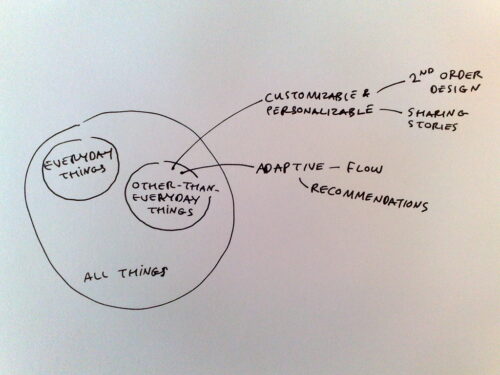
The topic is pretty broad so I decided to narrow things down to a class of product that is other-than-everyday — meaning both wide and deep in scope. Using Norman’s The Design of Everyday Things as a starting point, I wanted to show that these products require a high level of explorability that is remarkably similar to play. After briefly examining the phenomenon of play itself I moved on to show applications of this understanding to two types of product: customizable & personalizable ones, and adaptive ones.
For the former, I discussed how game design frameworks such as MDA can help with sculpting the parameter space, using ‘experience’ as the starting point. I also looked at how games support players in sharing stories and speculated about ways this can be translated to both digital and physical products.
For the latter — adaptive products — I focussed on the ways in which they induce flow and how they can recommend stuff to people. With adaptation, designers need to formulate rules. This can be done using techniques from game design, such as Daniel Cook’s skill chains. Successful rules-based design can only happen in an iterative environment using lots of sketching.
The presentation was framed by a slightly philosophical look at how certain games subliminally activate cognitive processes and could thus be used to allow for new insights. I used Breakout and Portal as examples of this. I am convinced there is an emerging field of playful products that interaction designers should get involved with.
Sources referenced in this presentation:1
- Pilgrim in the Microworld (PDF) by David Sudnow
- The Core of Fun by Raph Koster
- The Art of Interactive Design by Chris Crawford
- The Design of Everyday Things by Donald Norman
- Designing for Interaction by Dan Saffer
- Homo Ludens by Johan Huizinga
- Man, Play and Games by Roger Caillois
- A Theory of Play and Fantasy by Gregory Bateson
- The Ambiguity of Play by Brian Sutton-Smith
- Rules of Play by Katie Salen and Eric Zimmerman
- Stranger in a Strange Land by Robert A. Heinlein
- The Life of Products by Schulze & Webb
- MDA (PDF) by Robin Hunicke and Robert Zubek
- The Conversation Gets Interesting by Stephen P. Anderson
- The Chemistry of Game Design by Daniel Cook
- Waterfall Bad, Washing Machine Good by Leisa Reichelt
- Sketching User Experiences by Bill Buxton
- How Can A Game Be Subversive? by Borut Pfeifer
As usual, many thanks to all the Flickr photographers who’ve shared their images under a CC license. I’ve linked to the originals from the slides. Any image not linked to is probably mine.
- Most of these are offline books or papers, those that aren’t have been hyperlinked to their source. [↩]