-
“iSee is a web-based application charting the locations of closed-circuit television (CCTV) surveillance cameras in urban environments. With iSee, users can find routes that avoid these cameras (“paths of least surveillance”) allowing them to walk around their cities without fear of being “caught on tape” by unregulated security monitors.” This project was started in 2001. Here’s me thinking I had an original idea with the concept I developed for my Procedural Urban Rhetorics talk from 2008. Sigh. This is very interesting stuff, by the way.
-
Niels ‘t Hooft reports on Adrian Hon’s presentation at the NLGD Festival of Games 2009 (in Dutch). Of all the event’s keynotes, the one he highlights is programmed by yours truly.
Author: Kars Alfrink
Designer turned design researcher. Postdoc at TU Delft. Exploring contestable AI.
links for 2009-06-08
-
“Celebrating nearly 2 years as the CEO of a small and dynamic interaction design company I thought I’d collate some thoughts on starting up your own company in interaction design as this be useful for someone out there.” Solid advice rooted in first-hand experience from Alexandra, some of it useful to interaction designers going at it solo as well.
-
I haven’t seen much good come from the Dutch government’s obsession with what they call “the creative industry”. (The fact that they use the word “industry” is proof enough that they do not get it.) I’d be happy when they finally lose interest and leave “us” (the many-shaped creative disciplines) to our own diverse devices.
links for 2009-06-05
-
“Right “now” (early June in 1666) the English and Dutch are half-way through the Four Days Battle at sea and so we get to read updates in “real time” as Pepys hears them. The first day he didn’t even mention what was going on. Yesterday he was busy helping the war effort” A diary of a famous Englishman is being tweeted more or less in sync with “our” time. What a wonderful idea.
links for 2009-06-02
-
A punch bag that changes colour the more you hit it. A simple but fun interactive lighting installation.
-
“You know what they say: game designers do it better outdoors. OK, maybe that’s not quite right. But game players, put down your controllers and blink into the light. There are stories on the streets, and the game is to find them.” Krotoski celebrates the charms of pervasive gaming. Some of the comments to this piece are telling; people bemoaning the fact that these games seem to be popular only in areas with lots of web geeks hanging out. I guess that means the games need to get a broader appeal.
A third This happened – Utrecht coming this way
Around this time, an email to the ever-growing This happened – Utrecht mailing list will be sent to announce our third edition, which will take place on Monday 29 June at Theater Kikker in Utrecht.

Clockwise: Trompe L’Oeil, FluxFloor, Swarm and Hyper Human.
As always, I am super excited about hearing the stories our wonderful speakers will tell about the things they’ve made. Here’s who’ll be there this time around:
- Aldo Hoeben of fieldOfView will discuss his work on Trompe L’Oeil; a panoramic projection in the alcove of one of Utrecht’s oldest churches.
- David Kousemaker and Tim Olden of Blendid will give us an inside look at the work behind their latest interactive light installation called Swarm.
- Lucy McRae will go into the details of her Hyper Human project, which consists of explorations of fashion that is grown on the human body.
- Anouk Randag of 31Volts, finally, will talk about FluxFloor, the sustainable dance floor she designed while graduating at TU Delft.
We’re going to open up registration in two weeks time on Monday 15 June at 12:00. I expect space to fill up real quick again as usual. So mark your calendars and set an alarm!
Announcing a hybrid game opera for Monster
I never thought I would make an opera. But now I have.
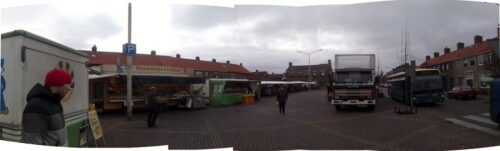
In a few weeks time the above market square in the town of Monster will be transformed into an arena where fighters duel each other using their pet monsters. If this sounds familiar, it is no coincidence.
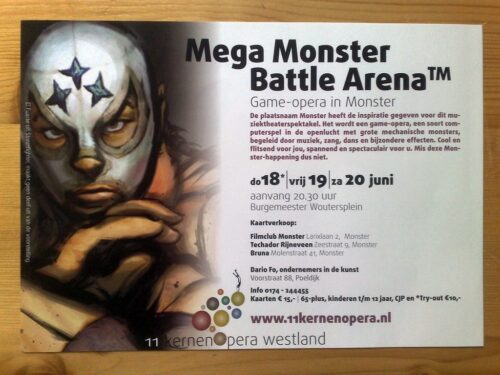
Mega Monster Battle Arena is one of 11 operas produced by Dario Fo to celebrate the fifth anniversary of the Westland municipality. Dario Fo specialize in creating music theatre in close collaboration with the local community. They asked composer Daniël Hamburger to create the opera for Monster. The brief was to do ‘something’ with the town’s curious name, and to make it a production that would appeal to youth by referencing games culture.1
Daniël in turn approached me, since he had little affinity for games, and wanted the piece to not only be about games, but to be a game itself. So that’s what I helped do. By turning the game design principle of embedded narrative inside-out, we’ve managed to create a structure in which we can both tell a story using a script, and have performers improvise using game rules. Those rules I designed as a proper game. I could give you those rules and you would be able to play it yourself.
So there will be fights, and they’ll not be scripted. You won’t know beforehand who will win, and neither will we. There will also be a story, about a heroine facing off with a bad guy, in the best game and martial arts film tradition. Sieger M.G. was our third man, the piece’s writer. A rapper turned poet with a life-long games addiction, there could be no better fit.
What’s probably most exciting to me is that on top of the improvisational choreography of the duels, a live band will use a rule set of their own, composed by Daniël, that takes the game as it unfolds as its input to improvise. How’s that for adaptive music?2
It might all go horribly wrong, or it might become a wonderful spectacle. If you are like me and would like to find out which it will be, head to Monster for one of the shows. They’re scheduled for:
- Thursday 18 June 20:30 (tryout)
- Friday 19 June 20:30
- Saturday 20 June 20:30
Tickets are 15 Euro and can be bought at the venue. Once the show is over, I’ll post some more detailed stuff about the actual work I did. Stay tuned.
links for 2009-05-28
-
A new game by Jane McGonigal designed to encourage people to go out and exercise, inspired by cryptozoology. Lightweight and open-ended, this is a good example of how far one can go with little to no technology facilitating play directly.
“Stay hungry, stay foolish”
I graduated from the Utrecht School of the Arts in 2002. Now, less than seven years later, I am mentoring a group of five students who will be doing the same come September this year. I took a photo of them today, here it is:
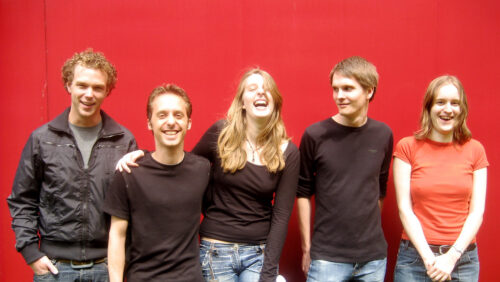
From left to right, here’s who they are and what they’re up to:
- Christiaan is tech lead on Hollandia, an action adventure game inspired by Dutch folklore. His research looks at ways to close the gap between creatives and technologists in small teams, using agile techniques.
- Kjell is designing a series of experimental games using voice as their only input. He’s researching what game mechanics work best with voice control.
- Maxine is game designer on the aforementioned Hollandia game. Her research looks at the translation of the play experience of physical toys to digital games. (In of Hollandia, you’ll be using a Wiimote to control the spinning top used by the heroine.)
- Paul is building a physics-based platform puzzle game for two players. His research looks at the design of meaningful collaborative play.
- Eva is making a space simulation game with realistic physics and complex controls. She’s researching what kinds of fun are elicited by such games.
Practically speaking, mentoring these guys means that I see them once a week for a 15-minute session. In this we discuss the past week’s progress and their plans for the next. They’ve set their own briefs, and are expected to be highly self-reliant. My task consists of making sure they stay on track and their work is relevant, both from an educational and a professional perspective. It’s challenging work, but a lot of fun. It forces me to make explicit the stuff I’ve picked up professionally. It’s also a lot about developing a sense for where each student individually can improve and encouraging them to challenge themselves in those areas.
I’m looking forward to seeing what they’ll deliver come September, when it’s their turn to graduate, and go out to conquer the world.
links for 2009-05-27
-
The author expounds on the virtues of manual labour, and the perversities of much knowledge work. Interesting to read w.r.t. the making versus thinking debate happening in design circles currently: “The gap between theory and practice stretches out in front of you, and this is where it gets interesting. What you need now is the kind of judgment that arises only from experience; hunches rather than rules. For me, at least, there is more real thinking going on in the bike shop than there was in the think tank.”
links for 2009-05-25
-
A piece that looks at the “boring future” as described by J.G. Ballard and the extreme obsessions that arise from living in its consumerist culture. Rossignol (the author) then proposes games should be more extreme and weird and violent (in stead of less) to alleviate said boredom. I am all for weird stuff, but I do think this article misrepresents Ballard’s views somewhat.
-
For those with access to academic papers, this piece is worth having a look. It describes a method for coming up with design ideas ‘in the wild’. Useful for those designing ubicomp systems, service design and (my personal interest) pervasive games.
-
Having done interaction design for large organizations, I can only agree with “Mr. X” who writes “doing the design isn’t the hard part”. On the other hand, I like Dustin Curtis’s take on why some companies succeed in delivering a good experience while others don’t: they have taste.