Week 183

And so the last workweek of the year has come to an end. I’ve just wrapped some going-away gifts for Wieger and Sylvan, who have been interns at Hubbub for the past four months. I’ve put together a little survival kit containing everything a junior agent of Hubbub needs to make it out in the big bad world.

It’s been a relatively quiet week, with some work on Maguro, which will kick off properly in the new year when all of the team is back on deck. Alper has started doing some small software prototyping of the basic gameplay. Prototypes over ideas, that’s how I prefer to do things.

I went over to the Netherlands Film Festival to look back on our collaboration as part of the PLAY Pilots project. Seems like we’re both keen to do more work together in 2011, which is nice.

I was at Mediamatic wednesday night to do an Ignite talk on the work that’s been going on at Hubbub. That went quite well (I was glad to have practiced the thing a few times, because the time pressure is killer). I’ll post slides and a transcript to the Hubbub blog soonish.

I managed to squeeze in some shenanigans in the snow too. A nice follow up to last friday’s snow fight, this time I rode a too-fast-for-my-own-good sleigh down the side of the old city fortifications towards the moat and almost collided with a dog and a little kid. I managed to stay dry though. That was fun.

And with that it is time to sign off. I started writing these weeknotes at the beginning of this year and wasn’t at all sure if I would keep it up. Turns out I did, and I have to say it’s been a pleasure to write these for the most part.

Even so, I don’t think I’ll keep writing these here in 2011. Most of my work now happens at Hubbub so I’ll be writing the occasional update over at the blog there.

When it comes to the link posts, I used to do this with Delicious, but like many I’ve made the switch to Pinboard last week. I don’t think I’ll reactivate link posts, so if you want to follow the bookmarks, follow me there.

And of course there’s my personal Twitter account, and the Hubbub one. That might be easiest in fact although maybe a bit overwhelming at times.

All that’s left to say is thank you for reading this, have a merry Christmas a happy new year, and I will catch you again sometime somewhere.
Are games media or design objects?

In a recent post on the Edge blog – which, if you consider yourself a games designer, you absolutely must read – Matt Jones asks:

“Why should pocket calculators be put on a pedestal, and not Peggle?”

He writes about the need for games to be appreciated and critiqued as design objects. He points out that the creation of any successful game is “at least as complex and coordinated as that of a Jonathan Ive laptop”. He also speculates that reasons for games to be ignored is that they might be seen primarily as media, and that mainstream design critics lack literacy in games, which makes them blind to their design qualities.

Reading this, I recalled a discussion I had with Dave Malouf on Twitter a while back. It was sparked by a tweet from Matt, which reads:

“it’s the 3rd year in a row they’ve ignored my submission of a game… hmmph (L4D, fwiw) – should games be seen as design objects? or media?”

I promptly replied:

“@moleitau design objects, for sure. I’m with mr Lantz on the games aren’t media thing.”

For an idea of what I mean by “being with Mr. Lantz”, you could do worse that to read this interview with him at the Tale of Tales blog.

At this point, Dave Malouf joined the fray, posting:

“@kaeru can a game be used to convey a message? We know the answer is yes, so doesn’t that make it a form of media? @moleitau”

I could not resist answering that one, so I posted a series of four tweets:

“@daveixd let me clarify: 1. some games are bits of content that I consume, but not all are

“@daveixd 2. ultimately it is the player who creates meaning, game designers create contexts within which meaning emerges.

“@daveixd 3. thinking of games as media creates a blind spot for all forms of pre-videogames era play”

“@daveixd that’s about it really, 3 reasons why I think of games more as tools than media. Some more thoughts: http://is.gd/5m5xa @moleitau”

To which Dave replied:

“@kaeru re: #2 all meaning regardless of medium or media are derived at the human level.”

“@kaeru maybe this is semantics, but any channel that has an element of communicating a message, IMHO is media. Tag & tic-tac-toe also.”

“@kaeru wait, are you equating games to play to fun? But I’m limiting myself to games. I.e. role playing is play, but not always a game.”

At this point, I got frustrated by Twitter’s lack of support for a discussion of this kind. So I wrote:

“@daveixd Twitter is not the best place for this kind of discussion. I’ll try to get back to your points via my blog as soon as I can.”

And here we are. I’ll wrap up by addressing each of Dave’s points.

  1. Although I guess Dave’s right about all meaning being derived at the human level, what I think makes games different from, say, a book or a film is that the thing itself is a context within which this meaning making takes place. It is, in a sense, a tool for making meaning.
  2. Games can carry a message, and sometimes are consciously employed to do so. One interesting thing about this is on what level the message is carried – is it told through bits of linear media embedded in the game, or does it emerge from a player’s interaction with the game’s rules? However, I don’t think all games are made to convey a message, nor are they all played to receive one. Tic-Tac-Toe may be a very rough simulation of territorial warfare, and you could argue that it tells us something about the futility of such pursuits, but I don’t think it was created for this reason, nor is it commonly played to explore these themes.
  3. I wasn’t equating games to play (those two concepts have a tricky relationship, one can contain the other, and vice-versa) but I do feel that thinking of games as media is a product of the recent video game era. By thinking of games as media, we risk forgetting about what came before video games, and what we can learn from these toys and games, which are sometimes nothing more than a set of socially negotiated rules and improvised attributes (Kick the can, anyone?)

I think I’ll leave it at that.

Sketching in code — Twitter, Processing, dataviz

Sketching is the defining activity of design writes Buxton and I tend to agree. The genius of his book is that he shows sketching can take on many forms. It is not limited to working with pencils and paper. You can sketch in 3D using wood or clay. You can sketch in time using video, etc. Buxton does not include many examples of sketching in code, though.1 Programming in any language tends to be a hard earned skill, he writes, and once you have achieved sufficient mastery in it, you tend to try and solve all problems with this one tool. Good designers can draw on a broad range of sketching techniques and pick the right one for a given situation. This might include programming, but then it would need to conform to Buxton’s defining characteristics of sketching: quick, inexpensive, disposable, plentiful, offer minimal detail, and suggest and explore rather than confirm.

I have been spending some time broadening my sketching repertoire as a designer. Before I started interaction design I was mostly into visual arts (drawing, painting, comics) so I am quite comfortable sketching in 2D, using storyboards, etc.2 Sketching in code though, has always been a weak spot. I have started to remedy this by looking into Processing.

As an exercise I took some data from Twitter — one data set was the 20 most recent tweets and the other my friends list — and decided to see how quick I could create a few different visualizations of that data. The end results were:

Today's start - timeline

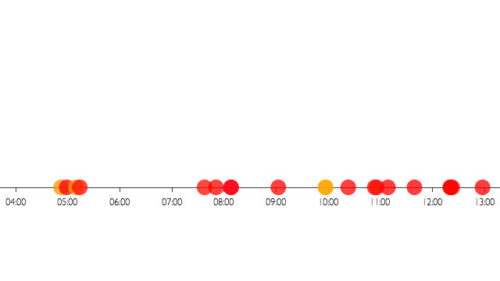
one: a timeline that spatially plots the latest tweets from my friends — showing density at certain points in time; or how ‘noisy’ it is on my Twitter stream,

Neatly centred now

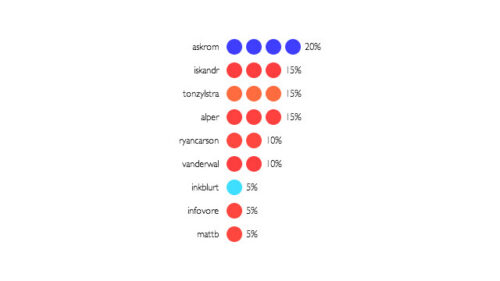
two: an ordering of friends based on the percentage of their tweets that take up my timeline — who’s the loudest of my friends?,

Bugfix – made a mistake in the tick mark labels

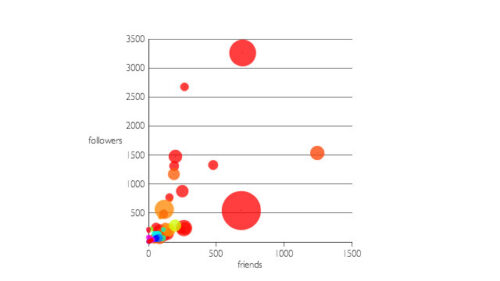
three: a graph of my friends list, with number of friends and followers on the axes and their total number of tweets mapped to the size of each point.

The aim was not to come up with groundbreaking solutions, or finished applications.3 The goal was to exercise this idea of sketching in code and use it to get a feel for a ‘complex’ data set, iterating on many different ways to show the data before committing to one solution. In a real-world project I could see myself as a designer do this and then collaborate with a ‘proper’ programmer to develop the final solution (which would most likely be interactive). I would choose different sketching techniques to design the interactive aspects of a data-visualization. For now I am content with Processing sketches that simply output a static image.

Tools & resources used were:

If as a designer you are confronted with a project that involves making a large amount of data understandable, sketching in code can help. You can use it to ‘talk’ to the data, and get a sense of its ‘shape’.

  1. There is one involving Phidgets and Max/MSP, a visual programming solution for physical computing. []
  2. Some examples include a multi-touch project I did for InUse and a recent presentation at TWAB 2008. []
  3. I don’t think any of these visualizations are very profound, they’re interesting at best. []