-
“[W]e propose and curate […] a collection of personal videos that adhere to the following principles: No zoom, No edit, No effects, 60 seconds max., Fixed camera, No audio.” Via Asbjørn.
-
Apparently these people make really nice notebooks. Via Ben Hammersley.
-
A silly conversation about the meaning of “nerd” and “geek” results in some interesting links. Who said microblogging was useless?
Author: Kars Alfrink
Designer turned design researcher. Postdoc at TU Delft. Exploring contestable AI.
Space to play
The languages you’ve mastered shape your thinking. Nouns, verbs, adjectives…if you think of your day-to-day interactions on the web it’s clear the language you’re using is (very) limited. Does that limit your range of thoughts, and the things you’re able to express? Certainly, I’d say.
A quote from an old Ben Cerveny bio found in the Doors of Perception museum:
‘Cerveny is interested in harnessing the computational power of platforms like Playstation2 to create simulations with basic rule-sets that allow complexities to emerge, forming patterns of behaviour and interaction that people instinctively parse. He believes that this essential human ability to find patterns in complex systems remains untapped by current “click on the smiley face to buy our product” interfaces. “There is a certain algorithmic lightness to a basic ruleset, like that of the game Go,” he argues. “Especially as it replaces a top-down specification for human-computer interactions.”‘
That was in 2001. Game-like interactions have the potential for expanding your thinking. Stamen—where I’m told Cerveny is spending part of his time—is doing this with datasets.
Recently, I’ve been asked by several people to come up with concrete examples for my “playful” shtick. I’m worried that people expect stuff that makes a typical UI more playful. Like a sauce. That’s never been my intention.
The examples I’m considering (which I intend to describe as patterns) are of a more structural kind. When I point to emergent behaviour in games, I’m not kidding—the idea here is to allow for surprising results. Results that you as a designer have not foreseen. Space to play. That’s what sets the typical web interaction apart from something like Digg Labs.
“Play is free movement within a more rigid structure”. There is (almost) no free movement in your typical web app. That’s why I would not call it playful. These apps are designed to fit predefined user scenarios and evaluated based on how well they support them. No surprise they turn out boring in stead of fun.
However: Not every web app has to be playful, because not every web app is trying to teach you something.
In DOET Norman writes on p.124:
“What are not everyday activities? Those with wide and deep structures, the ones that require considerable conscious planning and thought, deliberate trial and error: trying first this approach, then that—backtracking. Unusual tasks include […] intellectual games: bridge, chess, poker, crossword puzzles, and so on.”1
So that’s why I believe much of the foundations of human-centered design are not applicable to playful experiences—the teachings of Norman are aimed at everyday activities. The activities that are not aimed at making you smarter, at giving you new insights.
On the web (and in computing in general) we’ve moved beyond utility. If we keep designing stuff using methods derived from Donald Norman’s2 (and other’s) work, we’ll never get to playful experiences.
- Norman has a blind spot for digital games, although he does include a NES as an example in his book. About this he admits he made “a few attempts to master the game” (p.138). [↩]
- I’ll be speaking at a conference that has Mr. Norman as keynote speaker. I mean no disrespect. [↩]
links for 2008-02-02
-
Now that I know what a kotatsu is, I want one. The photo in this post of the guy working at one fills me with envy.
-
“The Superest is a continually running game of My Team, Your Team. The rules are simple: Player 1 draws a character with a power. Player 2 then draws a character whose power cancels the power of that previous character. Repeat.” Fun.
links for 2008-02-01
-
“In the coming decade, many businesses will achieve their greatest breakthroughs by playing games—specifically, alternate reality games, or ARGs.” Bold clame. The article this is part of seems chockfull of such mildly wacky but interesting ideas. Via Zb
-
Needless use of Flash in this site, but under “Potential” there’s an elegant visualization of the different places (multi)touch screens can be integrated.
-
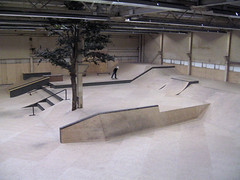
“I find Skate exciting because it’s a prime example of a game that understands Generation C; it allows players to share game-information outside the game – and in a manner that is so much more easily referenced, due to it having a permanent link […].”
-
Lots of design of playgrounds, skateparks, etc.
-
“Ludic fallacy is a term coined by the philosopher of knowledge Nassim Taleb […] summarized as “the misuse of games to model real-life situations”. Taleb characterizes the fallacy as mistaking the map (model) for the reality[…].”
Adaptive design and transformative play

Allowing people to change parts of your product is playful. It has also always ‘just’ seemed like a good thing to do to me. You see this with with people who become passionate about a thing they use often: They want to take it apart, see how it works, put it back together again, maybe add some stuff, replace something else… I’ve always liked the idea of passionate people wanting to change something about a thing I designed. And it’s always been a disappointment when I’d find out that they did not, or worse—wanted to but weren’t able to.
Apparently this is what people call adaptive design. But if you Google that, you won’t find much. In fact, there’s remarkably little written about it. I was put on the term’s trail by Matt Webb and from there found my way to Dan Hill’s site. There’s a lot on the topic there, but if I can recommend one piece it’s the interview he did for Dan Saffer’s book on interaction design. Read it. It’s full of wonderful ideas articulated 100 times better than I’ll ever be able to.
So why is adaptive design conducive to the playfulness of a user experience? I’m not sure. One aspect of it might be the fact that as a designer you explicitly relinquish some control over the final experience people have with your…stuff.1 As Matt Webb noted in an end-of-the-year post, in stead of saying to people: “Here’s something I made. Go on—play with it.” You say: “Here’s something I made—let’s play with it together.”
This makes a lot of sense if you don’t think of the thing under design as something that’ll be consumed but something that will be used to create. It sounds easy but again is surprisingly hard. It’s like we have been infected with this hard-to-kill idea that makes us think we can only consume whereas we are actually all very much creative beings.2 I think that’s what Generation C is really about.
A sidetrack: In digital games, for a long time developments have been towards games as media that can be consumed. The real changes in digital games are: One—there’s a renewed interest in games as activities (particularly in the form of casual games). And two—there’s an increase in games that allow themselves to be changed in meaningful ways. These developments make the term “replay value” seem ready for extinction. How can you even call something that isn’t interesting to replay a game?3
In Rules of Play, Salen and Zimmerman describe the phenomenon of transformative play—where the “free movement within a more rigid structure” changes the mentioned structure itself (be it intended or not). They hold it as one of the most powerful forms of play. Think of a simple house rule you made up the last time you played a game with some friends. The fact that on the web the rules that make up the structures we designed are codified in software should not be an excuse to disallow people to change them.
That’s true literacy: When you can both read and write in a medium (as Alan Kay would have it). I’d like to enable people to do that. It might be hopelessly naive, but I don’t care—it’s a very interesting challenge.
- That’s a comfortable idea to all of the—cough—web 2.0 savvy folk out there. But it certainly still is an uncomfortable thought to many. And I think it’d surprise you to find out how many people who claim to be “hip to the game” will still refuse to let go. [↩]
- Note I’m not saying we can all be designers, but I do think people can all create meaningful things for themselves and others. [↩]
- Yes, I am a ludologist. So shoot me. [↩]
links for 2008-01-31
-
“[A viral loop is] [t]he steps a user goes through between entering the site to inviting the next set of new users”. Via Webb.
-
Who will be the virtual graffiti cleaners once we all live in a Virtual Light world? Via the Roomware peeps.
-
“Maybe I love IA for the same reason I loved creating ‘dungeons’ as a kid playing D&D?” Glad to see I’m not the only UX person infected with the possibility space virus.
links for 2008-01-30
-
“Jake Zeller […] handily beat the other students on the pop quiz and was rewarded by watching his spaceship […] land on Mars while those of his classmates vaporized.” I cringe at the use of completely unrelated visualizations.
links for 2008-01-29
-
“Playyoo’s game creator allows users to create their own games too, and by uploading images and modifying game elements users now have more flexibility than with any other service.”
links for 2008-01-26
-
“…it’s not the diagram or the artifact that matters. It’s the process of making the diagram that produces innovation.”
-
Blog for an MMO I’ll be keeping my eyes on. One interesting aspect of Lila Dreams, for instance, is that it’s 2D side-scrolling. Oh and its front-end is Flash. And it’ll be hosted on Kongregate. Huh…
-
“[…] the movement is propelled by a new generation of kids who have easier technological access than ever before […] Today’s indie gamemakers possess the desire to tweak the old genres, and an intuitive sense of the language and mechanics of play.”
links for 2008-01-25
-
Of particular interest are the bits on using kaizen in service design and how brand and UX relate.
-
Karsten forwarded me this nice example of IKEA moving into Generation C territory: a furniture swap event supported with an online tool that allows you to map your room and have it subsequently be shuffled for inspiration.
-
“Personas are to Persona Descriptions as Vacations are to Souvenir Picture Albums. […] If the vacation pictures aren’t compelling, did the vacation itself suck?” Thank you Jared. Can we wrap up this silly persona discussion now?