-
Lots to chew on in this post on location based services by Matt Jones. I think predictive modelling of the future using past location data is an interesting avenue of exploration. The hardest problem, as far as I’m concerned, is how to communicate the ambiguity and potential multiplicity of said future in visualizations?
Author: Kars Alfrink
Designer turned design researcher. Postdoc at TU Delft. Exploring contestable AI.
links for 2009-02-11
-
A brief discussion of This happened in Dutch. Mainly focussed on the DIY / grass roots nature of the events and the fact that it is supported by cheap and / or free online tools.
links for 2009-02-07
-
My friends at Tinker.it! are making prototyping for physical computing even simpler with TinkerKit: “TinkerKit is an Arduino-compatible physical computing prototyping toolkit aimed at design professionals.”
links for 2009-02-04
-
MIMOA announces their appearance at This happened – Utrecht #2. Looking forward to their talk.
links for 2009-02-02
-
A short talk by Kevin Slavin at MIND08, about breaking machines “not to escape reality, but to make reality bigger … to evoke in stead of inform … not to ground us further, but to keep us further on our toes”.
The 2nd Dutch ‘This happened’ is coming this way
We’re less than four weeks removed from the second edition of ‘This happened – Utrecht’. As you may know, this is an event I am organizing and curating together with Alexander and Ianus. We’re trying to offer an alternative to flashy product-focused (and fuzzy theory-based) sessions that are prevalent in the interaction design event landscape. ‘This happened’ presentations are short stories about how a project came to be, warts and all. Think of them as the DVD extras for interaction design.
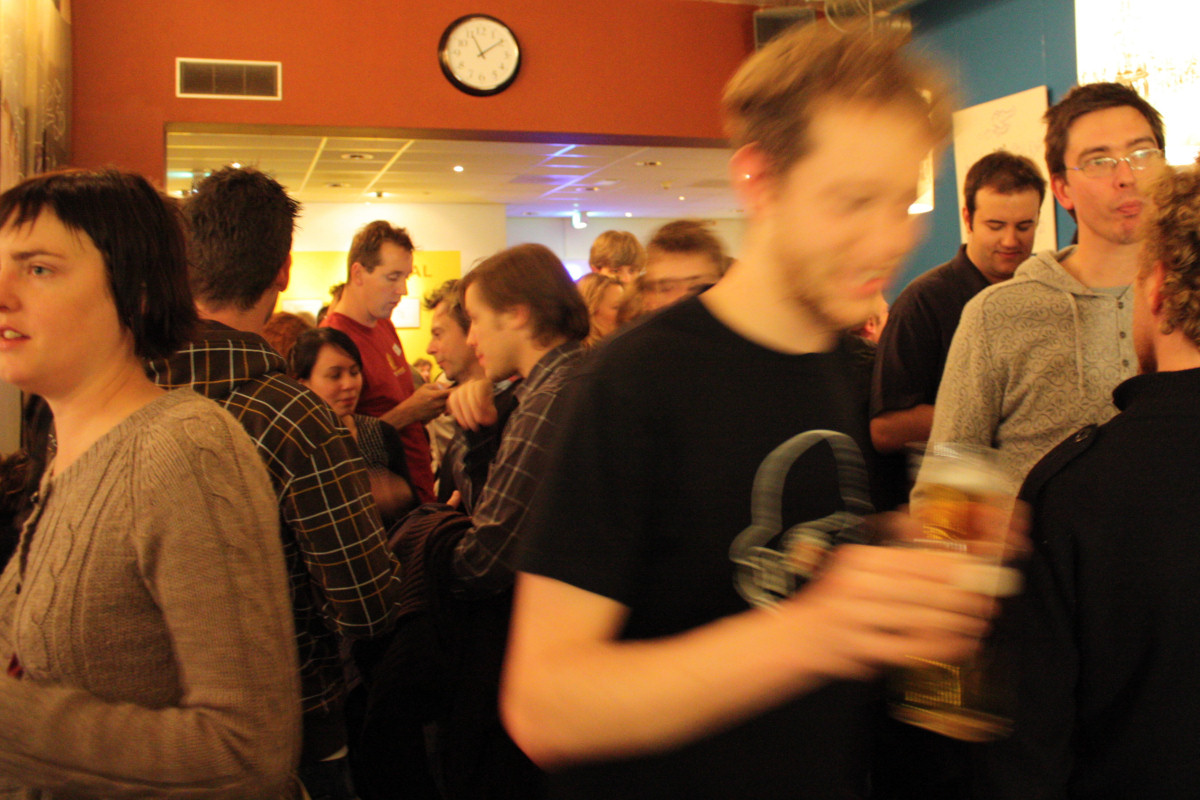
On Monday February 23, we’ll return to Theater Kikker in Utrecht, the Netherlands for #2. Our first edition was a success, and I’m really looking forward to continuing the experiment. Here’s who we’ve invited this time to come and shed light on one of their projects:
- Niels Keetels, a game design researcher at the HKU, will be talking about Softbody. A game that is interesting because of its lush expressive visuals, as well as the clever balancing of open-ended and goal-directed play. Oh, and how many games fo you know that had their mechanics inspired by honest-to-goodness field research?
- Sanne Kistemaker of Muzus will present Piece of Family, which was developed in collaboration with Vodafone. It’s a communication device designed for the elderly, composed of a sketchpad and a scanner, which instantly posts whatever’s written to a blog. The design won a prestigious Dutch Design Award.
- Irene van Peer, a celebrated product designer, will talk about the Mahlangu Hand-washer, which was featured in the New York Times 8th Annual Year in Ideas. It is both a product (developed as part of a sanitation project in Africa) that involves converting the cap of an empty bottle into a homemade tap, as well as a set of instructions that can be passed on from person to person.
- Finally, we have Naomi Schiphorst and Mieke Vullings of MIMOA, who will show how their free and open online guide to modern architecture came into being. The site is aimed at a broad audience, not just architects, and aims to build a durable community.
Head over to the This happened – Utrecht website for expanded descriptions of the talks (in Dutch). The registration will open on Monday February 9. I hope to see you there!
The theory and practice of urban game design
A few weeks ago NLGD asked me to help out with an urban games ‘seminar’ that they had commissioned in collaboration with the Dutch Game Garden. A group of around 50 students from two game design courses at the Utrecht School of the Arts1 were asked to design a game for the upcoming Festival of Games in Utrecht. The workshop lasted a week. My involvement consisted of a short lecture, followed by several design exercises designed to help the students get started on Monday. On Friday, I was part of the jury that determined which game will be played at the festival.
Lecture
In the lecture I briefly introduced some thinkers in urbanism that I find of interest to urban game designers. I talked about Jane Jacobs’ view of the city as a living organism that is grown from the bottom up. I also mentioned Kevin Lynch’s work around wayfinding and the elements that make up people’s mental maps of cities. I touched upon the need to have a good grasp of social interaction patterns2. Finally, I advised the students to be frugal when it comes to the inclusion of technology in the students’ game designs. A good question to always ask yourself is: can I have as much fun without this gadget?
I wrapped up the lecture by looking at 5 games, some well-known, others less so: Big Urban Game, ConQwest, Pac-Manhattan, The Soho Project and The Comfort of Strangers. There are many more good examples, of course, but each of these helped in highlighting a specific aspect of urban games design.
Workshop
Next, I ran a workshop of around 3 hours with the students, consisting of two exercises (plus one they could complete afterwards in their own time). The first one is the most interesting to discuss here. It’s a game-like elicitation technique called VNA3, which derives its name from the card types in the deck it is made up of: verbs, nouns and adjectives.

The way it works is that you take turns drawing a card from the deck and make up a one-sentence idea involving the term. The first person to go draws a verb, the second person a noun and the third an adjective. Each person builds on the idea of his or her precursor. The concept that results from the three-card sequence is written down, and the next person draws a verb card again.4 The exercise resembles cadavre exquis, the biggest difference being that here, the terms are predetermined.
VNA is a great ice-breaker. The students were divided into teams of five and, because a side-goal of the seminar was to encourage collaboration between students from the different courses, they often did not know each other. Thanks to this exercise they became acquainted, but within a creative context. The exercise also privileges volume of ideas over their quality, which is perfect in the early stages of conceptualization. Last but not least, it is a lot of fun; many students asked where they could get the deck of cards.
Jurying
On Friday, I (together with the other jury members) was treated to ten presentations by the students. Each had prepared a video containing footage of prototyping and play-testing sessions, as well as an elevator pitch. A lot of them were quite good, especially considering the fact that many students had not created an urban game before, or hadn’t even played one. But one game really stood out for me. It employed a simple mechanic: making chains of people by holding hands. A chain was started by players, but required the help of passers-by to complete. Watching the videos of chains being completed evoked a strong positive emotional response, not only with myself, but also my fellow jurors. What’s more important though, is that the game clearly engendered happiness in its participants, including the people who joined in as it was being played.

In one video sequence, we see a near-completed chain of people in a mall, shouting requests at people to join in. A lone man has been observing the spectacle from a distance for some time. Suddenly, he steps forward, and joins hands with the others. The chain is completed. A huge cheer emerges from the group, hands are raised in the air and applause follows, the man joining in. Then he walks off towards the camera, grinning, two thumbs up. I could not help but grin back.5

- Game Design and Development and Design for Virtual Theatre and Games [↩]
- pointing to this resource, that was discussed at length on the IGDA ARG SIG [↩]
- developed by Annakaisa Kultima [↩]
- An interesting aside is that the deck was originally designed to be used for the creation of casual mobile games. The words were chosen accordingly. Despite this, or perhaps because of this, they are quite suitable to the design of urban games. [↩]
- To clarify, this was not the game that got selected for the Festival of Games. There were some issues with the game as a whole. It was short-listed though. Another excellent game, involving mechanics inspired by photo safari, was the winner. [↩]
links for 2009-01-23
-
Architects responsible for the Blur Building and the upcoming Alice Tully Hall.
links for 2009-01-20
-
Of interest because of Gilberto Esparza’s Urban Parasites, the example of parents prototyping the addition of a small playground to the corner of their block, and the observation that with the arrival of the real-time city “governance becomes more akin to gardening”.
-
Write-up of a workshop-like IxDA event, focused on a brief design project mainly involving sketching and a critique session afterwards. A nice idea. Via Peter.
-
Brief description of the project done by the people of Mobile Monday Amsterdam at the fablab in Utrecht. Looking forward to seeing this in action.
links for 2009-01-16
-
“A Parascope resembles traditional scenic viewer binoculars but instead of showing the here and now, it displays several visualisations of how things might be in the future in that particular place.” An Unsworn Industries project for the city of Malmö. I can’t wait to see the next phase, where they will allegedly open up the viewer content for outside contributions.
-
“What is the relationship between wine varieties and flavor components? This visualization attempts to show the strength of these relationships. I culled descriptive flavor words from over 5,000 published wine tasting notes written between 1995-2000 in a major Australian wine magazine.” Simple but fun, mainly due to its subject matter.