-
“a reconfigurable grid of backlit keypads which connects to a computer. interaction between the keys and lights is determined by the application running on the computer. there is no hard-wired functionality” I love the fact that these are (apparently) made in a barn in the Catskill Mountains.
Buildings and Brains at the Nijmegen Design Platform (NOP)
It’s been a few weeks since I presented at the Nijmegen Design Platform (NOP), but I thought it would still be useful to post a summary of what I talked about here.
Update: it took me a while, but the slides that accompanied this talk are now up at SlideShare.
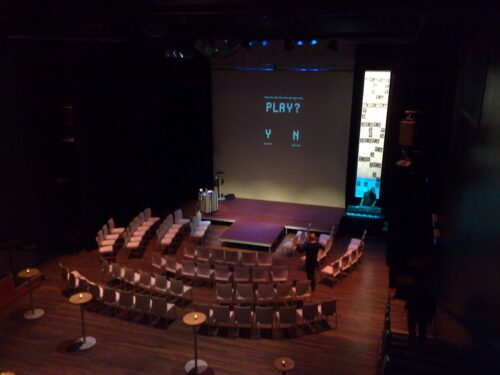
A little context: The NOP run frequent events for designers in the region. These designers mostly work in more traditional domains such as graphic, fashion and industrial design. NOP asked Jeroen van Mastrigt — a friend and occasional colleague of mine — to talk about games at one of their events. Jeroen in turn asked me to play Robin to his Batman, I would follow up his epic romp through game design theory with a brief look at pervasive games. This of course was an offer I could not refuse. The event was held at a lovely location (the huge art-house cinema LUX) and was attended by a healthy-sized crowd. Kudos to the NOP for organizing it and many thanks to them (and Jeroen) for inviting me.
So, what I tried to do in the talk was to first give a sense of what pervasive games are, what characterizes them. I drew from the Hide & Seek website for the list of characteristics and used The Soho Project as a running example throughout this part. I also tied the characteristics to some theory I found interesting:
- Mixing digital technology with real world play — I emphasized that ultimately, technology is but a means to an end. At Interaction ‘09 Robert Fabricant said the medium of interaction design is human behavior. I think the same holds true for the design of pervasive games.
- Social interaction — Raph Koster once said single player games are a historical aberration. It is clear much of the fun in pervasive games is social. In a way I think they bridge the gap between the “old” board games and contemporary video games.
- Using the city as a playground — Here I could not resist bringing in Jane Jacob’s notions of the city as an entity that is organised from the bottom up and Kevin Lynch’s work on the mental maps we create of cities as we move through them. Cities play a vital role in facilitating the play of pervasive games. At best they are the main protagonist of them.
- Transforming public spaces into theatrical stagesets — This is related to the previous one, but here I made a sidestep into the embodied nature of player interactions in pervasive games and how embodiment facilitates reading at a distance of such actions. In a sense, the social fun of embodied play is due to its performative quality.
After this, I tried to show why designers outside the domain of games should care about pervasive games. This I did by talking about ways they can be used for purposes other than ‘mere’ entertainment. These were:
- Enlarging perceived reality; you can create games that play with the way we customarily perceive reality. This was inspired by the talk Kevin Slavin of Area/Code delivered at MIND08. Examples I used were Crossroads and The Comfort of Strangers.
- Changing human behavior for the better; think of the Toyota Prius dashboard’s effect on people’s driving behavior. Examples of games that use feedback loops to steer us towards desirable goals are CryptoZoo and FourSquare.
- Crowdsourcing solutions; games can simulate possible futures and challenge players to respond to their problems. Here I used Jane McGonigal’s ideas around collective intelligence gaming. The example game I talked about was World Without Oil.
- Conveying arguments procedurally; Ian Bogost‘s concept of procedural rhetoric isn’t specific to pervasive games, but I think the way they get mixed up with everyday life make them particularly effective channels for communicating ideas. I used The Go Game, Cruel 2B Kind and Join the Line1 as examples.
By talking about these things I hoped to provide a link to the audience’s own design practice. They may not deal with games, but they surely deal with communicating ideas and changing people’s behavior. Come to think of it though, I was doing a very old media style presentation in attempt to achieve the same… Oh well.
- Join the Line is a game students conceptualized during a workshop I ran. [↩]
links for 2009-07-18
-
Interesting and beautiful visualization of London noise level data. I am particularly intrigued by the braille like version.
-
PIPS:lab have a new show that features a thing called the Radarfunk. Here’s a nice clip of a small performance that demoes what it can do.
-
A crazy mockumentary by Matt Cottam on computational wood. It’s an effective format to use for communicating such far-future design.
-
“The PlayPump systems are innovative, sustainable, patented water pumps powered by children at play. Installed near schools, the PlayPump system doubles as a water pump and a merry-go-round for children.” I am not sure wether this is awesome, or very very wrong. It makes me think of Luis von Ahn’s games that double as human computation harvesters (such as the ESP Game).
-
Reading this, particularly the bit about the zillion derivative apps on sale, makes me wonder wether the App Store might be headed towards a Atari 2600 style demise.
-
An interesting invitation-only summit on physical computing happening in London right now. Will be keeping an eye on what comes out of this.
This pervasive games workshop I ran at this conference
A few things I got people to do at this year’s NLGD Festival of Games:

Fight each other with paper swords…

…and run around with lunch-boxes on their heads.1
This was all part of a workshop I ran, titled ‘Playful Tinkering’. The mysterious Mink ette — who amongst many things is a designer at Six to Start — and I got people to rapidly prototype pervasive games that were be played at the conference venue the day after. The best game won a magnificent trophy shaped like a spring rider.
Some exercises we did during the workshop:
- Play a name game Mink ette had made up shortly before the workshop in no time at all. This is good for several things: physical warm-up, breaking the ice, demonstrate the kinds of games the session is about.
- Walk around the room and write down imaginary game titles as well as names of games you used to play as a child. Good for emptying heads and warming up mentally.
- Walk around again, pick a post-it that intrigues you. Then guess what the game is about, and have others to fill in the blanks where need. Then play the game. This is mostly just for fun. (Nothing wrong with that.)
- Analyse the games, break them up into their basic parts. Change one of those parts and play the game again. See what effect the change has. This is to get a sense of what games design is about, and how changing a rule impacts the player experience.

Participants brainstorming game ideas
People then formed groups and worked on an original game. We pushed them to rapidly generate a first ruleset that could be playtested with the other groups. After this they did another design sprint, and playtested again outside the room, “in the wild”. All of this in less than four hours. Whew!
The games that were made:
- A game that involved hunting for people that matched the descriptions on post-its that were hidden around the venue. You first needed to find a post-it, then find the person that matched the description on it and finally take a photo of them for points. This game was so quick to play it already ran at the party, hours after the workshop finished.
- ‘Crowd Control’ — compete with other players to get the largest percentage of a group of people to do what you are doing (like nodding your head). This game won the trophy, in part because of the ferocious player recruitment style the runners employed during the playtest.
- A sailing game, where you tried to maneuver an imaginary boat from one end of a space to the other. Your movement was constrained by the “wind”, which was a function of the amount of people on either side of your boat. It featured an ingenuous measuring mechanic which used an improvised rope made from a torn up conference tote bag.
- The lunchbox thing was improvised during the lunch before the playtest. A student also brought in a game he was working on for his graduation to playtest.
We set up the playtest itself as follows:
The room was open to anyone passing by. Each game got their own station where they could recruit players, explain the rules, keep score, etc. Mink ette and I handed each player a red, blue and yellow tiddlywink. They could use this to vote on their favorite game in three separate categories, by handing the runners a tiddlywink. People could play more than once, and vote as often as they liked. We also kept track of how much players each game got. We handed out prizes to winners in the different categories (a lucky dip box loaded with piñata fillers). The most played game got the grand prize — the spring rider trophy I created with help from my sister and fabricated at the local fablab.2

Spring rider trophy and tiddlywinks ready for some playtesting action
It was a pleasure to have the elusive Mink ette over for the ride. I loved the way she explained what pervasive games were all about — being able to play anytime, anywhere with anything. I was also impressed with the way she managed to get people to do strange things without thinking twice.
We had a very dedicated group of participants, most of whom stuck around for the whole session and returned again for the playtest the next day. I’m very grateful for their enthusiasm. The whole experience was very rewarding, I’m keen on doing this more often at events and applying what I learnt to the workshops I run as part of my own games design practice.

Happy winners of the spring rider trophy flanked by Mink ette and yours truly
links for 2009-07-07
-
At this year’s Develop conference, Tom will be talking about applying service design to games. What a nice idea, do check him out.
-
When androids dream of electric sheep, this is what it looks like.
links for 2009-07-06
-
A location-based treasure hunting game on the Nintendo DS. Might just need to get this.
-
Utrecht-based web agency Rhinofly report on our third edition (in Dutch). I’m happy to see the author enjoyed himself, but he does mention that, for him, the evening wasn’t about interacton design. I wonder why he feels that way?
links for 2009-06-30
-
Iskander sacrifices sleep to be the first to write up a report of the third This happened in Utrecht, and as always tries to discover a theme where none was intended. I am glad the notion of craftsmanship was something he picked up on in all presentations though, because I think that is central to the This happened concept.
links for 2009-06-24
-
A three-part book on the Dutch electronic culture sphere, looking at how the ways we engage with culture are changing, reporting on a recent e-culture conference and the state of the sector in general. Worth the EUR 12,50? I’ll soon find out.
-
Alper shares the work he’s done in the open government data space (in Dutch). “Het kan allemaal wél beter. Laten we het dus gaan doen.” Amen.
-
“GaIn focuses on developing systematic and playful approaches to enhance and organize the process of creating new products, especially from the perspective of game design processes.” These Fins remain at the forefront of games design research.
links for 2009-06-23
-
A brief interview with Alexander that touches upon what is wrong with pure repetition and the virtues of generative systems.
links for 2009-06-19
-
Photos of “the first East African skatepark constructed by local youngsters.” Wonderful stuff, via Hessel.
-
“And Yet It Moves is a puzzle-platformer, set in a unique world, made of ripped paper. Within the paper collage, you can jump, run and last but certainly not least: rotate the world.” There are too many interesting indie games being released to keep track of, lately.