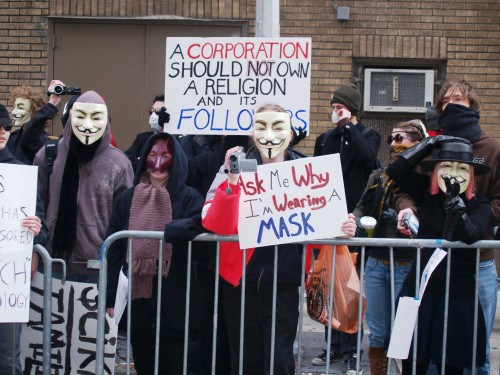
"Anonymous Scientology 1 by David Shankbone" by David Shankbone - David Shankbone. Licensed under CC BY-SA 3.0 via Wikimedia Commons - https://commons.wikimedia.org/wiki/File:Anonymous_Scientology_1_by_David_Shankbone.JPG#mediaviewer/File:Anonymous_Scientology_1_by_David_Shankbone.JPG

Political play is a mode of thinking critically about politics, and of developing an agonistic approach to those politics. This agonism is framed through carnivalesque chaos and humour, through the appropriation of the world for playing. By playing, by carefully negotiating the purpose of playing between pleasure and the political, we engage in a transformative act.

Quote taken from PARTICIPATORY REPUBLICS: PLAY AND THE POLITICAL by Miguel Sicart on the Play Matters book blog.

I love where Miguel is going with his thinking on the relationship between play, politics, appropriation and resistance.

I am interested in this because at Hubbub we have been exploring similar themes through the making of games and things-you-can-play-with.

The big challenges with this remain in the area of instrumentalisation – if you set out to design a thing that encourages this kind of play you often end up with something that is far from playful.

But the opportunities are huge because so much of today’s struggles of individuals against the state relate to legibility and control in some way, and play is the perfect antidote.

For example shortly after reading Miguel’s piece I came across this McKenzie Wark piece on extrastatecraft via Honor Harger. Extrastatecraft shifts the focus from architecture and politics to infrastructure.

Infrastructure is how power deploys itself, and it does so much faster than law or democracy.

You should read the whole thing. What’s fascinating is that Wark briefly discusses strategies and tactics for resisting such statecraft.

So the world might be run not by statecraft but at least in part by extrastatecraft. Easterling: “Avoiding binary dispositions, this field of activity calls for experiments with ongoing forms of leverage, reciprocity, and vigilance to counter the violence immanent in the space of extrastatecraft.” (149) She has some interesting observations on the tactics for this. Some exploit the informational character of third nature, such as gossip, rumor and hoax. She also discusses the possibilities of the gift or of exaggerated compliance (related perhaps to Zizek’s over-identification), and of mimicry and comedy.

“Gossip, rumor and hoax” sound a lot like the carnivalesque reflective-in-action political play Miguel is talking about.

To finish off, here’s a video of the great James C. Scott on the art of not being governed. He talks at length about how peoples have historically fled from statecraft into geographical zones unreachable by power’s infrastructure. And how they deploy their own, state-resistant infrastructure (such as particular kinds of crops) to remain illegible and uncapturable.

Reboot 10 slides and video

I am breaking radio-silence for a bit to let you know the slides and video for my Reboot 10 presentation are now available online, in case you’re interested. I presented this talk before at The Web and Beyond, but this time I had a lot more time, and I presented in English. I therefore think this might still be of interest to some people.1 As always, I am very interested in receiving constructive criticism Just drop me a line in the comments.

Update: It occurred to me that it might be a good idea to briefly summarize what this is about. This is a presentation in two parts. In the first, I theorize about the emergence of games that have as their goal the conveying of an argument. These games would use the real-time city as their platform. It is these games that I call urban procedural rhetorics. In the second part I give a few examples of what such games might look like, using a series of sketches.

The slides, posted to SlideShare, as usual:

Slides also on SlideShare.

The video, hosted on the Reboot website:

  1. I did post a transcript in English before, in case you prefer reading to listening. [↩]

Urban procedural rhetorics — transcript of my TWAB 2008 talk

This is a transcript of my presentation at The Web and Beyond 2008: Mobility in Amsterdam on 22 May. Since the majority of paying attendees were local I presented in Dutch. However, English appears to be the lingua franca of the internet, so here I offer a translation. I have uploaded the slides to SlideShare and hope to be able to share a video recording of the whole thing soon.

Update: I have uploaded a video of the presentation to Vimeo. Many thanks to Almar van der Krogt for recording this.

In 1966 a number of members of Provo took to the streets of Amsterdam carrying blank banners. Provo was a nonviolent anarchist movement. They primarily occupied themselves with provoking the authorities in a “ludic” manner. Nothing was written on their banners because the mayor of Amsterdam had banned the slogans “freedom of speech”, “democracy” and “right to demonstrate”. Regardless, the members were arrested by police, showing that the authorities did not respect their right to demonstrate.1

Good afternoon everyone, my name is Kars Alfrink, I’m a freelance interaction designer. Today I’d like to talk about play in public space. I believe that with the arrival of ubiquitous computing in the city new forms of play will be made possible. The technologies we shape will be used for play wether we want to or not. As William Gibson writes in Burning Chrome:

“…the street finds its own uses for things”

For example: Skateboarding as we now know it — with its emphasis on aerial acrobatics — started in empty pools like this one. That was done without permission, of course…

Only later half-pipes, ramps, verts (which by the way is derived from ‘vertical’) and skateparks arrived — areas where skateboarding is tolerated. Skateboarding would not be what it is today without those first few empty pools.2

Continue reading Urban procedural rhetorics — transcript of my TWAB 2008 talk

  1. The website of Gramschap contains a chronology of the Provo movement in Dutch. [↩]
  2. For a vivid account of the emergence of the vertical style of skateboarding see the documentary film Dogtown and Z-Boys. [↩]