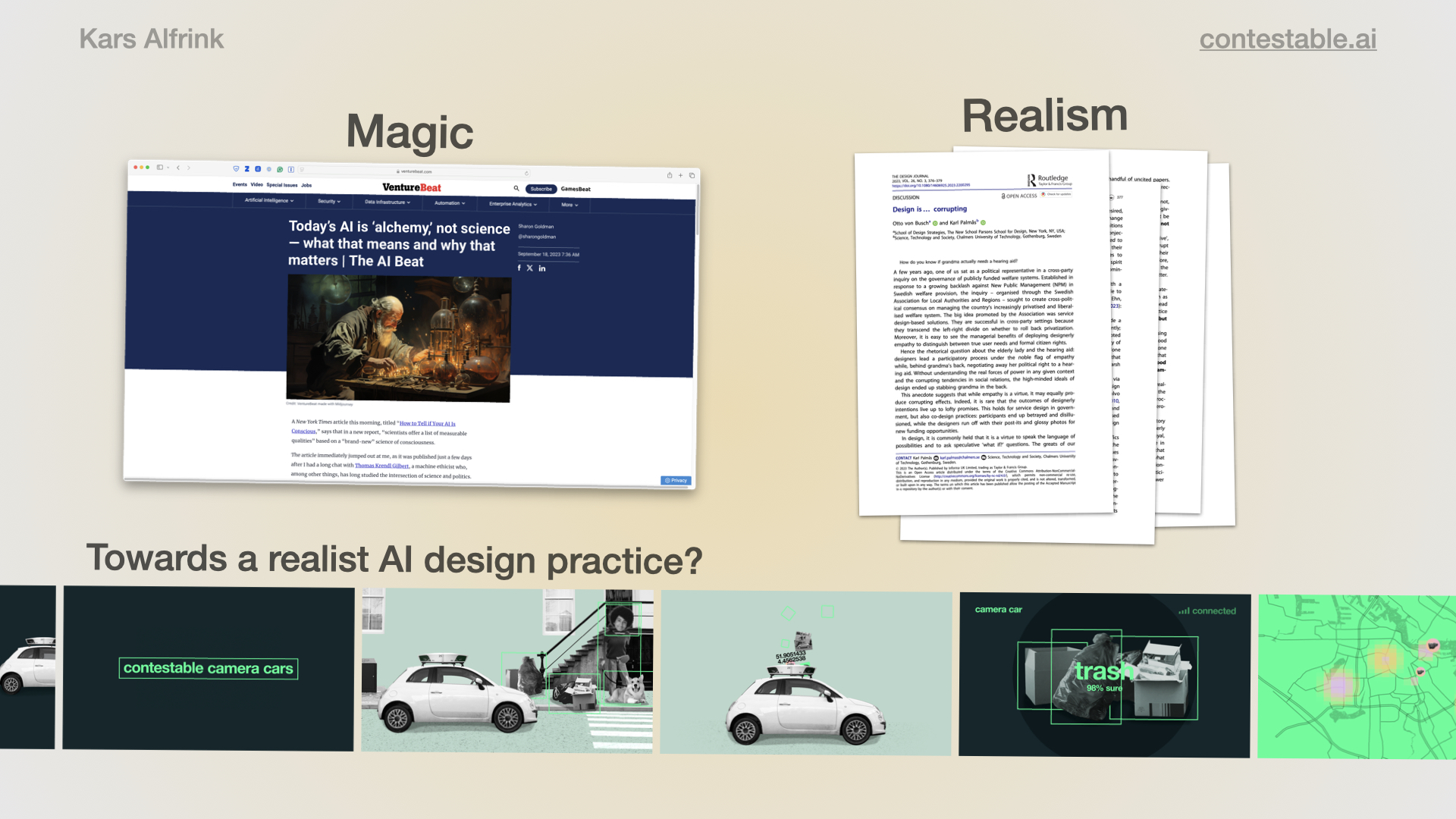
Slides from my keynote at the CLICKNL Design Innovation Sessions, Digital Futures theme session, Dutch Design Week, 21 October 2026, Natlab, Eindhoven.
CLICKNL invited me to give this keynote. I saw it as a great opportunity to intervene in the debate about design and generative AI. My take is informed by my past work on contestability. That work is all about approaching “AI” as an arena where various parties compete over how it is made and how it is used. My take is also informed by my commitments to practice theory and political realism. Practice theory means looking at what people and things do together, rather than at technologies in isolation. Political realism means looking at politics as it actually happens. It asks who does what to whom, for whose benefit, instead of starting from abstract moral principles.
In the talk I argue that neither wholesale rejection nor uncritical embrace of generative AI will get us very far. GenAI deskills designers and opens up new ways of designing at the same time. It is built on the past work of designers, which raises the question of whose work we build on, and who gets to call the results their own. And it automates work, but in the process work may get delegated more than replaced, transforming practices as a result. Rather than trying to resolve these tensions, I look for emerging design practices that hold them and use them as an engine for moving forward. I discuss three cases: Vera van der Burg’s Text-to-Clay, Blaze Type’s test of Monotype’s AI type tool, and The Call by Holly Herndon and Mat Dryhurst. They all go beyond consuming off-the-shelf models. They treat pipelines and workflows as an object of design. And in all three there is an awareness of the value of effort and friction. I end with an open question. If AI is not one thing, not an agent, and neither our savior nor our doom, what metaphor does your mind go to?
I hope this talk helps designers think in concrete terms about how we might “do AI” differently from the dominant ways. And I hope it helps them break free from the simplistic for-or-against debates that get us nowhere.
Works discussed
Studio Dumbar
- Rob Alderson, “How is Studio Dumbar/DEPT using AI?”, Design Week, 13 Oct 2025. https://www.designweek.co.uk/how-is-studio-dumbar-using-ai/
From Text-to-Clay, Vera van der Burg
- Vera van der Burg, From Text-to-Clay, shown at Dutch Design Week 2025, Klokgebouw, Eindhoven. https://veravanderburg.nl
- Rima Sabina Aouf, “Vera van der Burg puts AI and ceramics into ‘reflective’ feedback loop”, Dezeen, 2 Feb 2026. https://www.dezeen.com/2026/02/02/vera-van-der-burg-ai-ceramics-text-to-clay/
- Helen Gonzalez Brown, “Text-to-Clay”, Disegno Journal, 25 Feb. https://disegnojournal.com/newsfeed/vera-van-der-burg-from-text-to-clay
- TU Delft, “Crafting reflection through AI and clay”, Delft Design Stories, 15 Oct 2025. https://www.tudelft.nl/en/ide/delft-design-stories/crafting-reflection-through-ai-and-clay
- Vera van der Burg, The Material Gaze: Reflective AI as a Design Practice, PhD dissertation, Delft University of Technology, 2026. https://doi.org/10.4233/uuid:fb78a0d0-0eb9-46e9-b7af-d54bca8796ca (Text-to-Clay is Chapter 7, with technical details in Appendix D.)
Blaze Type and Monotype’s AI type tool
- Sebastien Hayez, “Designing Fonts with AI: Future of Type Design”, Blaze Type Blog, 18 June 2025. https://blazetype.eu/blog/designing-fonts-with-ai/ (It reports Matthieu Salvaggio’s talk at Brand Talks, London, 12 June 2025.)
- Monotype, Re:Vision 2025 (trends report), Monotype, 2025.
- Monotype, “Human Types and AI: Blaze Type” (project page). https://www.monotype.com/type-trends/human-types/blaze-type/
- Monotype, “Monotype unveils Human Types and AI project” (press release), 29 May 2025. https://www.monotype.com/company/press-release/monotype-unveils-human-types-and-ai-project
- Monotype, “AI Code of Ethics” (undated). https://www.monotype.com/monotype-ai-code-ethics
The Call, Holly Herndon and Mat Dryhurst
- Holly Herndon and Mat Dryhurst, The Call, Serpentine North, London, 4 Oct 2024 – 2 Feb 2025. https://www.serpentinegalleries.org/whats-on/holly-herndon-mat-dryhurst-the-call/
- Victoria Ivanova and Jennifer Ding, Choral Data ‘Trust’ Experiment White Paper, Serpentine Arts Technologies, Zenodo, 17 Feb 2025. https://doi.org/10.5281/zenodo.14859320
- Jérémie Szpirglas, “The Call by Holly Herndon & Mat Dryhurst – Towards an Ethical and Open-Sourced AI 1/2”, IRCAM (interview with the artists and Robin Meier). Internet Archive copy: https://web.archive.org/web/20250803021949/https://www.ircam.fr/article/the-call-de-holly-herndon-mat-dryhurst-pour-une-ia-ethique-et-partagee
- Jérémie Szpirglas, “The Call by Holly Herndon & Mat Dryhurst – Towards an Ethical and Open-Sourced AI 2/2”, IRCAM (interview with Nils Demerlé), 30 Sep 2024. Internet Archive copy: https://web.archive.org/web/20251014184206/https://www.ircam.fr/article/the-call-de-holly-herndon-mat-dryhurst-pour-une-ia-ethique-et-partagee-22
- Louis Jebb, “All together now: Holly Herndon and Mat Dryhurst on their AI choir at the Serpentine”, The Art Newspaper, 4 Oct 2024. https://www.theartnewspaper.com/2024/10/04/all-together-now-artists-holly-herndon-and-mat-dryhurst-ai-choir-serpentine
- Jennifer Ding, Eva Jäger, Victoria Ivanova and Mercedes Bunz, “My Voice, Your Voice, Our Voice: Attitudes Towards Collective Governance of a Choral AI Dataset”, arXiv, 2 Dec 2024. https://arxiv.org/abs/2412.01433
CRTA visual identity, Bruketa&Žinić&Grey
- Bruketa&Žinić&Grey, CRTA visual identity, for the Regional Centre of Excellence for Robotic Technology, Faculty of Mechanical Engineering and Naval Architecture, University of Zagreb, 2021.
- designboom, on the CRTA visual identity. https://www.designboom.com/design/crta-visual-identity-artificial-intelligence-bruketa-zinic-07-04-2021/
- Bruketa&Žinić&Grey, “CRTA – visual identity created with the help of artificial intelligence” (case study), 4 Feb 2021. https://bruketa-zinic.com/2021/02/04/crta-visual-identity-created-with-the-help-of-artificial-intelligence/
Mud to Models and Soil to Servers workshops
- Fieke Jansen, Sunjoo Lee, Kars Alfrink and Lena Trotereau, From Mud to Models: Regenerative Futures for Community AI (conference workshop), TH/NGS 2025, Amsterdam, 12 Dec 2025, and From Soil to Servers: Regenerative Futures for Community Computing (workshop), Creative Coding Utrecht, Utrecht, 27 Mar 2026; Kars Alfrink and Sunjoo Lee, with Advaita Jairam, From Soil to Servers: Pairing Material Practice with Speculative Design to Rethink Computing Infrastructure (conference workshop), Philosophy of Human-Technology Relations Conference (PHTR 2026), The Hague, 22 Sep 2026.
- TU Delft, “From Mud to Models: A Workshop on Regenerative AI Futures”, 17 Dec 2025. https://www.tudelft.nl/2025/io/december/from-mud-to-models-a-workshop-on-regenerative-ai-futures
- Kars Alfrink, Sunjoo Lee, Lena Trotereau and Fieke Jansen, “Mud and models: Does making matter for regenerative AI speculation?”, in Iskander Smit and Andrea Krajewski (eds.), The State of Responsible Technology – RESIZE<REMIX<REGEN (RIOT 2026), Stichting ThingsCon Amsterdam, June 2026, pp. 34–39. https://doi.org/10.5281/zenodo.20569440
Further reading
- Alfrink, K. (2025). People’s compute: Design and the politics of AI infrastructures. OSF. https://doi.org/10/q8kp
- Caplan, L. (2025). Introduction: Contesting models – art and democracy since the 1990s. In L. Caplan & K. Greaves (Eds.), Model collapse: European contemporary art in a time of democratic crisis (pp. 1–20). Manchester University Press. http://www.jstor.org/stable/jj.36233585.6
- Geuss, R. (2008). Philosophy and real politics. Princeton University Press.
- Kuutti, K., & Bannon, L. J. (2014). The turn to practice in HCI: Towards a research agenda. In Proceedings of the SIGCHI Conference on Human Factors in Computing Systems (pp. 3543–3552). ACM. https://doi.org/10.1145/2556288.2557111
- Löwgren, J., & Stolterman, E. (2004). Thoughtful interaction design: A design perspective on information technology. MIT Press.
- McGowan, T. (2016). Capitalism and desire: The psychic cost of free markets. Columbia University Press.
- McGowan, T. (2019). Emancipation after Hegel: Achieving a contradictory revolution. Columbia University Press.
- Morozov, E. (2024, August). AI and the techno-utopian path not taken. Le Monde diplomatique (English edition). https://mondediplo.com/2024/08/07ai-cold-war
- Parsons, P. C. (2026). Myths and ironies of AI-assisted design. In Designing Interactive Systems Conference (DIS ’26) (pp. 523–535). ACM. https://doi.org/10.1145/3800645.3813086
- Porfirio, D., McDermott, I., Chen, H.-M., Satake, S., Kanda, T., & LaToza, T. D. (2026). Designing for robot wranglers: A synthesis of literature and practice. In Designing Interactive Systems Conference (DIS ’26) (pp. 4284–4298). ACM. https://doi.org/10.1145/3800645.3813070
- Retkowsky, J., Hafermalz, E., & Huysman, M. (2026). Harnessing a “spirited technology”: How working with generative AI collapses the creative process. Academy of Management Discoveries, 12(3), 363–387. https://doi.org/10.5465/amd.2024.0280
- Retkowsky, J., Hafermalz, E., Huysman, M., & Odijk, D. (2026, September 16). Research: Gen AI is collapsing creative processes. Harvard Business Review. https://hbr.org/2026/09/research-gen-ai-is-collapsing-creative-processes
- Salvaggio, E. (2026, August 16). The system from nowhere. Cybernetic Forests. https://mail.cyberneticforests.com/the-system-from-nowhere/
- Sayers, S. (2011). Alienation as a critical concept. International Critical Thought, 1(3), 287–304. https://doi.org/10.1080/21598282.2011.609265
- Shumailov, I., Shumaylov, Z., Zhao, Y., Gal, Y., Papernot, N., & Anderson, R. (2024). The curse of recursion: Training on generated data makes models forget. arXiv. https://arxiv.org/abs/2305.17493
- Stilgoe, J., Owen, R., & Macnaghten, P. (2013). Developing a framework for responsible innovation. Research Policy, 42(9), 1568–1580. https://www.sciencedirect.com/science/article/pii/S0048733313000930
- Suchman, L. (2023). The uncontroversial ‘thingness’ of AI. Big Data & Society, 10(2), 1–5. https://doi.org/10.1177/20539517231206794
- Unger, G., & Narayanan, A. (2026, October 14). Steering AI beyond automation: A research agenda and plan for action. AI as Normal Technology. https://www.normaltech.ai/p/steering-ai-beyond-automation
- van Maanen, G. (2022). AI ethics, ethics washing, and the need to politicize data ethics. Digital Society, 1(2), Article 9. https://doi.org/10.1007/s44206-022-00013-3
- Wright, E. O. (2010). Envisioning real utopias. Verso.