The following is a section from a manuscript in press on the similarities and differences in approaches to explainable and contestable AI in design and law (Schmude et al., 2025). It ended up on the cutting room floor, but it is the kind of thing I find handy to refer back to, so I chose to share it here.
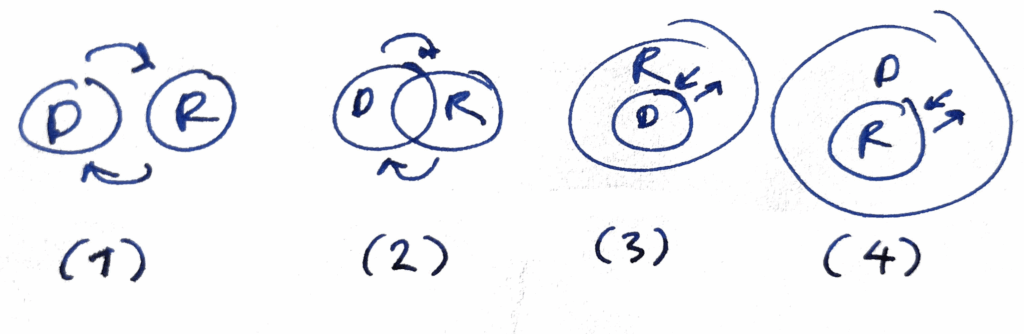
The responsible design of AI, including practices that seek to make AI systems more explainable and contestable, must somehow relate to legislation and regulations. Writing about responsible research and innovation (RRI) more broadly, Stilgoe et al. (2013) assert that RRI, which we would say includes design, must be embedded in regulation. But does it really make sense to think of the relationship between design and regulation in this way? Understood abstractly, there are in fact at least four ways in which we can think about the relationship between the design and regulation of technology (Figure 1).
To establish the relationship between design and regulation, we first need to establish how we should think about regulation, and related concepts such as governance and policymaking more generally. One straightforward definition would be that regulation entails formal rules and enforcement mechanisms that constrain behavior. These are backed by authority—typically state authority, but increasingly also non-stake actors. Regulation and governance are interactive and mutually constitutive. Regulation is one mechanism within governance systems. Governance frameworks establish contexts for regulation. Policymaking connects politics to governance by translating political contestation into actionable frameworks. Politics, then, influences all these domains: policymaking, governance, and regulation. And they, in turn, operate within and reciprocally shape society writ large. See Table 1 for working definitions of ‘regulation’ and associated concepts.
| Concept | Definition |
|---|---|
| Regulation | Formal rules and enforcement mechanisms that constrain behavior, typically state-backed but increasingly emerging from non-state actors (industry self-regulation, transnational regulatory bodies). |
| Governance | Broader arrangements for coordinating social action across public, private, and civil society spheres through both formal and informal mechanisms. |
| Policymaking | Process of formulating courses of action to address public problems. |
| Politics | Contestation of power, interests, and values that shapes governance arrangements. |
| Society | Broader context of social relations, norms, and institutions. |
What about design? Scholars of regulation have adopted the notion of ‘regulation by design’ (RBD) to refer to the inscribing of rules into the world through the creation and implementation of technological artifacts. Prifti (2024) identifies two prevailing approaches to RBD: The essentialist view treats RBD as policy enactments, or “rules for design.” By contrast, the functionalist view treats design as a mere instrument, or “ruling by design.” We agree with Prifti when he states that both approaches are limited. Essentialism neglects the complexity of regulatory environments, while functionalism neglects the autonomy and complexity of design as a practice.
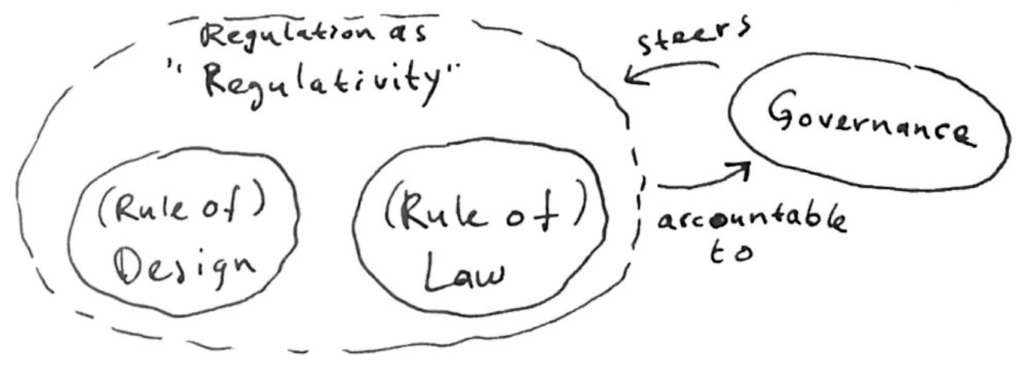
Prifti proposes a pragmatist reconstruction that views regulation as a rule-making activity (“regulativity”) performed through social practices including design (the “rule of design”). Design is conceptualized as a contextual, situated social practice that performs changes in the environment, rather than just a tool or set of rules. Unlike the law, markets, or social norms, which rely on incentives and sanctions, design can simply disable the possibility of non-compliance, making it a uniquely powerful form of regulation. The pragmatist approach distinguishes between regulation and governance, with governance being a meta-regulative activity that steers how other practices (like design) regulate. This reconceptualization helps address legitimacy concerns by allowing for greater accountability for design practices that might bypass democratic processes.
Returning to the opening question then, out of the four basic ways in which the relationship between design and regulation can be drawn (Figure 1), if we were to adopt Prifti’s pragmatist view, Type 3 would most accurately capture the relationship, with design being one of a variety of more specific ways in which regulation (understood as regulativity) actually makes changes in the world. These other forms of regulatory practice are not depicted in the figure. This seems to align with Stilgoe et al.’s aforementioned position that responsible design must be embedded within regulation. Although there is a slight nuance to our position: Design is conceived of as a form of regulation always, regardless of active work on the part of designers to ‘embed’ their work inside regulatory practices. Stilgoe et al.’s admonition can be better understood as a normative claim: Responsible designers would do well to understand and align their design work with extant laws and regulations. Furthermore, following Prifti, design is beholden to governance and must be reflexively aware of how governance steers its practices (cf. Figure 2).
Bibliography
- Prifti, K. (2024). The theory of ‘Regulation By Design’: Towards a pragmatist reconstruction. Technology and Regulation, 2024, 152–166. https://doi.org/10/g9dr24
- Stilgoe, J., Owen, R., & Macnaghten, P. (2013). Developing a framework for responsible innovation. Research Policy, 42(9), 1568–1580. https://doi.org/10/f5gv8h