Now that the IxDA has posted a video of my presentation at Interaction 09 to Vimeo, I thought it would be a good idea to provide a little background to the talk. I had already posted the slides to SlideShare, so a full write-up doesn’t seem necessary. To provide a little context though, I will summarize the thing.
Summary
The idea of the talk was to look at a few qualities of embodied interaction, and relate them to games and play, in the hopes of illuminating some design opportunities. Without dwelling on what embodiment really means, suffice to say that there is a school of thought that states that our thinking originates in our bodily experience of the world around us, and our relationships with the people in it. I used the example of an improvised information display I once encountered in the paediatric ward of a local hospital to highlight two qualities of embodied interaction: (1) meaning is socially constructed and (2) cognition is facilitated by tangibility.1

With regards to the first aspect — the social construction of meaning — I find it interesting that in games, you find a distinction between the official rules to a game, and the rules that are arrived at through mutual consent by the players, the latter being how the game is actually played. Using the example of an improvised manège in Habbo, I pointed out that under-specified design tends to encourage the emergence of such interesting uses. What it comes down to, as a designer, is to understand that once people get together to do stuff, and it involves the thing you’ve designed, they will layer new meanings on top of what you came up with, which is largely out of your control.

For the second aspect — cognition being facilitated by tangibility — I talked about how people use the world around them to offload mental computation. For instance, when people get better at playing Tetris, they start backtracking more than when they just started playing. They are essentially using the game’s space to think with. As an aside, I pointed out that in my experience, sketching plays a similar role when designing. As with the social construction of meaning, for epistemic action to be possible, the system in use needs to be adaptable.
To wrap up, I suggested that, when it comes to the design of embodied interactive stuff, we are struggling with the same issues as game designers. We’re both positioning ourselves (in the words of Eric Zimmerman) as meta-creators of meaning; as designers of spaces in which people discover new things about themselves, the world around them and the people in it.
Sources
I had several people come up to me afterwards, asking for sources, so I’ll list them here.
- the significance of the social construction of meaning for interaction design is explained in detail by Paul Dourish in his book Where the Action Is
- the research by Jean Piaget I quoted is from his book The Moral Judgement of the Child (which I first encountered in Rules of Play, see below)
- the concept of ideal versus real rules is from the wonderful book Rules of Play by Katie Salen and Eric Zimmerman (who in turn have taken it from Kenneth Goldstein’s article Strategies in Counting Out)
- for a wonderful description of how children socially mediate the rules to a game, have a look at the article Beyond the Rules of the Game by Linda Hughes (collected in the Game Design Reader)
- the Will Wright quote is from an interview in Tracy Fullerton’s book Game Design Workshop, second edition
- for a discussion of pragmatic versus epistemic action and how it relates to interaction design, refer to the article How Bodies Matter (PDF) by Scott Klemmer, Björn Hartmann and Leila Takayama (which is rightfully recommended by Dan Saffer in his book, Designing Gestural Interfaces)
- the Tetris research (which I first found in the previously mentioned article) is described in Epistemic Action Increases With Skill (PDF), an article by Paul Maglio and David Kirsh
- the “play is free movement…” quote is from Rules of Play
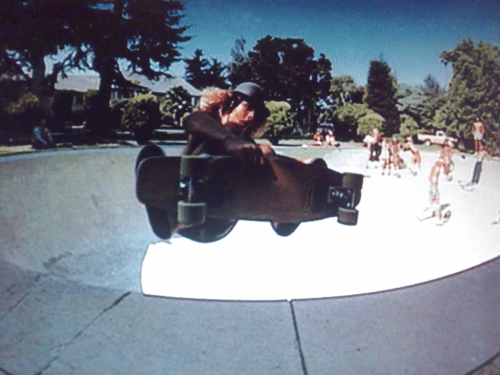
- the picture of the guy skateboarding is a still from the awesome documentary film Dogtown and Z-Boys
- for a lot of great thinking on “loose fit” design, be sure to check out the book How Buildings Learn by Stewart Brand
- the “meta-creators of meaning” quote is from Eric Zimmerman’s foreword to the aforementioned Game Design Workshop, 2nd ed.
Thanks
And that’s it. Interaction 09 was a great event, I’m happy to have been a part of it. Most of the talks seem to be online now. So why not check them out? My favourites by far were John Thackara and Robert Fabricant. Thanks to the people of the IxDA for all the effort they put into increasing interaction design’s visibility to the world.
- For a detailed discussion of the information display, have a look at this blog post. [↩]
