Notes on play, exploration, challenge and learning

(My reading notes are piling up so here’s an attempt to clear out at least a few of them.)

Part of the play experience of many digital games is figuring out how the damn thing works in the first place. In Rules of Play on page 210:

“[…] as the player plays with FLUID, interaction and observation reveals the underlying principles of the system. In this case the hidden information gradually revealed through play is the rules of the simulation itself. Part of the play of FLUID is the discovery of the game rules as information.”

(Sadly, I could not find a link to the game mentioned.)

I did not give Donald Norman all the credit he was due in my earlier post. He doesn’t have a blind spot for games. Quite the contrary. For instance, he explains how to make systems easier to learn and points to games in the process. On page 183 of The Design of Everyday Things:

“One important method of making systems easier to learn and to use is to make them explorable, to encourage the user to experiment and learn the possibilities through active exploration.”

The way to do this is through direct manipulation, writes Norman. He also reminds us that it’s not necessary to make any system explorable.1 But (on page 184):

“[…] if the job is critical, novel, or ill-specified, or if you do not yet know exactly what is to be done, then you need direct, first-person interaction.”

So much written after DOET seems to have added little to the conversation. I’m surprised how useful this classic still is.

I’m reminded of a section of Matt Jones’s Interaction 08 talk—which I watched yesterday. He went through a number of information visualisations and said he’d like to add more stuff like that into Dopplr, to allow people to play with their data. He even compared this act of play to Will Wright’s concept of possibility space.2 He also briefly mentioned that easily accessible tools for creating information visualisations might become a valuable tool for designers working with complex sets of data.

Norman actually points to games for inspiration, by the way. On page 184 just before the previous quote:

“Some computer systems offer direct manipulation, first-person interactions, good examples being the driving, flying, and sports games that are commonplace in arcades and on home machines. In these games, the feeling of direct control over the actions is an essential part of the task.”

And so on.

One of the most useful parts of Dan Saffer’s book on interaction design is where he explains the differences between customisation, personalisation, adaptation and hacking. He notes that an adaptive system can be designed to induce flow—balancing challenge with the skill of the user. In games, there is something called dynamic difficulty adjustment (DDA) which has very similar aims.

Salen and Zimmerman have their doubts about DDA though. In Rules of Play on page 223 they write:

“Playing a game becomes less like learning an expressive language and more like being the sole audience member for a participatory, improvisational performance, where the performers adjust their actions to how you interact with them. Are you then playing the game, or is it playing you?”

Perhaps, but it all depends on what DDA actually adjusts. The technique might be objectionable in a game (where a large part of the point is overcoming challenge) but in other systems many of these objections do not apply.

“With a successful adaptive design, the product fits the user’s life and environment as though it were custom made.”

(Designing for Interaction, page 162.)

Adaptive systems explicitly anticipate transformative play. They allow themselves to be changed through a person’s interactions with it.3

A characteristic of good interaction design is playfulness, writes Mr. Saffer in his book on page 67:

“Through serious play, we seek out new products, services and features and then try them to see how they work. How many times have you pushed a button just to see what it did?”

The funny thing is, the conditions for play according to Saffer are very similar to some of the basic guidelines Norman offers: Make users feel comfortable, reduce the chance for errors and if errors do occur, make sure the consequences are small—by allowing users to undo, for instance.

Mr. Norman writes that in games “designers deliberately flout the laws of understandability and usability” (p.205). Although even in games: “[the] rules [of usability] must be applied intelligently, for ease of use or difficulty of use” (p.208).

By now, it should be clear making interactions playful is very different from making them game-like.

  1. Apparently, “explorable” isn’t a proper English word, but if it’s good enough for Mr. Norman it’s good enough for me. []
  2. I blogged about possibility space before here. []
  3. Yes, I know I blogged about adaptive design before. Also about flow and adaptation, it seems. []

Space to play

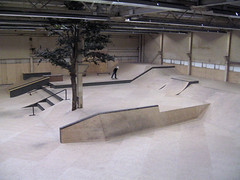
Tree by Pocketmonsterd on Flickr

The languages you’ve mastered shape your thinking. Nouns, verbs, adjectives…if you think of your day-to-day interactions on the web it’s clear the language you’re using is (very) limited. Does that limit your range of thoughts, and the things you’re able to express? Certainly, I’d say.

A quote from an old Ben Cerveny bio found in the Doors of Perception museum:

‘Cerveny is interested in harnessing the computational power of platforms like Playstation2 to create simulations with basic rule-sets that allow complexities to emerge, forming patterns of behaviour and interaction that people instinctively parse. He believes that this essential human ability to find patterns in complex systems remains untapped by current “click on the smiley face to buy our product” interfaces. “There is a certain algorithmic lightness to a basic ruleset, like that of the game Go,” he argues. “Especially as it replaces a top-down specification for human-computer interactions.”‘

That was in 2001. Game-like interactions have the potential for expanding your thinking. Stamen—where I’m told Cerveny is spending part of his time—is doing this with datasets.

Recently, I’ve been asked by several people to come up with concrete examples for my “playful” shtick. I’m worried that people expect stuff that makes a typical UI more playful. Like a sauce. That’s never been my intention.

The examples I’m considering (which I intend to describe as patterns) are of a more structural kind. When I point to emergent behaviour in games, I’m not kidding—the idea here is to allow for surprising results. Results that you as a designer have not foreseen. Space to play. That’s what sets the typical web interaction apart from something like Digg Labs.

“Play is free movement within a more rigid structure”. There is (almost) no free movement in your typical web app. That’s why I would not call it playful. These apps are designed to fit predefined user scenarios and evaluated based on how well they support them. No surprise they turn out boring in stead of fun.

However: Not every web app has to be playful, because not every web app is trying to teach you something.

In DOET Norman writes on p.124:

“What are not everyday activities? Those with wide and deep structures, the ones that require considerable conscious planning and thought, deliberate trial and error: trying first this approach, then that—backtracking. Unusual tasks include […] intellectual games: bridge, chess, poker, crossword puzzles, and so on.”1

So that’s why I believe much of the foundations of human-centered design are not applicable to playful experiences—the teachings of Norman are aimed at everyday activities. The activities that are not aimed at making you smarter, at giving you new insights.

On the web (and in computing in general) we’ve moved beyond utility. If we keep designing stuff using methods derived from Donald Norman’s2 (and other’s) work, we’ll never get to playful experiences.

  1. Norman has a blind spot for digital games, although he does include a NES as an example in his book. About this he admits he made “a few attempts to master the game” (p.138). []
  2. I’ll be speaking at a conference that has Mr. Norman as keynote speaker. I mean no disrespect. []

Spectra of learnability

They gave us Donald Norman’s The Design of Everyday Things1 to read in interaction design school. I remember reading it and—being young an cocky—finding it all very common sense and “Why do they ask us to read this stuff?” And so on.2

I am rereading it now, in the hopes of sharpening my argument for playful user experiences.

(There are a lot of things I want to blog about actually, such as how Hill and Webb‘s adaptive design reminds me of Salen & Zimmerman‘s transformative play, why Cook rejects MDA while Saffer embraces it and more.)

Anyway, my new copy of DOET has a nice introduction by Norman in which he summarizes a few core concepts form the book. On page xi—writing on conceptual models—he writes:

“[G]ood design is … an act of communication between the designer and the user, … all the communication has to come about by the appearance of the device itself.”

In other words, if you can’t figure “it” out by just looking at it, it’s not well designed. Where “figure it out” basically means understand how to operate “it” successfully. Of course this is an important concept, but I think something’s missing.

In games, it’s not enough just to be able to figure out how to make Mario jump—for instance—you want to learn how to jump well.

It’s about skill and mastery in other words. A “Norman Door” (a door that is difficult to open) can be fixed so that people can open the door easily. But a door has a narrow spectrum of learnability. Or as Koster would probably say: The pattern to “grok” is really simple.

Figure 1: A door’s spectrum of learnability

And anyway, why would you want to become a master at opening doors, right?

But a lot of the things I’m working on (for instance creative tools, but also toy-like environments) have more complex patterns and therefore (wether I like it or not) have a wider spectrum of learnability. And that’s where usability alone is not enough. That’s where in testing, I’d need to make sure people don’t just understand how to do stuff by looking at it. (That’s the start, for sure.) But I also want to be able to tell if people can get better at doing stuff. Because if they get better at it, that’s when they’ll be having fun.

Figure 2: A toy’s spectrum of learnability
  1. Or The Psychology of Everyday Things as it was then titled. []
  2. I still consider myself young, only slightly less cocky. []