Metagames as viral loops

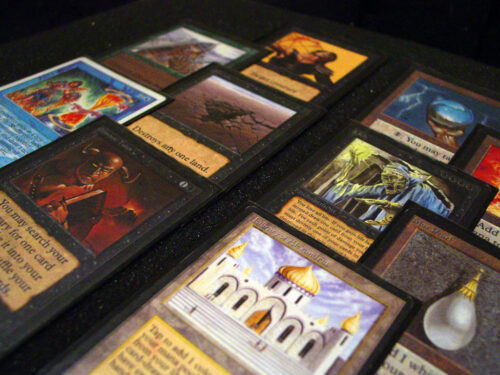
MtG: My Pride-n-Joys by AuE on Flickr

‘Metagames’—Richard Garfield’s presentation for the 2000 Game Developers Conference—is in today’s links, but I think it deserves a bit more attention than that. Here are some quotes from the document that stood out for me.1

What a metagame is:

“My definition of metagame is broad. It is how a game interfaces with life.”

In other words, metagame design is contextual. It forces you to think about when, where, how and by who your game will be played.

Why metagame design has not been getting as much attention as game design itself:

“…the majority of a game’s metagame is probably unalterable by game designer or publisher.”

So, metagame design is a second order design problem. Designers can only indirectly influence how metagames play out. They facilitate it, but do not direct it.

Garfield divides metagames in four broad categories:

  • What you bring to a game
  • What you take away from a game
  • What happens between games
  • What happens during a game

Where “game” should be understood as a single play session of a game.

Garfield has interesting things to say about all these categories, and I recommend reading the article in full, but I’d like to zoom in on one bit mentioned under “from”:

“It is worth noting that many things listed have a ‘circular’ value to the player.”

Getting something from a game that you can bring with you again to a game makes you care more and more about the game itself. One clear example of how metagames are a helpful concept for making a game more self-sustaining.

Better yet, the ‘stuff’ that players get from a game play session can be shared or passed on to others. In this manner, the metagame becomes a viral loop.2

  1. Richard Garfield is the designer of the CCG Magic: The Gathering. [↩]
  2. Via Matt Webb. [↩]

links for 2008-03-04

Second order design and play in A Pattern Language

According to Molly, architects hate Christopher Alexander’s guts. Along with a lot of other interaction designers I happen to think his book A Pattern Language is a wonderful resource. It has some interesting things to say about designing for emergence—or second order design—and also contains some patterns related to play. So following the example of Michal Migurski (and many others after him) I’ll blog some dog eared pages.

In the introduction Alexander encourages readers to trace their own path through the book. The idea is to pick a pattern that most closely fits the project you have in mind, and from there move through the book to other ‘smaller’ patterns. It won’t surprise frequent readers of this blog that my eye was immediately caught by the pattern ‘Adventure Playground’ (pattern number 73). Let’s look at the problem statement, on p.368:

“A castle, made of carton, rocks and old branches, by a group of children for themselves, is worth a thousand perfectly detailed, exactly finished castles, made for them in a factory.”

And on the following two pages (p.369-370), the proposed solution:

“Set up a playground for the children in each neighborhood. Not a highly finished playground, with asfalt and swings, but a place with raw materials of all kinds—nets, boxes, barrels, trees, ropes, simple tools, frames, grass, and water—where children can create and re-create playgrounds of their own.”

In the sections enclosed by these two quotes Alexander briefly explains how vital play is to the development of children. He states that neatly designed playgrounds limit children’s imagination. In the countryside, there is plenty of space for these adventure playgrounds to emerge without intervention, but in cities, they must be created.

I’m reminded of the rich range of playful activities teenagers engage in on Habbo Hotel, despite the lack of explicit support for them. At GDC 2008 Sulka Haro showed one example in particular that has stuck with me: Teens enacted a manege by having some of them dress up in brown outfits (the horses), and other standing next to them (the caretakers).

What would the online equivalent of an adventure playground look like? What are the “kinds of junk” we can provide for play (not only by children but by anyone who cares to play). In the physical world, what happens when connected junk enters the playground? Food for thought.

Adventure playground is a pattern “of that part of the language which defines a town or a community.” (p.3)

What I like the most about A Pattern Language is its almost fractal nature. Small patterns can be implemented by one individual or a group of individuals. These smaller ones flow into ever larger ones, etc. Alexander does not believe large scale patterns can be brought into existence through central planning (p.3):

“We believe that the patterns in this section [the largest scale patterns of towns] can be implemented best by piecemeal processes, where each project built or each planning decision made is sanctioned by the community according as it does or does not help to form certain large-scale patterns. We do not believe that these large patterns, which give so much structure to a town or of a neighborhood, can be created by centralized authority, or by laws, or by master plans. We believe instead that they can emerge gradually and organically, almost of their own accord, if every act of building, large or small, takes on the responsibility for gradually shaping its small corner of the world to make these larger patterns appear there.”

So to build an adventure playground, you’ll need smaller-scale patterns, such as ‘bike paths and racks’ and ‘child caves’. Adventure playground itself is encapsulated by patterns such as ‘connected play’. It is all beautifully interconnected. On page xiii:

“In short, no pattern is an isolated entity. Each pattern can exist in the world, only to the extent that is supported by other patterns: the larger patterns in which it is embedded, the patterns of the same size that surround it, and the smaller patterns which are embedded in it. This is a fundamental view of the world. It says that when you build a thing you cannot merely build that thing in isolation, but must repair the world around it, and within it, so that the larger world at the one place becomes more coherent, and more whole; and the thing which you make takes its place in the web of nature, as you make it.”

Wonderful. A solid description of second order design and another piece of the Playful IAs puzzle. The only way to know if something “does or does not help to form certain large-scale patterns” is by having a language like Alexander’s. The online equivalent of the largest scale patterns would be encompass more than just single sites, they would describe huge chunks of the internet.

In social software, in playful spaces, the large scale patterns cannot be designed directly, but you must be able to describe them accurately, and know how they connect to smaller scale patterns that you can design and build directly. Finally, you need to be aware of even larger scale patterns, that make up the online ecosystem, and play nicely with them (or if your agenda is to change them, consciously create productive friction).

A great book. I would recommend anyone with a passion for emergent design to buy it. As Adaptive Path say:

“This 1977 book is one of the best pieces of information design we’ve come across. The book’s presentation — the layout of each item of the language, the nodal navigation from item to item, the mix of text and image — is as inspiring as the topic itself.”
links for 2008-03-01

links for 2008-02-29

A Game Developers Conference 2008 postmortem

The 2008 Game Developers Conference was a bit of a confusing experience for me. To begin with, I felt out of place. Anytime I introduced myself to someone—“I’m an interaction designer, I work freelance”—I would usually get a blank stare. (Not many independents making a living in the games industry it seems.) At a lot of the talks, I was struck by the huge gap between the practice of UX designers native to the web, and designers working in the games industry. I’m generalizing here, but I’ll give some examples:

  • Game designers still don’t strive to understand their audience and the experience they’d like to have.
  • Game designers still don’t understand the significance of the web. They very rarely embrace the web way of doing things.
  • Game designers quite often aren’t able to think on different levels of abstraction about their medium, art form or whatever you want to call it.

If that doesn’t get me flamed, I don’t know what will.

GDC 2008 was huge. By far the largest conference I have ever been to. I heard someone mention the number of 16.000 but I could be completely off. The program committee obviously went for quantity over quality—I attended some really great talks, but also some really bad ones. In addition it was hell to figure out where to go. In hindsight I missed out on some great sessions. Apparently everything was recorded, but they need to be paid for—CMP apparently think they’re doing the games industry a service like this. I think not.

GDC Mobile in particular was a weird, depressing affair. The mobile game industry seems to have defined itself in such a way that there is no way for it to actually succeed. The majority are still trying to deliver a console-like experience on a small screen, completely missing the potential of the medium. Sigh.

Some themes I spotted:

  • Techniques for enhancing creativity: Annakaisa Kultima, a (game)researcher at the university of Tampere in Finland presented game-like techniques for idea generation. I’d particularly love to play around with her NVA cards. Sam Coates and Graeme Ankers of SCEE showed how they’ve improved innovation and concept creation using a whole range of techniques including lateral thinking.
  • The web way: There were some happy exceptions to the general ignorance of the power of the web. Justin Hall demoed PMOG—an exciting concept using the web as a gaming platform. Hopefully this will start a whole wave of “datagames”. Raph Koster blew me away with his very techy antemortem of Metaplace—a complete reinvention of MMOGs built from the ground up both with and as web technologies.
  • Story, drama, narrative, blah: “The audience are not your mom. They don’t care about your stupid story,” said Ken Levine, writer and designer of the critically acclaimed BioShock. I’m still not sure BioShock is actually as revolutionary as people make it out to be. But Levine’s approach to story in games—having multiple levels of detail that can be consumed as the player sees fit and telling the story through the environment—makes sense to me. I enjoyed Peter Molyneux’s demo of Fable 2 mostly because of his criticism of American prudishness. “If this were Germany I’d be naked on stage right this moment.” Molyneux attempts to create drama through simulation. Offering freedom of choice, but choice with consequences. I wonder if this is a road leading nowhere…
  • Mobile: Some people attempt to play to mobile’s strengths, with great success. DC of Pikkle in Japan showed a lot of crazy-ass Flash Lite games that are delivered over mobile web. These mobile social games completely circumvent the carriers and consequently disrupt the whole mobile market over there. Shades of Playyoo here—although Pikkle has the benefit of 90% Flash Lite player penetration, whereas in Europe we’re apparently on 20%. Equally true to mobile’s nature but offering a completely different experience is location based gaming. Jeremy Irish talked about the origins of Geocaching and showed wonderful work he is doing at Groundspeak. Location based games are full of emergent complexity. I enjoyed hearing that Irish tries to have players be in the world in stead of the screen when playing.
  • Miscellaneous: Sulka Haro‘s talk about Habbo was surprisingly thoughtful. Lots of good stuff on identity play and how Habbo’s lack of explicit support for it is not holding players back—on the contrary, less features seems to create more space for play. Takao Sawano of Nintendo delighted me with an in depth look at the evolution of the Wii Fit controller. Secret of the big N’s success is clearly the close collaboration between its hard- and software divisions. Rod Humble unveiled The Sims Carnival, EA’s contribution to the continuing democratization of creative tools (again reminiscent of Playyoo). Humble proved to be a very knowledgeable not to mention funny speaker. Seeing Ralph Baer and Allan Alcorn play PONG on the Brown Box was awesome.

There was more—I’d love to go over all the wonderful indie games I saw at the IGF and elsewhere for instance—but these were by far the most enjoyable sessions for me. If you’re looking for in-depth reports you could do worse than to start at Gamasutra. For me the real challenge begins now—digesting this and making it applicable for interaction designers on the web. I have a huge backlog of smaller posts lying around that I want to get out there first though (and this one has grown far too large already). So I’ll end here.