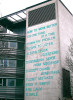
Language in all its forms, from poetry to cliché, was a continual source of intrigue for Fischli/Weiss. How to Work Better (1991) is a manifesto comprising 10 persuasive but empty sentences, each with the aim of improving workplace productivity and morale: “Know the problem”; “Accept change as inevitable.” Fischli/Weiss plucked these stock phrases from a factory in Thailand and painted them in large stencilled letters to cover the exterior of an office block in Oerlikon, Zurich, visible on the approach into the city centre by train from Zurich Airport.
Author: Kars Alfrink
Designer turned design researcher. Postdoc at TU Delft. Exploring contestable AI.
[TAS] Super Mario World “Executes Arbitrary Code” in 02:25.19 by Masterjun (by Masterjun3)
How this works is described in the previous post. The tool-assisted speedrun (TAS) phenomenon is pushed beyond its initial intentions and morphs into something altogether different. What it exactly will become I’m not sure but I can imagine people taking videogames and performing them as if they’re instruments of a kind.
(Source: https://www.youtube.com/)
It’s at 1:39 in the video where things really start going pear-shaped, as the fabric of the game’s reality comes apart at the seams for a few seconds before inexplicably transitioning to Mario-themed versions of Pong and Snake. […] Suffice it to say that the first minute-and-a-half or so of this TAS is merely an effort to spawn a specific set of sprites into the game’s Object Attribute Memory (OAM) buffer in a specific order. The TAS runner then uses a stun glitch to spawn an unused sprite into the game, which in turn causes the system to treat the sprites in that OAM buffer as raw executable code. In this case, that code has been arranged to jump to the memory location for controller data, in essence letting the user insert whatever executable program he or she wants into memory by converting the binary data for precisely ordered button presses into assembly code.
Never attribute to malice that which is adequately explained by stupidity.
Hanlon’s razor – Wikipedia, the free encyclopedia
Useful adage encountered in the aforementioned post on surveillance.
So the key to restoring the balance of power between governments and the governed is not uncomprehending fear of surveillance, but understanding the mobility-surveillance trade-off equation, and figuring out how much increased mobility we can demand in return for consenting to increased surveillance. Once we figure out how to increase our mobility to match the limits of the new technologies of consent, the trade implied by the new social contract will be fair once again.
Nobody can be quite as contrarian and make sense at the same time as Venkatesh can.
I’m not sure increased mobility is a fair trade-off for increased surveillance if it is not coupled with increased care. Otherwise, I don’t see how it will serve anybody except those who are already well-off.
Her research for the book has involved hours upon hours of talking with people about conversation as well as eavesdropping on conversations: the kind of low-grade spying that in academia is known as “ethnography,” that in journalism is known as “reporting,” and that everywhere else is known as “paying attention.”
She advocates limiting our device usage in “sacred spaces” like the dinner table, the places where phones and their enticements may impede intimacy and interaction. She wants us to look into each other’s eyes as we talk. She wants us to read each other’s movements. She wants us to have conversations that are supremely human.
Saving the Lost Art of Conversation – Megan Garber – The Atlantic
Of all the tech skeptics, Turkle is certainly the best informed and most reasonable. For sure, having a proper conversation requires attention, and most of our tech constantly draws this attention away. Being able to ignore it, even for a short while, takes willpower.
You can’t always tell, in a conversation, when the interesting bit is going to come,” Turkle says. “It’s like dancing: slow, slow, quick-quick, slow. You know? It seems boring, but all of a sudden there’s something, and whoa.
Because many slaves had their history erased by their owners when they were brought to America from Africa centuries ago, Afrofuturism emerged in 20th-Century music, film, art and literature and pointed this exiled culture in a new direction: the future. In this view, Africans are the alien ‘other’ in Western society, stigmatized as outcasts, who must build bridges in their imaginations to a new utopia, possibly far removed geographically and spiritually from the world that is marginalizing them.
BBC – Culture – Janelle Monae: Science fiction in African-American pop
Unexpectedly interesting article on sci-fi influences in African-American pop music. ATLiens, The Cold Vein and Deltron 3030 remain favourite albums of mine but I’d never connected them under the umbrella of Afrofuturism.